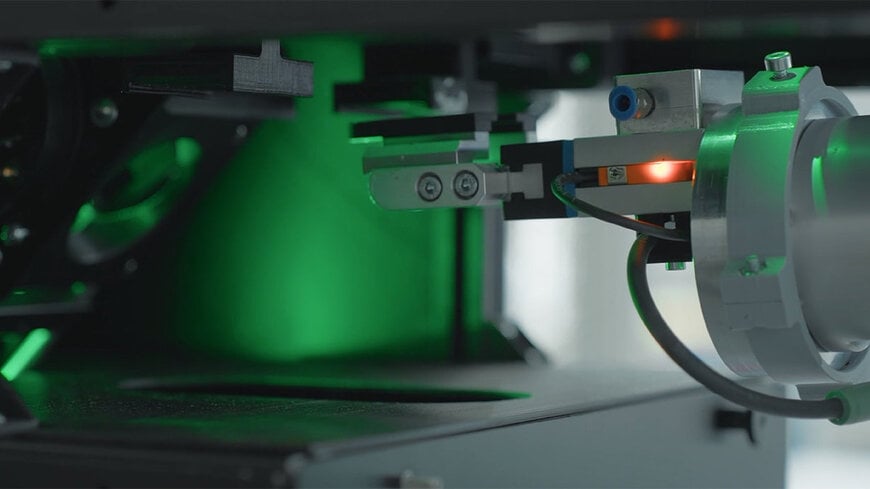
Chroma Technology, a market leader in the precision optics industry, is proud to present its new SWIR filters for machine vision and remote sensing. Delivering the most accurate performance for the same cost as lower-quality interference filters, these filters can significantly improve food safety inspection, machine vision systems, remote sensing for asset management, and a host of other applications.
Available through MakerBot LABS, the newly-qualified 3D printing materials are ideal for demanding engineering applications that require high strength and heat resistance.
With the partial automation of work steps, time-intensive work such as the processing of cables can be carried out more efficiently. The new CUTFIX PRO as a purely electrical driven machine is supporting the semi-automatic cable confectioning in terms of cutting various conductors. Robust and compactly built, it fits on a single DIN A4 page and features fast processing times and flexible application options. It can cut conductors to length with the cross-section range of 0.08 mm2 to 10 mm2 (AWG 40-8) or an outside diameter of up to 8 mm.
Thales Australia has received Development Approval and will commence construction in February on the first phase of an ambitious industrial plan to transform its Lithgow Arms facility in regional New South Wales.
Applications in the healthcare market – such as dental tools, respiratory and ventilation equipment, and other medical devices – pose unique challenges for the motors that drive them, and manufacturers often have to make trade-offs between performance and size. But with Delta Line’s new high-speed series of slotless, brushless DC (BLDC) motors, manufacturers can now achieve the speed, power, size, and efficiency they need without compromise – so their devices perform better and last longer, while satisfying the need for doctor and patient comfort.
Efficiency of >90% even at low load: With the RPA100E and RPA300E series, RECOM is adding two new cost-efficient DC/DC products with outputs of 100W and 300W respectively in the DOSA-compatible, through-plated eighth-brick format (58.4mm x 23mm) to its portfolio.
Pickering Interfaces, the leading supplier of modular signal switching and simulation solutions for electronic test and verification, is now an OpenTAP partner. Focused on simplicity, scalability and speed.