
www.ptreview.co.uk
17
'26
Written on Modified on
Collaboration Advances AI-Driven Industrial Robotics
FANUC and NVIDIA partner to integrate AI, simulation and robotics for adaptive factory automation.
www.fanuc.eu
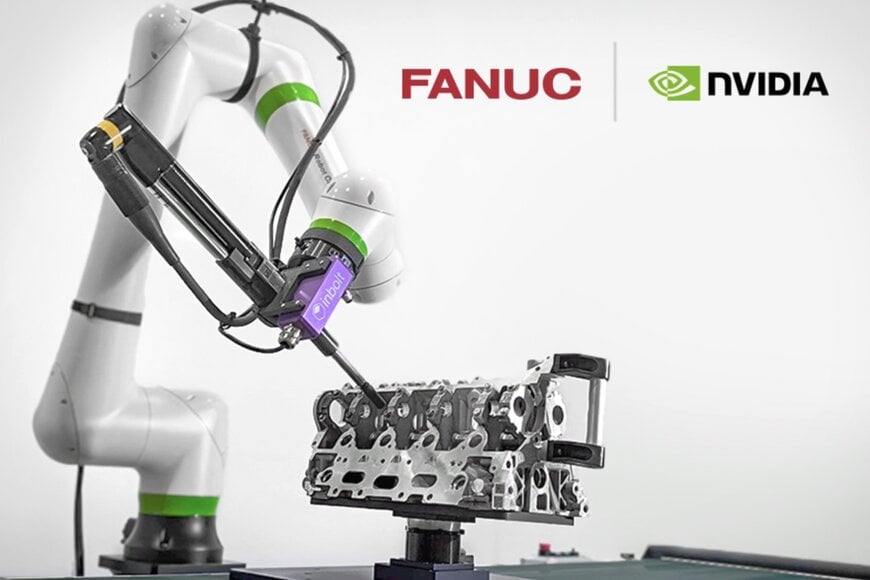
FANUC has announced a strategic collaboration with NVIDIA to advance physical AI in industrial automation. The initiative combines FANUC’s robotics and factory automation expertise with NVIDIA’s AI computing and simulation technologies to enable robots that can perceive, reason and act in dynamic production environments.
The collaboration focuses on integrating AI-driven capabilities across FANUC’s robot portfolio and simulation tools, supporting more flexible and intelligent manufacturing systems.
Digital Twins and Virtual Robot Training
A central element of the collaboration is the integration of FANUC’s ROBOGUIDE simulation software with NVIDIA Isaac Sim and NVIDIA Omniverse.
This allows manufacturers to create photorealistic digital twins of production environments, simulate workflows and train robots virtually before deployment. By validating processes in a virtual setting, companies can reduce commissioning time, lower costs and improve system performance.
Digital twin technology also enables continuous optimization of production systems as conditions change.
AI-Powered Robotics at the Edge
FANUC will leverage NVIDIA Jetson edge computing modules and AI infrastructure to bring real-time intelligence to industrial robots.
This enables robots to process data locally, adapt to variability in production environments and execute complex tasks with greater precision. Applications include automotive manufacturing, logistics operations and food processing.
The integration of AI inference at the edge supports faster decision-making and improved responsiveness in time-critical operations.
Open Platform for AI Development
FANUC is expanding its open platform strategy to support AI-driven application development. The company has introduced a ROS 2 driver and supports Python programming across its robot range.
This enables developers to build and deploy AI applications more easily, supporting a wider ecosystem of robotics solutions.
The robots also support ultra-high-speed streaming motion control, allowing precise and dynamic adjustments to robot movement during operation.
Natural Interaction and Simplified Programming
The collaboration also explores new ways for operators to interact with robots. By applying NVIDIA AI technologies, FANUC is enabling systems that can interpret voice commands and automatically generate Python code.
This approach simplifies robot programming and reduces the need for specialized expertise, allowing more workers to configure and adjust automation processes.
Toward Adaptive Manufacturing Systems
The combination of AI, simulation and robotics reflects a broader shift toward more adaptive manufacturing systems. By enabling virtual training, real-time intelligence and simplified programming, the collaboration aims to help manufacturers respond more quickly to changing production demands.
These capabilities support efforts to address labor shortages, increase customization and improve operational efficiency, positioning physical AI as a key technology in the future of industrial automation.
Edited by Industrial Journalist, Romila DSilva, with AI assistance.
www.fanucamerica.com
