
www.ptreview.co.uk
25
'26
Written on Modified on
AI-Enabled Robotics Advance Adaptive Manufacturing
FANUC America will demonstrate AI-enabled robotics, physical AI systems and adaptive automation technologies for industrial manufacturing at Automate 2026 in Chicago.
www.fanuc.eu
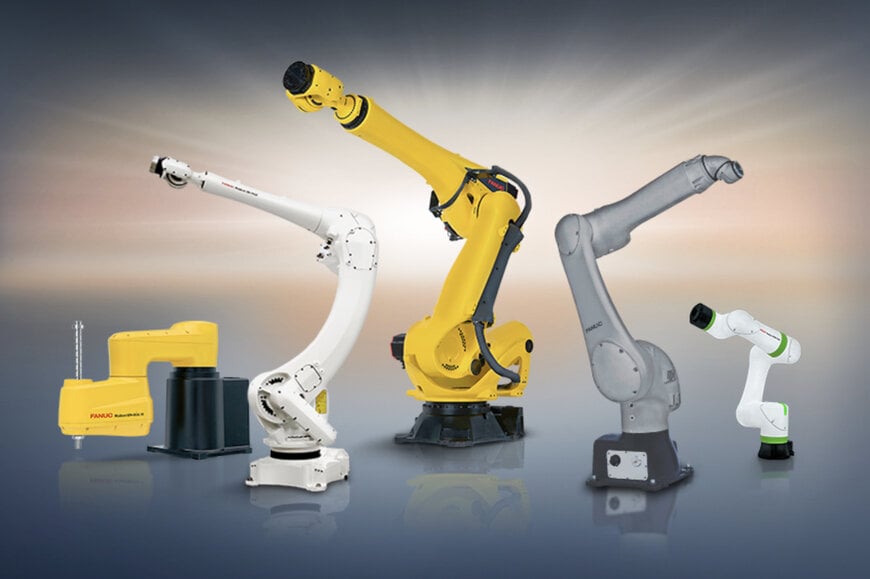
FANUC America plans to showcase robotics systems integrating physical AI, generative AI, digital twins, 3D vision and real-time motion adaptation at Automate 2026, held at McCormick Place in Chicago at Booth 1401 from June 22–26, with demonstrations focused on automotive, food processing, logistics, packaging, welding and industrial finishing applications.
Adaptive robotics and AI-enabled manufacturing have gained importance as manufacturers seek higher throughput, flexible production and reduced downtime without extensive fixed infrastructure. FANUC’s demonstrations focus on systems capable of perception, autonomous adjustment and operation in dynamic production environments.
AI-driven robotics applications for welding and assembly
Among the showcased systems, the CRX-3iA collaborative robot performs vertical-up welding on structural steel I-beams, a process traditionally difficult to automate due to weld pool control and restricted access. The robot uses a newly developed welding profile designed to compensate for weld puddle sag while reproducing motion patterns associated with skilled manual welding.
The system weighs 11 kg, allowing manual deployment onto workpieces without permanent installation. During demonstrations, operators position the cobot using a crane basket before magnetic attachment and weld path execution following touch-sensing joint detection.
Another application features a CRX-20iA/L collaborative robot performing bolt tightening on moving engine blocks. Combined with Inbolt physical AI technology and NVIDIA processing, the robot tracks components in motion on bi-directional conveyors and completes fastening tasks without halting production. This approach targets continuous assembly operations where conveyor stoppages reduce productivity.
Digital twins and simulation in industrial automation
Digital twin technologies are increasingly used to reduce commissioning time and optimize manufacturing cells before deployment. FANUC’s M-710/50/26D Food Option robot integrates NVIDIA Isaac Sim with palletizing operations, enabling simulation of robotic workflows for packaged food handling.
Simulation environments allow manufacturers to test configurations, validate workflows and identify bottlenecks before physical deployment, reducing commissioning risk and engineering iteration time.
Human-aware robotics and machine vision systems
Human-machine collaboration remains a key automation challenge in packaging and logistics environments. FANUC’s CRX-10iA/L demonstration combines RGB-D cameras, AI-based tracking algorithms and barcode scanning to enable dynamic proximity monitoring.
The system adjusts robotic motion or transitions into safe positions when detecting nearby operators while maintaining production continuity. The demonstration highlights integration of 3D vision, human tracking and intelligent reject handling.
High-payload robotics for automotive manufacturing
FANUC introduced the R-2000/E Series robots with eight configurations targeting automotive material handling and spot welding. The systems include higher axis speeds, increased wrist load capacities and reduced installation footprints.
Such specifications address manufacturing environments requiring heavy payload handling and high-cycle welding processes, where throughput and spatial efficiency directly affect production economics.
Generative AI for robot programming
One demonstration converts spoken instructions into executable robotic movements using AI-generated Python code. The approach aims to reduce programming complexity by enabling natural-language interaction with collaborative robots.
Natural-language robot programming may shorten setup times and lower technical barriers for deployment, although performance depends on code reliability, task complexity and validation mechanisms.
Additional Context
Technical specifications and competitive benchmarking not included in the original announcement
Physical AI systems demonstrated by FANUC align with broader industry trends involving embodied AI, digital twins and edge AI processing. NVIDIA Isaac Sim is widely adopted for robotics simulation, while competing industrial robotics providers including ABB and KUKA increasingly integrate AI-based perception and simulation environments. Comparable benchmarking criteria typically include deployment time reduction, payload capacity, axis speed, repeatability and simulation-to-deployment accuracy.
Collaborative robots in the lightweight category generally prioritize portability and rapid deployment. At 11 kg, the CRX-3iA targets mobile welding scenarios where conventional robotic welding cells require fixed infrastructure. Digital twin workflows using simulation tools can reduce commissioning time compared with physical-only validation, although outcomes vary by application complexity.
Edited by Natania Lyngdoh, Induportals editor, assisted by AI.
www.fanucamerica.com
