
www.ptreview.co.uk
15
'26
Written on Modified on
Collaborative Robot Launch Delivers Enhanced Safety and Workspace Flexibility
YASKAWA has launched the MOTOMAN-HC12 collaborative robot, featuring a 12 kg payload capacity and a 1410 mm reach to enhance workplace safety and deployment flexibility.
www.yaskawa.eu.com
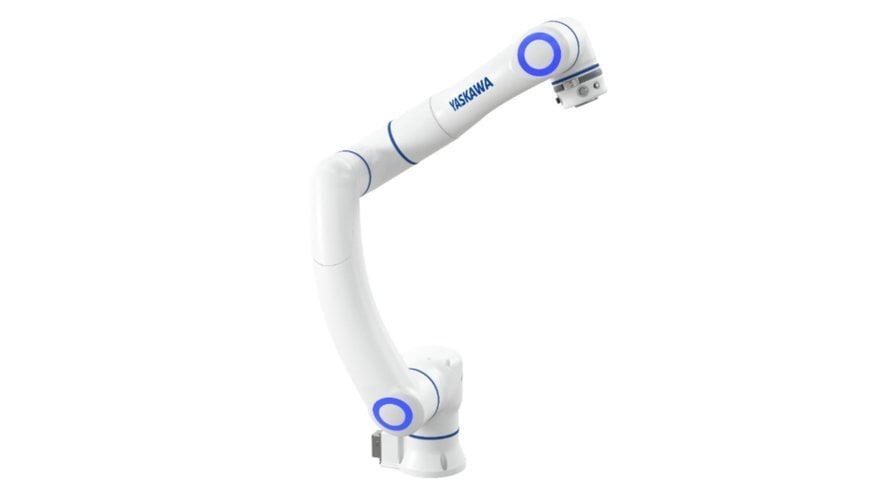
The MOTOMAN-HC12 collaborative robot delivers a 12 kg payload capacity paired with a 1410 mm reach, succeeding the previous MOTOMAN-HC10DTP model. Engineered to address manufacturing labor shortages and simplify automation deployment, the system combines safety systems and improved productivity with lower manufacturing costs.
Mechanical Architecture and Installation Footprint
The robot utilizes a slim arm profile, reduced overall manipulator weight, and a downsized base footprint. The base mounting dimension is reduced to φ170 mm, compared to the φ275 mm profile of the MOTOMAN-HC10DTP. This compact geometry limits physical interference with adjacent machines and structures, facilitating installation within space-constrained production environments and easing access into confined workstations.
Integrated Torque Sensing and Safety Performance
The arm incorporates newly developed proprietary torque sensors engineered to enhance collision detection sensitivity and system response speeds. This sensor integration permits higher operational movement speeds during collaborative workflows while mitigating impact force levels if contact occurs with human personnel. The mechanical design also provides smooth, intuitive hand-guiding capability to streamline manual teaching sequences and everyday operation.
Internal Application Cable Routing
To protect wiring and simplify tooling setup, application cabling—including a high-speed Cat6A Ethernet line—is routed completely through the internal structure of the arm as standard. This internal arrangement eliminates external cable bundles, preventing snagging hazards with peripheral machinery and providing direct electrical connections for end-of-arm tooling at the wrist.
Industrial Applications
The MOTOMAN-HC12 is configured for automated material handling and assembly processes, including palletizing, screwdriving, arc welding, optical inspection, and general industrial tasks.
Additional Context
This section details technical specifications and competitive benchmarking not included in the original news release.
Unlike standard collaborative robots that infer contact forces via motor current monitoring—which suffers from gear friction and demands slower operating speeds to satisfy ISO/TS 15066 safety thresholds—dedicated joint torque sensors measure contact forces directly at the load point, enabling faster transit velocities and millisecond-level collision stops.
Additionally, reducing the mounting footprint to a compact φ170 mm facilitates drop-in installation onto Autonomous Mobile Robots (AMRs) and tight machine-tending fixtures that cannot accommodate standard 200 mm to 275 mm bases. Routing shielded Cat6A lines internally directly to the wrist flange also eliminates external split-loom dress packs, removing snag risks and cabling fatigue during continuous axis rotation.
Edited by Romila DSilva, Induportals Editor, with AI assistance.
www.yaskawa-global.com
