
www.ptreview.co.uk
22
'26
Written on Modified on
Local AI Processors for Autonomous Workstations
AMD introduced the Ryzen AI Halo platform and Ryzen AI Max PRO 400 Series processors designed for AI workstations and future Agent Computers capable of running agentic artificial intelligence workloads locally on PCs.
www.amd.com
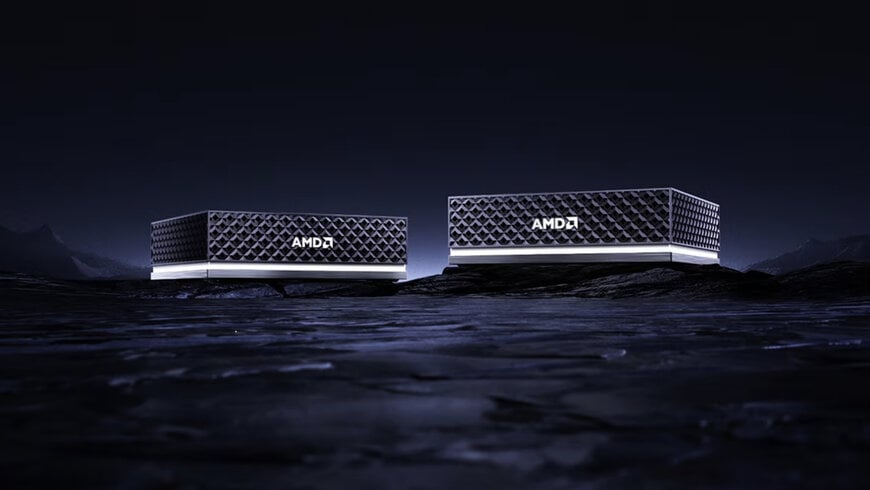
AMD announced the upcoming availability of its Ryzen AI Halo platform alongside the launch of the Ryzen AI Max PRO 400 Series processors, developed for AI workstations and next-generation Agent Computers. These systems are designed to execute large artificial intelligence models locally without constant reliance on cloud infrastructure, particularly for generative AI workflows, simulation and data-intensive computing applications.
The architecture targets AI developers, enterprises and system manufacturers seeking to deploy autonomous agents capable of interpreting prompts, planning actions and executing tasks in real time with low latency. The platforms are positioned within the growing edge AI computing and local AI infrastructure market for enterprise environments.
Local Execution of AI Models up to 300 Billion Parameters
AMD stated that the Ryzen AI Max PRO 400 Series processors are the first x86 client processors capable of running AI models with up to 300 billion parameters locally. This capability is based on an architecture combining Zen 5 processors, XDNA 2 AI accelerators and RDNA 3.5 graphics within a unified computing platform.
The systems support up to 192 GB of unified memory and up to 160 GB of addressable VRAM, enabling simultaneous execution of generative models, complex AI agents and professional graphics applications on a single workstation.
The currently announced Ryzen AI Halo platform is based on the Ryzen AI Max+ 395 processor with up to 128 GB of unified memory. According to AMD, this configuration can already run models with up to 200 billion parameters locally, workloads that typically require specialized cloud infrastructure.
This approach is intended to reduce data transfers to remote infrastructure while improving response times for latency-sensitive AI applications.
Unified Architecture for AI Compute, Graphics and Simulation
The new Ryzen AI Max PRO 400 Series processors are aimed at mobile workstations, AI-enabled enterprise PCs and compact high-performance systems. AMD positions the architecture for industrial simulation, content creation, real-time rendering and scientific computing applications.
The product range includes three main models:
- The Ryzen AI Max+ PRO 495 features 16 cores and 32 threads, a maximum frequency of 5.2 GHz, 80 MB of cache, 40 graphics compute units and up to 55 TOPS of NPU performance.
- The Ryzen AI Max PRO 490 integrates 12 cores and 24 threads, a maximum frequency of 5 GHz and 32 graphics compute units.
- The Ryzen AI Max PRO 485 offers 8 cores and 16 threads with a maximum frequency of 5 GHz.
All three models support configurable thermal design power between 45 and 120 watts and up to 192 GB of unified memory.
AMD stated that the architecture allows AI workloads, graphics processing and professional applications to run on a single system without requiring dedicated graphics cards or external cloud computing resources.
Software Compatibility for Local AI Development
The Ryzen AI Halo platform supports several widely used frameworks for generative AI and large language model development, including PyTorch, vLLM, llama.cpp, Ollama, ComfyUI and LM Studio.
AMD also stated that the platform is optimized for the ROCm software environment designed for large language models, diffusion models and agentic AI workflows. Developers can prototype applications under Linux and deploy them under Windows using the same hardware architecture.
This multi-environment compatibility addresses enterprise requirements for local AI application development while maintaining interoperability with existing software infrastructures.
Deployment Planned Across AI Workstation Manufacturers
AMD announced that pre-orders for the Ryzen AI Halo platform will begin in June 2026 through Micro Center. A next-generation platform based on Ryzen AI Max PRO 400 Series processors is scheduled for release in the third quarter of 2026.
HP and Lenovo confirmed plans to integrate these processors into future AI workstation and enterprise PC product lines. Both companies highlighted growing demand for local AI execution to reduce latency, improve data privacy and lower long-term cloud infrastructure costs.
Additional Context: Technical Specifications and Competitive Benchmarking
The market for local AI processors is evolving rapidly as enterprises increase deployment of generative AI workloads directly on client systems. Major competing platforms include Intel Core Ultra processors with integrated NPUs, as well as Nvidia DGX Spark and Nvidia Grace Blackwell systems designed for local and hybrid AI computing.
AMD’s announced AI performance of up to 55 TOPS places the Ryzen AI Max PRO 400 Series among platforms targeting advanced professional AI workloads. By comparison, Intel Core Ultra Series 2 processors for enterprise AI PCs typically provide NPU performance between 40 and 48 TOPS depending on the configuration.
The use of unified memory up to 192 GB is also a significant technical differentiator for running large AI models locally. This architecture reduces data transfers between system memory and graphics memory, a critical factor in generative AI workflows and automotive data ecosystem applications that require simultaneous data processing and visualization.
The AMD platforms are also based on a standard x86 architecture compatible with both Windows and Linux, unlike certain ARM-based AI platforms designed primarily for specialized infrastructure environments.
Edited by Sucithra Mani, Induportals editor – adapted by AI.
www.amd.com
AMD stated that the architecture allows AI workloads, graphics processing and professional applications to run on a single system without requiring dedicated graphics cards or external cloud computing resources.
Software Compatibility for Local AI Development
The Ryzen AI Halo platform supports several widely used frameworks for generative AI and large language model development, including PyTorch, vLLM, llama.cpp, Ollama, ComfyUI and LM Studio.
AMD also stated that the platform is optimized for the ROCm software environment designed for large language models, diffusion models and agentic AI workflows. Developers can prototype applications under Linux and deploy them under Windows using the same hardware architecture.
This multi-environment compatibility addresses enterprise requirements for local AI application development while maintaining interoperability with existing software infrastructures.
Deployment Planned Across AI Workstation Manufacturers
AMD announced that pre-orders for the Ryzen AI Halo platform will begin in June 2026 through Micro Center. A next-generation platform based on Ryzen AI Max PRO 400 Series processors is scheduled for release in the third quarter of 2026.
HP and Lenovo confirmed plans to integrate these processors into future AI workstation and enterprise PC product lines. Both companies highlighted growing demand for local AI execution to reduce latency, improve data privacy and lower long-term cloud infrastructure costs.
Additional Context: Technical Specifications and Competitive Benchmarking
The market for local AI processors is evolving rapidly as enterprises increase deployment of generative AI workloads directly on client systems. Major competing platforms include Intel Core Ultra processors with integrated NPUs, as well as Nvidia DGX Spark and Nvidia Grace Blackwell systems designed for local and hybrid AI computing.
AMD’s announced AI performance of up to 55 TOPS places the Ryzen AI Max PRO 400 Series among platforms targeting advanced professional AI workloads. By comparison, Intel Core Ultra Series 2 processors for enterprise AI PCs typically provide NPU performance between 40 and 48 TOPS depending on the configuration.
The use of unified memory up to 192 GB is also a significant technical differentiator for running large AI models locally. This architecture reduces data transfers between system memory and graphics memory, a critical factor in generative AI workflows and automotive data ecosystem applications that require simultaneous data processing and visualization.
The AMD platforms are also based on a standard x86 architecture compatible with both Windows and Linux, unlike certain ARM-based AI platforms designed primarily for specialized infrastructure environments.
Edited by Sucithra Mani, Induportals editor – adapted by AI.
www.amd.com
