
www.ptreview.co.uk
06
'26
Written on Modified on
Razorcat Expands Automated C++ Unit Testing
Integration of compiler-based link stubbing into TESSY reduces manual dependency handling for embedded software testing in safety-critical systems.
www.razorcat.com
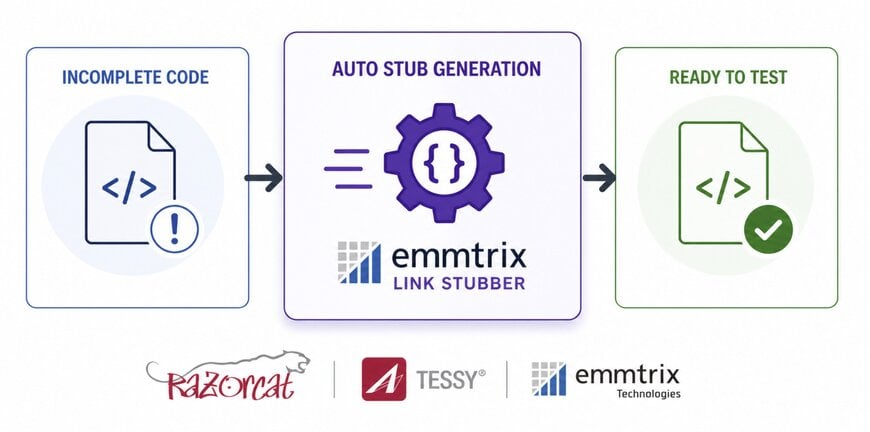
Testing embedded C++ software often becomes difficult when missing dependencies prevent isolated modules from compiling and linking correctly. The problem is particularly significant in safety-critical industries such as automotive, aerospace, and industrial automation, where large codebases, legacy software, and strict validation requirements increase test complexity. In this context, Razorcat Development GmbH integrated emmtrix Technologies’ link stubbing technology into its TESSY test automation platform for C and C++ software development.
The integration adds automated link stub generation capabilities to TESSY, enabling embedded software teams to create isolated C++ unit tests with reduced manual setup effort.
Why C++ unit testing becomes difficult
Compared with C-based software, C++ introduces additional testing challenges through language features such as inheritance, constructors, virtual functions, templates, and complex object initialization behavior. During unit testing, unresolved dependencies often generate linker errors, forcing developers to manually create stubs or dependency implementations before tests can run.
In large embedded software projects, this process can significantly slow down test development and reduce the level of automation achievable in continuous integration and quality assurance workflows.
Razorcat stated that the integration targets these workflow bottlenecks by automating dependency isolation during test preparation.
Clang-based stub generation inside TESSY
The integrated emmtrix Link Stubber is based on Clang compiler technology and automatically generates stub implementations for unresolved C and C++ symbols.
Instead of requiring developers to manually implement missing dependencies, the tool allows incomplete translation units to be linked during testing. This enables software teams to focus on validating the target module without fully resolving unrelated dependencies elsewhere in the codebase.
The technology supports automated generation of stubs for functions, classes, constructors, destructors, and global variables. It also handles advanced C++ constructs including inheritance hierarchies, abstract classes, and standard library types.
By integrating the functionality directly into TESSY, the workflow becomes part of the existing unit and integration testing environment used in embedded software validation processes.
Faster workflows for legacy and safety-critical software
The integration is intended to improve scalability for automated software testing workflows, particularly in projects involving legacy code or tightly coupled software architectures.
Reducing manual stub creation can shorten test setup times and simplify isolated unit testing for complex embedded applications. This is particularly relevant in regulated industries where software verification processes must comply with functional safety and quality standards while maintaining broad test coverage.
The collaboration between Razorcat and emmtrix also reflects broader adoption of compiler-assisted tooling in embedded software engineering, where automation is increasingly used to manage the growing complexity of modern C++ development environments.
Edited by Aishwarya Mambet, Induportals Editor, with AI assistance.
www.razorcat.com
