
www.ptreview.co.uk
15
'26
Written on Modified on
Basler integrates 3D vision into robotic bin picking systems
Basler’s 3D CADMatch vision solution combines stereo cameras and CAD-based AI to enable reliable bin picking, supporting faster cycle times and stable pick-and-place automation in industrial machine tending.
www.baslerweb.com
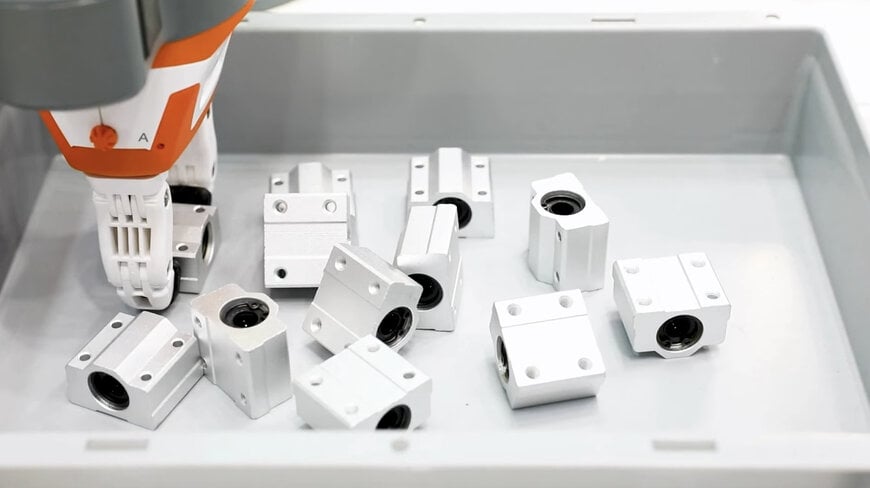
Automated machine tending increasingly relies on bin picking to handle randomly arranged components directly from load carriers. The challenge lies in reliably detecting, localising and grasping parts that may overlap, reflect light, or lack clear visual features. To address these constraints, Basler offers a bin picking solution that integrates stereo vision hardware with CAD-based 3D perception software.
At the core of the system is the 3D CADMatch software module, which enables robots to identify, prioritise and grasp parts in real time using a combination of 3D camera data and stored CAD models. This approach is designed to support stable operation even under dense packing conditions, poor lighting or with geometrically complex components.
CAD-based detection in unstructured environments
In typical bin picking scenarios, parts are often stacked chaotically, partially occluded or rotationally symmetrical, making feature-based recognition unreliable. The 3D CADMatch module addresses this by comparing a trained CAD model of the target part with a 3D point cloud generated by a stereo camera.
This comparison allows individual parts to be detected even when they overlap or are only partially visible. For each recognised component, the software calculates precise X, Y and Z coordinates as well as spatial orientation, forming the basis for accurate pick planning. The system then prioritises parts that are most accessible and least obstructed.
Grasp planning with collision avoidance
Once part positions are determined, the software computes optimal grasping points based on predefined grasp regions stored in the CAD template and the selected gripper model. Supported gripper types include two-finger mechanical grippers and suction grippers.
Grasp planning takes into account grip stability, accessibility for the robot arm and, optionally, collision avoidance. An integrated collision check can verify that the gripper will not collide with the load carrier or surrounding geometries when approaching the part. Collision-free grasp poses are then passed to the robot controller, while path planning and motion execution remain within the robot system or a higher-level control unit.
Efficient setup without programming
System configuration is performed via a browser-based web interface, reducing the need for specialised programming. Typical setup steps include selecting the CAD template, defining the load carrier and region of interest, choosing the gripper type and enabling collision checking if required.
Grasping points are defined once in the CAD model and can be reviewed and adjusted interactively. During operation, the system continuously updates the 3D point cloud after each pick, allowing the robot to adapt to changes in the bin as parts shift or settle.
Integrated hardware and software architecture
The bin picking solution is based on Basler’s stereo camera portfolio. The Stereo visard camera can be mounted directly on the robot arm or installed statically above the bin, while the Stereo ace camera is typically used in fixed, overhead configurations. Both camera families provide depth data suitable for CAD-based matching.
For processing, the 3D Camera Cube edge computer supplies the computational resources required for real-time 3D CADMatch operation and can handle multiple stereo cameras depending on configuration. Optional components such as a random dot projector and dedicated lighting can be added to improve depth perception on smooth or reflective surfaces.
Robotics integration and scalability
Data transmission and integration are handled via Ethernet, enabling stable communication with robot controllers. Software interfaces are available for a wide range of industrial robot platforms, including ABB, FANUC, KUKA, Universal Robots and Yaskawa Motoman, as well as support for specialised gripping systems.
By reusing trained CAD models, new picking tasks can be deployed with reduced engineering effort. This makes the solution scalable across different part geometries, container sizes and batch volumes, while avoiding the need for extensive AI expertise or manual teaching.
Through the combination of stereo vision, CAD-based recognition and collision-aware grasp planning, Basler’s bin picking solution targets higher throughput, lower error rates and reliable automation in machine tending and pick-and-place applications.
www.baslerweb.com
