
www.ptreview.co.uk
07
'26
Written on Modified on
Franka Robotics at CES 2026
From January 6-9 in Las Vegas, Franka Robotics and NVIDIA showcase NVIDIA GR00T AI integrated with Franka Research 3, advancing embodied AI and robot learning.
franka.de
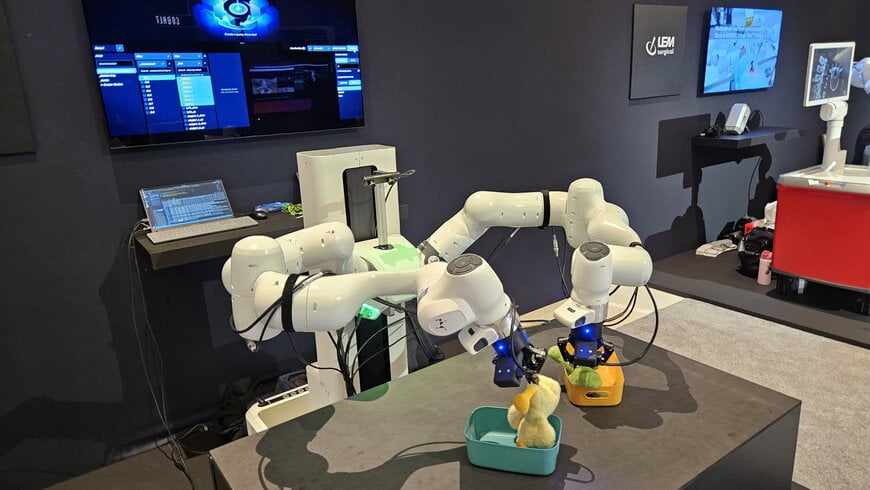
Franka Robotics, a Munich-based developer of force-sensitive, seven-degree-of-freedom robot arms, focuses on hardware and software platforms used in research and advanced automation. NVIDIA, a global provider of AI compute platforms and foundational models, has released a suite of open physical AI models and frameworks at CES 2026 to enable robots to reason and act in physical environments.
The technical challenge addressed by this cooperation lies in enabling robotic systems to perform complex tasks through learned policies rather than scripted motion sequences. Standalone robotic manipulators typically require separate integration of sensing, motion control, and AI inference; embedding advanced reasoning models directly on robotic platforms addresses scalability and real-time decision needs across diverse application sets.
Linking Physical Control and Foundation AI Models
The technical solution combines Franka robot hardware (e.g., the Franka Research 3 and FR3 Duo reference platforms) with NVIDIA’s open physical AI models, particularly the Isaac GR00T N1.6 vision-language-action (VLA) model. GR00T N1.6 is designed to support integrated perception, reasoning, and motion control, allowing robots to interpret sensor inputs and plan actions without traditional task scripting.
Franka Robotics provides the manipulators with integrated torque sensing and real-time control interfaces optimized for research and embodied AI workflows. NVIDIA supplies the AI model stack and simulation tools (e.g., Isaac Lab-Arena) that are used to pretrain and benchmark robot policies. The joint integration enables on-board execution of learned policies, combining perception outputs with control commands in closed-loop operation on physical hardware.
From Simulation to Live Systems at CES 2026
At CES 2026 in Las Vegas, the integrated solution was demonstrated live on the FR3 Duo dual-arm platform, showcasing teleoperated demonstrations, real-world data collection, and local, real-time inference driven by GR00T-based policies. USD (Universal Scene Description) assets for the FR3 platforms optimized for NVIDIA Isaac Sim were also released to support simulation-first development and reproducible benchmarking.
The implementation leverages existing robotic hardware and software ecosystems, with Franka’s control interfaces exposed to developers and researchers and NVIDIA’s models deployed through open frameworks that support simulation and real hardware. This layered architecture facilitates integration with third-party tools such as ROS and industry-standard AI training pipelines.
Where Embodied AI Moves Beyond the Lab
Target industries for this cooperation include industrial automation labs, academic robotics research, and scenarios requiring embodied AI such as flexible manufacturing, lab automation, and physical interaction tasks. The joint solution supports collection of high-quality interaction data for foundation model training and evaluation, enabling tasks like manipulation strategy learning, force-adaptive control, and context-aware task sequencing.
Operational Implications for Robotics Development
While quantitative performance data from the demonstrations have not been published, the integrated approach yields measurable benefits by reducing reliance on manual task scripting, enabling real-time inference directly on robot hardware, and providing reproducible simulation environments for pre-deployment validation. By consolidating AI reasoning with physical actuation, the cooperation addresses key barriers in embodied intelligence development, including interoperability between perception and control loops and scalability of learning workflows across robotic research and industrial deployments.
www.franka.de
