
www.ptreview.co.uk
23
'26
Written on Modified on
Industrial Edge Computing for Warehouse Visual Inspection Systems
NEXCOM introduces the NDiS B340 fanless box PC to execute local machine vision inspection, dimensioning, and sortation automation.
www.nexcom.com
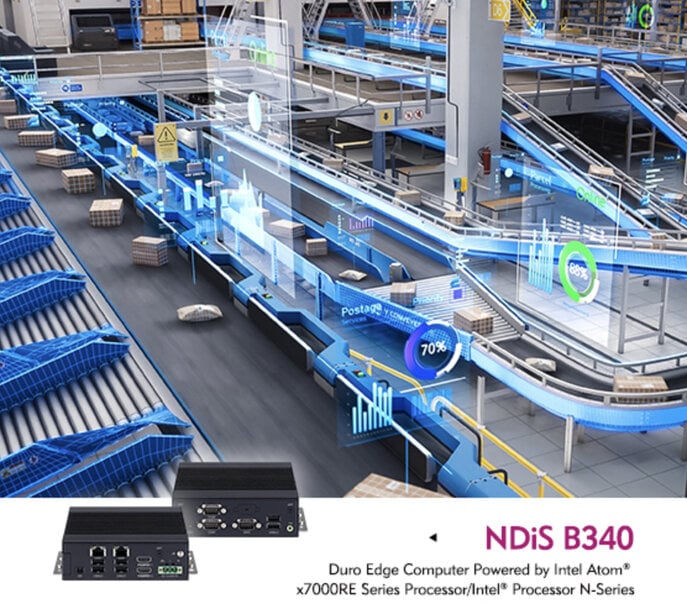
High-throughput logistics hubs, distribution centers, and parcel sorting facilities face operational bottlenecks caused by escalating freight volumes and the processing latency of centralized vision networks. To provide decentralized processing for camera-based inspection directly at conveyor lines, industrial computer manufacturer NEXCOM has developed the NDiS B340, a compact, fanless edge box PC engineered to execute local image verification, package dimensioning, and automated defect detection.
Edge Processing for Conveyor-Line Visual Verification
Automated logistics workflows rely on continuous item tracking, optical character recognition (OCR), barcode verification, and parcel profiling to prevent incorrect routing and line halts. Transmitting high-bandwidth camera feeds to centralized enterprise servers creates network congestion and introduces latency that limits conveyor speeds. Furthermore, electronic hardware installed directly on sorting lines must withstand continuous vibration, ambient dust accumulation, and fluctuating operational temperatures.
The NDiS B340 resolves these operational challenges by hosting inspection and decision logic locally at the sorting node. Built with a rigid aluminum chassis functioning as a passive heatsink, the system maintains fanless heat dissipation to eliminate mechanical fan failures in dust-laden warehouse environments. The system operates on DC power input ranging from +12V to 24V and integrates a hardware Trusted Platform Module (TPM 2.0) to secure edge communication with warehouse management systems (WMS).
Processor Scalability and Pin-Compatible Architecture
To accommodate varying inspection workloads without requiring structural mechanical redesigns, the computing platform features a pin-compatible layout across multiple low-power Intel processor families. System integrators can specify:
- Intel Atom x7000RE Series embedded processors (such as the x7433RE and x7213RE) operating at 9W thermal design power (TDP) for industrial operating environments requiring broader thermal margins.
- Intel Processor N-Series architectures, including the 6W processor N150 and the 12W processor N97, for cost-effective standard line verifications.
The motherboard supports a single DDR5 SO-DIMM slot accommodating up to 16GB of high-speed system memory (expandable up to 32GB on select processor configurations), paired with an M.2 Key M 2242 slot for solid-state storage. Dual HDMI 2.0 display interfaces deliver video output up to 3840x2160 resolution at 60 Hz for local human-machine interface (HMI) diagnostic monitors.
Bandwidth Optimization and Peripheral Sensor Integration
Conveyor-based automated inspection requires precise hardware synchronization between package detection sensors, image acquisition devices, and mechanical rejection gates. The NDiS B340 integrates specialized I/O connectivity to match camera bandwidth and control requirements directly on the line:
For simple tasks—including 1D/2D barcode reading, presence checks, and part counting utilizing VGA to 2-megapixel sensors—the platform provides six USB 2.0 ports. For higher-resolution 3D dimensioning and high-speed defect analysis, two integrated Intel Ethernet LAN ports interface with GigE Vision cameras over long industrial cable runs.
The unit includes two software-configurable RS-232/422/485 serial COM ports to interface with legacy programmable logic controllers (PLCs), label printers, and fixed handheld scanners. An onboard DB15 GPIO interface supplies six isolated digital inputs and six digital outputs. The digital inputs connect directly to photoelectric break-beam or inductive proximity sensors to trigger image capture precisely as an item crosses the camera axis. The digital outputs directly drive physical reject flippers, divert gates, or fault stack lights without requiring auxiliary external PLC expansion modules.
Modular Expansion via DockInfinity Architecture
To prevent premature equipment obsolescence as logistics facilities add secondary camera angles or multi-sided scanning tunnels, the platform pairs with the modular DockInfinity-E4X1 expansion enclosure. The expansion module attaches to the primary host chassis, adding a half-size PCI Express 3.0 x4 slot (backward compatible with PCIe x1 cards).
This interface allows integrators to install Power-over-Ethernet (PoE/PoE+) network cards, multi-channel frame grabbers, or high-speed USB expansion cards. Installing a multi-port PoE card allows the system to power and communicate with multiple GigE Vision cameras over a single Ethernet cable per channel, eliminating standalone external power injectors on conveyor structures. Wireless communication across expansive distribution floors is facilitated via an internal M.2 Key E 2230 slot for Wi-Fi modules and an M.2 Key B 3052 slot paired with a SIM socket for 5G/LTE cellular backhaul.
Additional Context:
This section details technical specifications and competitive benchmarking not included in the original product announcement.
In industrial machine vision and automated material handling, edge systems are benchmarked by camera interface bandwidth, thermal envelope tolerance, and deterministic I/O latency. GigE Vision (governed by the Automated Imaging Association / A3 standard) operates on Gigabit Ethernet (1000BASE-T) offering 125 MB/s uncompressed bandwidth per channel, with newer deployments leveraging 2.5GbE (IEEE 802.3bz) interfaces, such as the Intel I226V controllers integrated into the NDiS B340 rear panel, which provide 312.5 MB/s data transmission.
Comparable compact industrial vision controllers in this market category include the Advantech MIC-710AIX / UNO-2000 series and the Neousys POC-400 series. While competitive systems frequently feature soldered CPUs with fixed configurations, the NDiS B340's pin-compatible architecture between Intel Processor N-Series and industrial Atom x7000RE chips allows hardware standardization across both standard commercial (-5°C to 55°C) and extended industrial (-20°C to 60°C) operating temperature envelopes.
Furthermore, industrial conveyor sorting requires determinism within millisecond response thresholds. By routing the DB15 GPIO lines directly to the platform's low-latency controller rather than traversing universal serial bus bridges, edge controllers achieve response times under 1 millisecond between sensor signal detection, algorithmic defect classification, and pneumatic reject actuator firing, satisfying sorting throughput benchmarks exceeding 3,000 to 6,000 parcels per hour.
Edited by Natania Lyngdoh, Induportals editor, with AI assistance.
www.nexcom.com
