
www.ptreview.co.uk
07
'26
Written on Modified on
Beckhoff at the Hydrogen Technology World Expo 2026
From October 20 to 22, in Hamburg, Germany, Beckhoff implements PC-based control systems to resolve interface complexity and cell stack monitoring challenges.
www.beckhoff.com
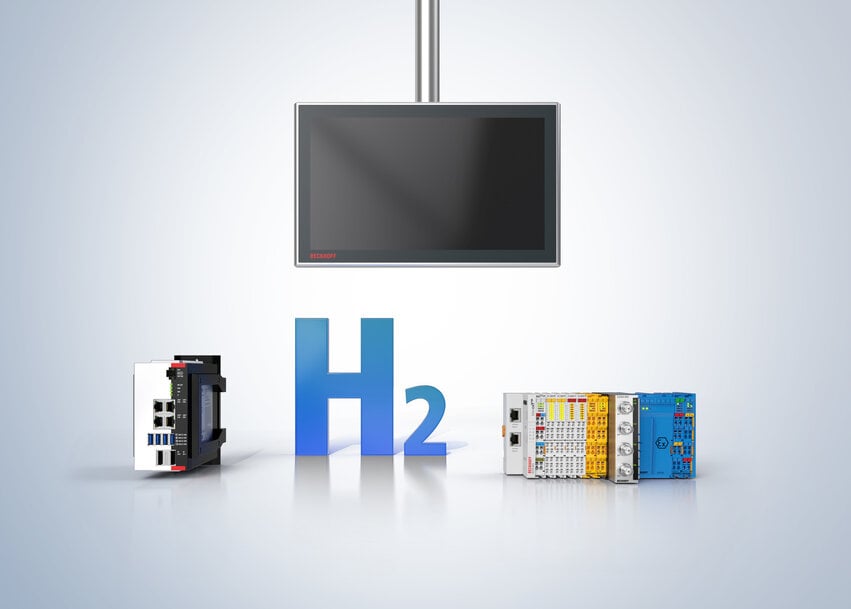
The presented solution utilizes PC-based control linked via high-speed EtherCAT to integrate process automation, functional safety, and measurement data acquisition onto a single hardware platform. At the field interface, the ELX terminal series incorporates intrinsic safety barriers directly into the I/O housing, enabling direct wiring to field instrumentation across Zone 0/20 and Zone 1/21 hazardous locations without external zener barriers. Decentralized field distribution is handled by IP67-rated EPX modules, while operator interfaces rely on CPX series panel PCs certified for Zone 2/22. International compliance is established through unified certification under ATEX, IECEx, and NEC/CEC standards.
Industry Applications
The system targets chemical plant engineering, renewable power-to-gas facilities, and heavy-duty transport refueling. In industrial water electrolysis, the architecture manages high-density multichannel voltage monitoring across series-connected cell stacks to prevent membrane degradation. In distributed compressor stations and hydrogen fueling facilities, the unified control environment synchronizes high-pressure valve actuation, gas flow monitoring, and safety shutoff protocols across hazardous operating zones without segregated PLC networks.
Deployment and Implementation
The hardware integrates directly into existing control cabinets using standard DIN-rail mounting or field deployment via decentralized IP67 modules, interfacing with legacy supervisory systems through standard industrial Ethernet protocols. For grid connectivity, the EL3475 power measurement terminal pairs with SCL6xxx split-core current transformers to capture electrical feed parameters, facilitating compliance with Section 14a of the German Energy Industry Act (EnWG) during facility retrofits. Software configuration operates within the TwinCAT development environment, where the integrated TwinCAT CoAgent provides automated code generation for PLC logic, human-machine interfaces, and I/O mapping.
Operational Impact and Performance Metrics
Eliminating external galvanic isolation barriers significantly reduces control cabinet footprint and wiring overhead. Precision monitoring of cell potentials is achieved through EL3008-0003 and EL3008-0005 EtherCAT terminals, which sample single-cell potentials at eight channels per terminal within measurement windows of plus or minus 3 V or 5 V, rated for stacked series potentials up to 1,500 V CAT II. Cascading the measurement topology reduces physical lead counts across large cell arrangements. During ongoing operations, TwinCAT CoAgent continuously parses process variables to generate deterministic fault diagnostics and procedural maintenance instructions, accelerating commissioning timelines and shortening mean time to repair.
Edited by Evgeny Churilov, Induportals Media - Adapted by AI.
www.beckhoff.com
