
www.ptreview.co.uk
24
'26
Written on Modified on
System-Integrated Machine Vision for Real-Time Industrial Automation
Beckhoff embeds image processing directly into the machine control architecture, eliminating communication latencies and separate hardware interfaces for motion control.
www.beckhoff.com
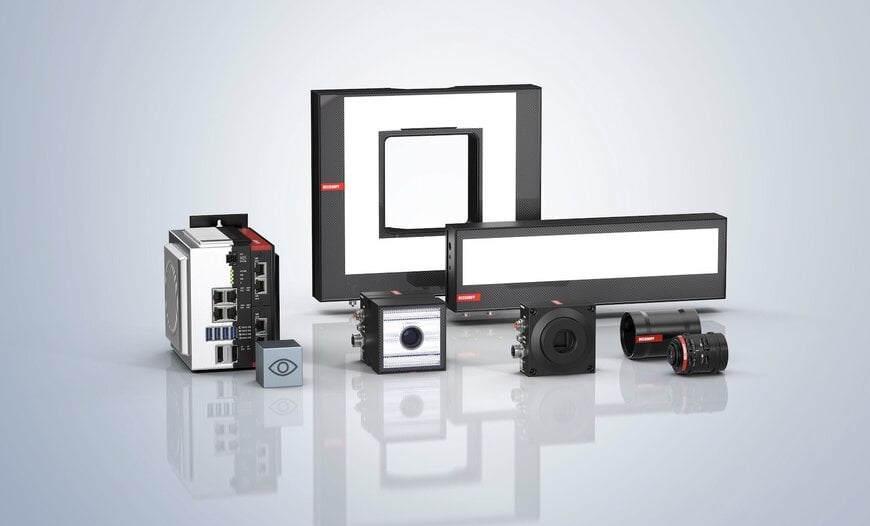
Beckhoff has expanded its automation portfolio with TwinCAT Vision, a system that integrates machine vision algorithms directly within the programmable logic controller (PLC) environment. This architecture allows quality assurance, track-and-trace, and adaptive process control applications to run synchronously with motion and robotics in the manufacturing and logistics industries.
Eliminating Hardware Interfaces and Latency
Traditionally, machine vision operates as a downstream test system, utilizing separate controllers that communicate with the primary machine PLC over external network interfaces. This separation introduces latency and non-deterministic behavior. Beckhoff addresses this by executing image processing algorithms in the exact same real-time environment and task cycles as the PLC, motion control, and robotics logic.
By eliminating the external vision controller, the system achieves synchronous processing and strictly deterministic behavior. Using the distributed clock function inherent to the EtherCAT network protocol, the camera image capture, illumination triggers, and machine kinematics can be precisely synchronized to within a microsecond.
Hardware Components and Network Integration
The vision hardware relies on the EtherCAT-compatible VCS2000 series area-scan cameras, which carry an IP65/67 rating for harsh industrial environments. These cameras utilize monochrome and color Sony CMOS sensors to deliver resolutions up to 24 megapixels with a transmission rate of 2.5 Gbit/s. The hardware ecosystem includes rugged C-mount lenses featuring visual (VIS) and near-infrared (NIR) anti-reflective coatings, resolving details down to 2 µm across 11 mm and 19.3 mm image circles.
To simplify installation, Beckhoff utilizes EtherCAT P technology, which transmits both data and power over a single cascaded cable. For immediate integration, the Vision Unit Illuminated (VUI) provides an all-in-one assembly containing the camera, LED illumination, and electronically focusable optics. The multi-color LED lights—configured as bars, areas, or rings—operate at different wavelengths to allow spectral adjustments during the process, maximizing optical contrast without mechanical readjustments.
Algorithm Processing and Machine Learning
From a software perspective, the architecture remains open to third-party GigE Vision cameras, which can be configured natively via a network scan similar to a standard servo axis. The TwinCAT 3 Vision Base library handles algebraic image operations, Fourier analysis, color processing, and contour/blob analysis. For advanced object classification and OK/NOK decisions, TwinCAT 3 Vision Matching 2D adds template matching and keypoint detection.
Furthermore, the system bridges the gap to data-driven production by integrating TwinCAT Analytics for seamless data recording and TwinCAT 3 Machine Learning. This integration executes trained neural networks directly within the PLC runtime at the application clock rate, enabling end-to-end processes from image capture to AI-assisted quality control and preventive maintenance.
The comprehensive vision portfolio will be demonstrated at the VISION exhibition in Stuttgart from October 6 to 8, 2026.
Additional Context
This section details technical specifications and competitive benchmarking not included in the original news release.
The integration of machine vision directly into the PLC runtime represents a structural shift in industrial automation, primarily driven by the need to reduce network latency. Comparable systems include B&R Industrial Automation’s Integrated Machine Vision.
A primary benchmark for these integrated systems is the deterministic synchronization between the camera trigger, the illumination strobe, and the position of a moving robot axis or conveyor. Traditional setups routing GigE Vision data to a separate industrial PC and passing OK/NOK signals via standard Ethernet typically introduce millisecond-level jitter, limiting maximum conveyor speeds. Beckhoff’s TwinCAT Vision utilizes the EtherCAT distributed clock to achieve microsecond-level synchronization, placing it in direct structural parity with B&R, which utilizes the POWERLINK protocol for the same deterministic, microsecond-level synchronization. By avoiding external gateways and processing the image matrices directly in the IEC 61131-3 logic environment, both platforms offer objective, measurable improvements in high-speed sorting and adaptive robotic guidance compared to standalone smart cameras.
Edited by Aishwarya Mambet, Induportals Editor, with AI assistance.
www.beckhoff.com
