
www.ptreview.co.uk
06
'26
Written on Modified on
Hydraulic Press Brakes Drive Systems
Optimizing Hydraulic Press Brakes With Advanced Power Units.
www.boschrexroth.com
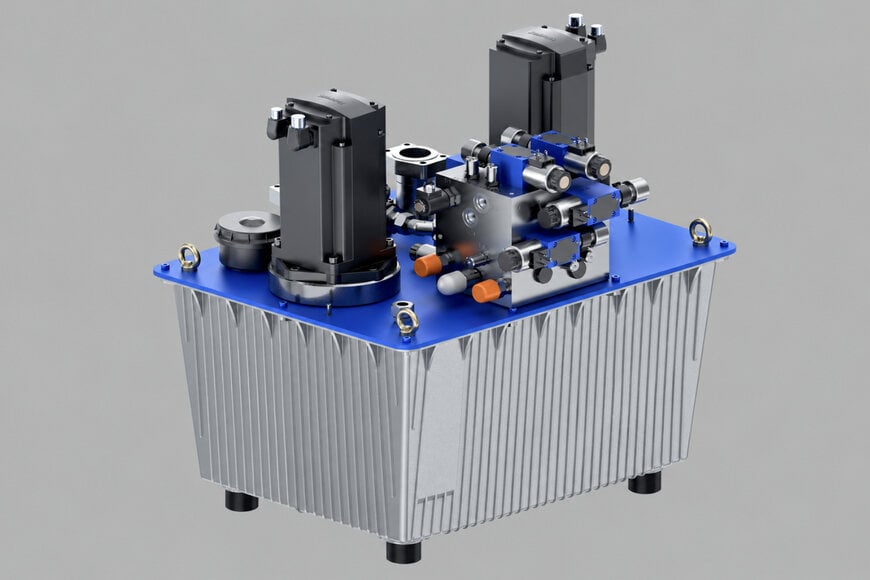
Modern sheet metal processing relies on hydraulic press brakes to achieve high force density and precise bending control, but traditional hydraulic configurations often suffer from complex piping architectures, energy waste during idle states, and space constraints within machine frames. Addressing these persistent engineering challenges, Bosch Rexroth presented its expanded portfolio of drive and control solutions for hydraulic press brakes at EuroBLECH, held in Hanover, Germany.
The integration of advanced electro-hydraulic components is crucial for modern metal-forming equipment where footprint reduction, dynamic response times, and high energy efficiency directly impact manufacturing productivity. By combining variable-speed pump drives with centralized hydraulic routing, machine builders can overcome traditional hydraulic inefficiencies.
Compact Architecture of the Double Power Unit
The newly introduced ABKAG double power unit integrates two individual power units into a unified, highly compact system. Operating with a single fluid tank and a centralized manifold architecture, this design eliminates substantial amounts of traditional piping, discrete valves, and interconnecting accessories. Delivered ready for connection, the pre-assembled unit significantly reduces assembly labor and installation overhead for original equipment manufacturers. The condensed physical footprint allows the double power unit to be integrated directly into press brakes constrained by limited floor space.
Dynamic Energy Management via Servo-Pump Technology
Energy efficiency in the ABKAG series is achieved through an intelligent power-on-demand control strategy. The system pairs high-performance MS2N servomotors with proven A10FZG axial piston pumps. Instead of running a constant-displacement pump continuously against load, the servomotor adjusts pump delivery dynamically based on real-time process requirements, supplying hydraulic energy only when demanded by the bending cycle. This approach minimizes idle-state power losses, curtails overall energy consumption, and decreases operating expenditures over the lifecycle of the machine.
Expanded Single Power Unit Capabilities
To provide greater configuration flexibility across varying tonnage classes, the established ABKAG single power unit portfolio has been expanded to include a higher performance tier. Furthermore, these units are now available with integrated manifolds in size 16. This versatile single-unit design can be positioned interchangeably on either the left or right side of the press brake frame. By standardizing mounting options, original equipment manufacturers reduce component variants, streamline inventory management, and simplify spare parts logistics.
Precision Control via Function-Integrated Cylinder Manifolds
In addition to pump-controlled architectures, Bosch Rexroth optimized its valve-controlled press brake offerings through a new function-integrated cylinder manifold. Mounted directly onto the hydraulic cylinder, this close-coupled configuration minimizes fluid volume under compression, mitigates pressure drops within the circuit, and enhances dynamic response. Proximity to the actuator enables tighter closed-loop control of the bending stroke, resulting in maximum angular accuracy and repeatable component quality.
Additional Context:
This section details technical specifications and competitive benchmarking not included in the original product announcement.
The evolution of press brake hydraulics reflects a broader industrial shift from traditional constant-displacement, throttle-regulated circuits toward servo-controlled, variable-displacement architectures. Traditional systems typically utilized fixed-speed AC motors driving radial piston or internal gear pumps, relying on proportional valves to throttle flow and pressure, which generated significant thermal losses and required extensive fluid cooling capacity.
In contrast, modern electro-hydraulic servo drives, such as those implemented in the ABKAG series, control axis velocity and force directly through variable motor speeds. This architecture aligns with ISO 4413 standards for hydraulic fluid power safety and general requirements. Compared to legacy centralized pump stations with long distribution lines, decentralizing manifold blocks directly onto actuators minimizes fluid compressibility effects and improves system rigidity. Similar technological approaches are observed in servo-hydraulic injection molding machines and high-speed metal stamping presses, where dynamic servomotor control replaces conventional proportional valve throttling to achieve higher energy efficiency and tighter position repeatability.
Edited by Sucithra Mani, Induportals editor – adapted by AI.
www.boschrexroth.com
