
www.ptreview.co.uk
12
'26
Written on Modified on
Nine-Axis Bending Machinery For Metal Processing And Industrial Automation
Bosch Rexroth integrates advanced motion control systems into a new multi-slide metal bending platform to optimize cycle times for construction material production.
www.boschrexroth.com
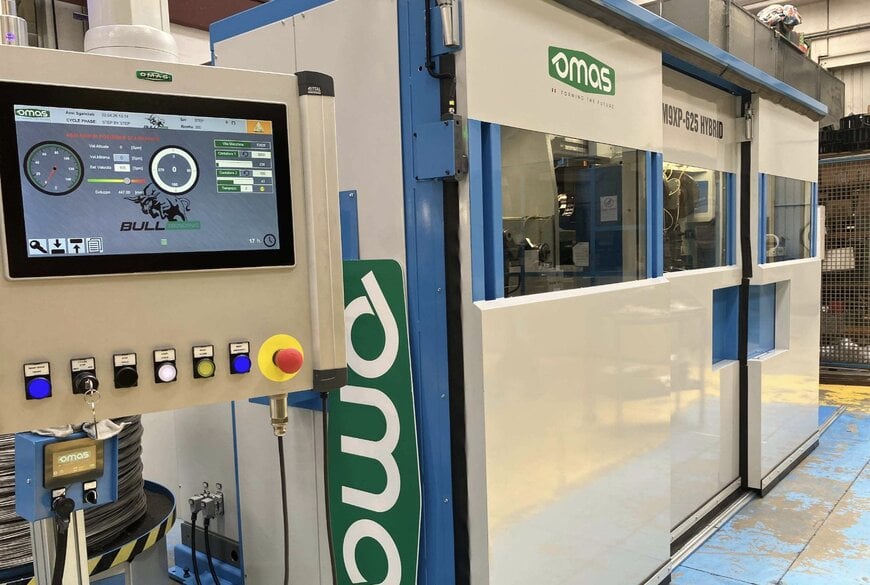
OMAS and Bosch Rexroth engineered a nine-axis hybrid multi-slide bending machine designed for manufacturing stainless-steel tie rods utilized in the construction industry. The integrated system utilizes advanced servo-controlled mechanisms to reduce format changeover times and improve operational repeatability during high-speed continuous metal processing.
Nine-Axis Servo Architecture And Changeover Efficiency
The primary operational constraint in industrial metal bending is minimizing machine downtime during product format adjustments. Traditional production systems utilizing a two-axis configuration frequently require more than an hour of manual mechanical recalibration when modifying the output dimensions of steel tie rods. To address this limitation within the industrial automation sector, OMAS transitioned to a nine-axis servo-controlled architecture. This engineering update enables fully automatic format changes directly from the machine's primary control panel, reducing dimensional adjustment times to approximately five seconds. The precise multi-axis synchronization manages the entire manufacturing cycle, maintaining consistent structural tolerances and high repeatability during rapid continuous bending operations.
Motion Control And Drive System Integration
The automated motion logic is governed by the Bosch Rexroth ctrlX AUTOMATION platform, which consolidates programmable logic controller functions, multi-axis synchronization, and spatial positioning into a unified digital manufacturing ecosystem. Power distribution is managed by a modular drive architecture featuring a common direct current bus and a regenerative power supply mechanism. This configuration recovers kinetic energy generated during mechanical braking phases and redistributes it across the other operational servo axes. Consequently, the machine maintains stable torque-speed ranges during peak power demands while significantly reducing the physical footprint required for the external electrical control cabinets.
Software Scalability And Network Security Protocols
At the control level, the system operates on a real-time Linux operating system that merges information technology and operational technology connectivity protocols. The software utilizes an application-based structure, allowing operators to deploy new manufacturing functionalities without requiring physical hardware modifications. To protect machine data across industrial networks, the control hardware complies with IEC 62443 cybersecurity standards, utilizing encrypted virtual private network connections and segmented application environments. OMAS publicly demonstrated this automated nine-axis platform at the Wire 2026 exhibition in Düsseldorf, Germany, held from April 13 to 17, showcasing its mechanical integration capabilities for complex wire and cable processing environments.
Additional Context
This section details technical specifications and competitive benchmarking not included in the original news release.
Within the high-volume wire and metal bending equipment sector, fully automated multi-axis configurations serve as the technical benchmark against traditional mechanical cam-driven machinery. Leading industry equivalents, such as the Wafios BM series or Bihler multi-slide servo platforms, similarly employ common direct current bus architectures and regenerative braking to manage the high dynamic loads of continuous metal deformation. By reducing changeover times to approximately five seconds, the nine-axis OMAS architecture performs at the upper tier of modern computer numerical control wire forming capabilities. While legacy two-axis or cam-driven equipment relies on mechanical tooling adjustments that yield lengthy production downtime, fully servo-electric platforms shift the setup process to digital software parameters, standardizing operational efficiency across the commercial metal processing industry.
Edited by Aishwarya Mambet, Induportals Editor, with AI assistance.
www.boschrexroth.com
