
www.ptreview.co.uk
01
'26
Written on Modified on
Drive-Based Motion Control for Modular Automation and Machine Building
Dunkermotoren integrates its QuickStart Control with standardized communication protocols to shift recurring programming tasks from central logic controllers to the drive level.
www.dunkermotoren.com
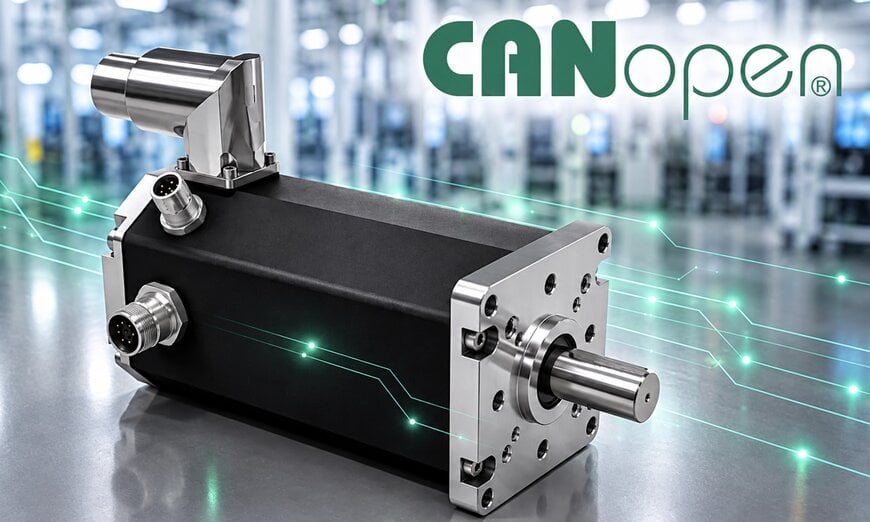
Dunkermotoren has released its QuickStart Control functionality integrated with CANopen communication to accelerate motion control implementation for machine builders and original equipment manufacturers (OEMs). This automation approach shifts repetitive motion programming from central controllers directly to the drive system, optimizing development cycles for modular machine architectures and industrial automation projects.
Decentralizing Motion Control Logic
To alleviate programming bottlenecks, the QuickStart Control system enables commonly used motion functions to execute directly within the drive hardware. Rather than developing and validating extensive programmable logic controller (PLC) code for every distinct motion sequence, machine builders can access predefined functions. By shifting these recurring tasks from the central controller to the drive, engineering teams reduce overall programming effort, shorten commissioning times, and simplify diagnostic and troubleshooting procedures. This architectural shift allows developers to reuse validated motion software modules across multiple automation projects, lowering lifecycle costs and reducing time-to-market.
Standardized Communication Protocols
The system operates on the CANopen architecture, utilizing the widely adopted CiA 301 and CiA 402 device profiles. This infrastructure provides an interoperable foundation for motion control applications across various industrial sectors. While the communication standard ensures reliable data exchange between controllers and drive systems, the integration of predefined control logic addresses the broader engineering challenges of maintaining software consistency across varying mechanical configurations.
Scalability in Modular Machine Architectures
The operational advantages of decentralized control are highly applicable to modular machine architectures, where OEMs build equipment families that share functional modules but serve differing output requirements. Using this integrated approach, machine builders can standardize motion concepts across the dCore, dMove, dPro, and dGo drive families. Within this modular motion ecosystem, engineers can combine different motors, gearboxes, encoders, and brakes while retaining a uniform software and control environment. This limits the need to alter programming approaches or commissioning procedures when scaling a machine design or adapting to new operational parameters.
Additional Context
This section details technical specifications and competitive benchmarking not included in the original news release.
In the motion control market, automation architectures are generally divided into centralized and decentralized control models. Centralized systems, utilizing protocols like EtherCAT or PROFINET, rely on a central PLC to calculate motion trajectories and transmit raw position data to drives at high frequencies. Conversely, decentralized architectures—such as those utilizing smart drives from competitors like maxon, ebm-papst, or Faulhaber—embed trajectory generation and position loops directly into the motor controller. By leveraging CiA 402 device profiles over a standard CANopen network, the QuickStart Control system significantly reduces the required network bandwidth. This allows engineers to execute complex motion sequences using highly robust, lower-speed fieldbuses (typically up to 1 Mbps) without the network overhead or extensive PLC programming required by centralized Industrial Ethernet solutions.
Edited by Aishwarya Mambet, Induportals Editor, with AI assistance.
www.dunkermotoren.com
