
www.ptreview.co.uk
13
'26
Written on Modified on
Advancements in Artificial Intelligence for Industrial 3D Vision Systems
SICK launches updated configurable software and next-generation 3D cameras to automate quality inspection and process monitoring in industrial manufacturing applications.
www.sick.com
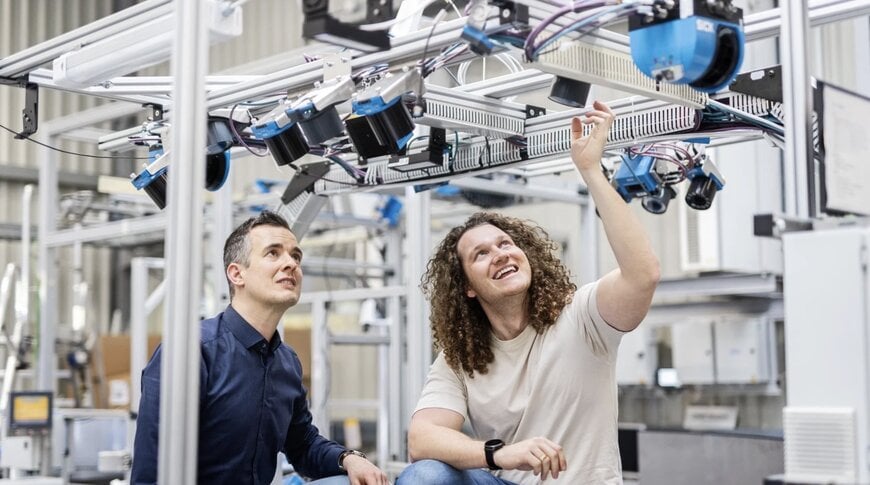
Photo: SICK
SICK is introducing the latest version of its NOVA image processing platform, alongside the Ranger NextGen 3D camera and AI Blob Finder tool, to enhance automated quality control. These industrial image processing solutions integrate artificial intelligence directly into three-dimensional data evaluation for manufacturing sectors requiring precise defect analysis, sorting, and dimensional inspection.
Artificial Intelligence Integration in 3D Data Analysis
With version 2.17 of the NOVA platform, artificial intelligence algorithms are applied to 3D image analysis, moving beyond traditional rule-based inspections. The system utilizes a 3D Anomaly Detection tool to identify topographical deviations, an Object Detection module for counting tasks, and 3D AI Classification to differentiate between acceptable products, defective items, or varying product variants. Instead of defining complex parameters for rule-based machine vision, operators configure inspections using sample images. These AI models can be trained and executed entirely on-device via smart sensors or processed using the D-Studio web service for exceptionally large training datasets.
Industrial Application Areas and Software Extensibility
The integration of these analytical tools supports a wide range of industrial manufacturing use cases, including volume, shape, and dimensional completeness inspections. The system also handles breakage detection, color verification, print contrast analysis, label legibility checks, and the decoding of 1D and 2D matrix codes. To support technical application flexibility, operators can extend the core software functionality by deploying self-developed or preconfigured plug-ins. Customer-specific software tools integrate directly into the ecosystem utilizing SICK AppSpace and AppStudio development environments.
Pixel-by-Pixel Object Separation and Defect Analysis
To support continuous software evolution in industrial automation, the system includes the AI Blob Finder image processing tool. Powered by a trained neural network, this feature detects, counts, and measures objects within a predefined spatial area. The algorithm identifies and isolates individual objects pixel by pixel, calculating precise dimensional metrics such as length, width, and total area. This pixel-level separation enables the reliable detection of microscopic cracks and surface deviations on highly reflective or structurally complex materials.
Next-Generation CMOS Sensor Hardware Specifications
The hardware backbone for these software capabilities is the Ranger NextGen 3D camera, which builds upon the existing Ranger3 architecture. Utilizing updated CMOS image sensor technology and advanced semiconductor manufacturing processes, the camera generates high-resolution 2D images, precise 3D height maps, and true-color data simultaneously. This hardware iteration delivers higher measurement accuracy and faster acquisition speeds, increasing parts-per-minute throughput without degrading spatial resolution. Furthermore, integrated image-data preprocessing allows the hardware to function reliably in outdoor environments or under highly variable ambient lighting conditions.
SICK will present the Ranger NextGen, alongside the Ruler3000 and Inspector 8xx family of 2D smart cameras, at the Vision 2026 tradeshow in Stuttgart, Germany, from October 6 to 8, 2026 (Hall 10, Booth 10D41).
Additional Context
This section details technical specifications and competitive benchmarking not included in the original news release.
In the industrial image processing market, the integration of artificial intelligence with 3D CMOS profiling sensors is a standard metric for comparing advanced machine vision systems. Systems such as the LMI Technologies Gocator series and the Cognex In-Sight 3D-L4000 serve as direct benchmarks for the Ranger NextGen and NOVA platform. Key competitive criteria include scan rates measured in kilohertz (kHz), Z-axis resolution evaluated in micrometers, and the physical location of AI inference. Similar to Cognex's ViDi software and LMI's GoPxL, the SICK architecture allows for edge-based AI model deployment directly on smart sensors, which reduces latency compared to cloud-dependent processing. Furthermore, shifting from traditional rule-based machine vision programming to sample-image dataset training has become the industry baseline for evaluating setup efficiency and hardware scalability in 3D anomaly detection.
Edited by Aishwarya Mambet, Induportals Editor, with AI assistance.
www.sick.com
SICK is introducing the latest version of its NOVA image processing platform, alongside the Ranger NextGen 3D camera and AI Blob Finder tool, to enhance automated quality control. These industrial image processing solutions integrate artificial intelligence directly into three-dimensional data evaluation for manufacturing sectors requiring precise defect analysis, sorting, and dimensional inspection.
Artificial Intelligence Integration in 3D Data Analysis
With version 2.17 of the NOVA platform, artificial intelligence algorithms are applied to 3D image analysis, moving beyond traditional rule-based inspections. The system utilizes a 3D Anomaly Detection tool to identify topographical deviations, an Object Detection module for counting tasks, and 3D AI Classification to differentiate between acceptable products, defective items, or varying product variants. Instead of defining complex parameters for rule-based machine vision, operators configure inspections using sample images. These AI models can be trained and executed entirely on-device via smart sensors or processed using the D-Studio web service for exceptionally large training datasets.
Industrial Application Areas and Software Extensibility
The integration of these analytical tools supports a wide range of industrial manufacturing use cases, including volume, shape, and dimensional completeness inspections. The system also handles breakage detection, color verification, print contrast analysis, label legibility checks, and the decoding of 1D and 2D matrix codes. To support technical application flexibility, operators can extend the core software functionality by deploying self-developed or preconfigured plug-ins. Customer-specific software tools integrate directly into the ecosystem utilizing SICK AppSpace and AppStudio development environments.
Pixel-by-Pixel Object Separation and Defect Analysis
To support continuous software evolution in industrial automation, the system includes the AI Blob Finder image processing tool. Powered by a trained neural network, this feature detects, counts, and measures objects within a predefined spatial area. The algorithm identifies and isolates individual objects pixel by pixel, calculating precise dimensional metrics such as length, width, and total area. This pixel-level separation enables the reliable detection of microscopic cracks and surface deviations on highly reflective or structurally complex materials.
Next-Generation CMOS Sensor Hardware Specifications
The hardware backbone for these software capabilities is the Ranger NextGen 3D camera, which builds upon the existing Ranger3 architecture. Utilizing updated CMOS image sensor technology and advanced semiconductor manufacturing processes, the camera generates high-resolution 2D images, precise 3D height maps, and true-color data simultaneously. This hardware iteration delivers higher measurement accuracy and faster acquisition speeds, increasing parts-per-minute throughput without degrading spatial resolution. Furthermore, integrated image-data preprocessing allows the hardware to function reliably in outdoor environments or under highly variable ambient lighting conditions.
SICK will present the Ranger NextGen, alongside the Ruler3000 and Inspector 8xx family of 2D smart cameras, at the Vision 2026 tradeshow in Stuttgart, Germany, from October 6 to 8, 2026 (Hall 10, Booth 10D41).
Additional Context
This section details technical specifications and competitive benchmarking not included in the original news release.
In the industrial image processing market, the integration of artificial intelligence with 3D CMOS profiling sensors is a standard metric for comparing advanced machine vision systems. Systems such as the LMI Technologies Gocator series and the Cognex In-Sight 3D-L4000 serve as direct benchmarks for the Ranger NextGen and NOVA platform. Key competitive criteria include scan rates measured in kilohertz (kHz), Z-axis resolution evaluated in micrometers, and the physical location of AI inference. Similar to Cognex's ViDi software and LMI's GoPxL, the SICK architecture allows for edge-based AI model deployment directly on smart sensors, which reduces latency compared to cloud-dependent processing. Furthermore, shifting from traditional rule-based machine vision programming to sample-image dataset training has become the industry baseline for evaluating setup efficiency and hardware scalability in 3D anomaly detection.
Edited by Aishwarya Mambet, Induportals Editor, with AI assistance.
www.sick.com
