
www.ptreview.co.uk
22
'26
Written on Modified on
Visual Components launches 5.1 for large-scale autonomous factory simulation
New release simulates hundreds of AMRs and AGVs with collision avoidance, 10x faster performance, realistic physics and expanded connectivity.
www.visualcomponents.com
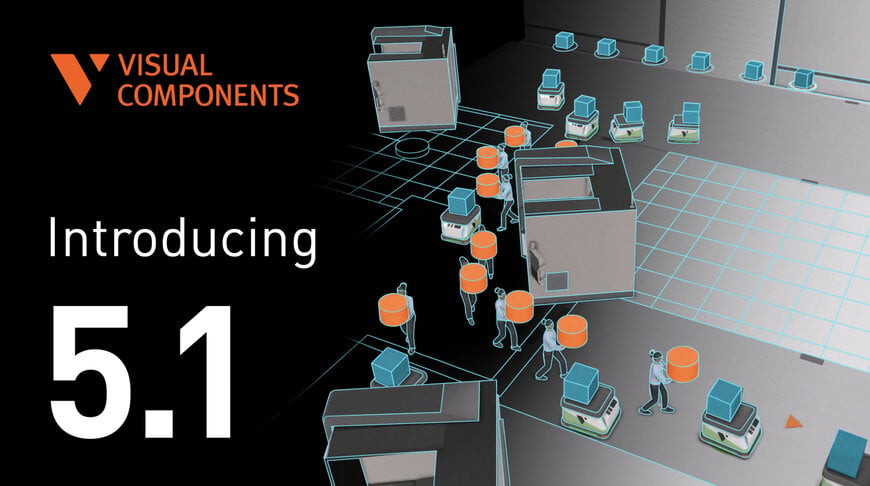
Visual Components has released Visual Components 5.1, an updated three-dimensional manufacturing simulation and offline robot programming platform designed to validate complex autonomous factory operations prior to physical installation. The software framework addresses layout design, control logic verification, and multi-agent interaction risks across automotive, electronics, logistics, and healthcare production facilities.
Multi-Agent Fleet Orchestration and Physics Engine Upgrades
Industrial facility planning increasingly requires simultaneous management of articulated industrial robots, automated guided vehicles, autonomous mobile robots, manual workstations, and material handling conveyors. Simulating these environments in isolation can obscure downstream bottlenecks, vehicle queue delays, and kinematic path interferences.
The 5.1 architecture integrates an updated implementation of the PhysX physics engine to accelerate dynamic collision detection and rigid-body mechanics. The upgraded simulation kernel supports the execution of hundreds of automated guided vehicles and autonomous mobile robots within a single factory scene, incorporating dynamic obstacle avoidance algorithms while achieving up to a tenfold increase in computational processing speed compared to prior software versions. Mika Anttila, Chief Technology Officer of Visual Components, stated that operational complexity in flexible manufacturing is outpacing traditional toolsets, noting that the platform allows engineering teams to validate interactions among hundreds of moving kinematic resources, mobile vehicles, products, and personnel before physical hardware is commissioned.
Controller Emulation and Programming Environment Transition
To support hardware-in-the-loop and software-in-the-loop virtual commissioning workflows, the release expands direct connectivity to industrial control platforms. The software integrates native driver connectivity for Allen-Bradley programmable logic controllers from Rockwell Automation, allowing automation engineers to connect external ladder logic directly to simulated sensors, actuators, and plant mechanisms. Additionally, dedicated virtual commissioning plugins have been added for Nachi and Epson industrial manipulators to mirror vendor-specific motion kinematics and joint limits.
For custom application development and robotic path sequencing, the internal development interface transitions from legacy execution scripting to Python 3. The modernized runtime environment provides development teams with standardized language syntax, broader access to standard modular libraries, and faster script execution when authoring custom behavioral components, kinematics solvers, and material routing routines.
Additional Context:
This section details technical specifications and competitive benchmarking not included in the original product announcement
Virtual commissioning and discrete-event manufacturing simulation platforms are evaluated primarily on physics fidelity, programmable logic controller (PLC) communication latency, multi-robot kinematic accuracy, and real-time execution capability. Major industrial platforms competing in this sector include Siemens Tecnomatix Process Simulate, Dassault Systèmes DELMIA, and Rockwell Automation Emulate3D.
Siemens Tecnomatix Process Simulate serves as an enterprise-grade digital manufacturing solution deeply embedded in high-volume automotive production. It utilizes the Siemens High-Speed Simulation kernel and direct connectivity to physical and software programmable logic controllers via Siemens S7-PLCSIM Advanced and the Open Platform Communications Unified Architecture (OPC UA) standard. While Process Simulate offers deep kinematic modeling for heavy industrial robots and native support for realistic robot simulation (RRS-1 and RRS-2) controller models, scaling scenes to accommodate hundreds of decentralized autonomous mobile vehicles simultaneously often requires high workstation computing resources or distributed server configurations.
Dassault Systèmes DELMIA operates on the 3DEXPERIENCE platform, integrating engineering computer-aided design data directly with manufacturing process planning and human ergonomics simulations. DELMIA provides multi-resource scheduling and virtual commissioning capabilities via standard industrial protocols, but implementation typically requires deep integration into broader enterprise product lifecycle management architectures.
Rockwell Automation Emulate3D focuses specifically on high-throughput material handling, sorting system mechanics, and dynamic conveyor routing. Emulate3D features a specialized discrete-event and physics-based engine with native tag-level integration for Allen-Bradley ControlLogix and CompactLogix processors via proprietary Ethernet/IP protocols. In comparison, Visual Components 5.1 bridges discrete-event material flow modeling with vendor-agnostic 3D robotic offline programming, combining unified automated guided vehicle fleet orchestration with multi-vendor controller plugins (Nachi, Epson, KUKA, ABB) on a single desktop platform.
Edited by Natania Lyngdoh, Induportals editor, assisted by AI.
www.visualcomponents.com
