
www.ptreview.co.uk
12
'26
Written on Modified on
KUKA Showcases Connected Robotics for Metalworking
KUKA will present integrated automation solutions for metalworking at AMB 2026, covering machine loading, workpiece transport, machining, quality control, simulation, and AI-supported process analysis.
www.kuka.com
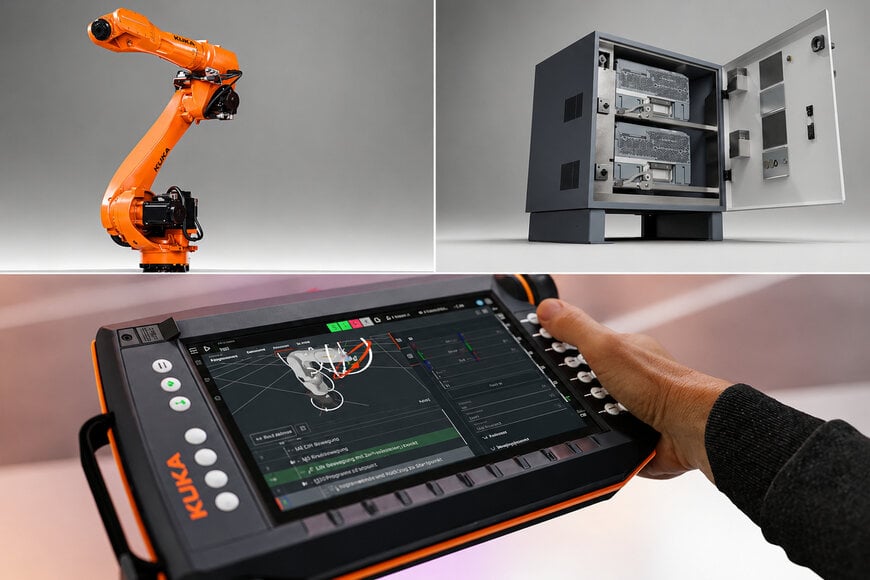
KUKA will demonstrate automation applications at AMB in Stuttgart ,Germany ( from September 15 to 19 - 2026 ) together with technology partners. The company will be located at Booth C51 in Hall 6, where it will showcase robots, autonomous mobile platforms, robot controllers, software, simulation tools, and AI-enabled applications for CNC machining and related production processes.
The demonstrations address multiple stages of the metalworking process chain, including automated loading and unloading of machine tools, workpiece transport between machining stations, machining operations, and quality-related processes. Connecting these stages can extend automation beyond individual robot cells and integrate robotics with machine too s, material flow, and production control systems.
Robot Controllers and Software for Integrated Automation
KUKA will present the KR C5 and KR C5 micro robot controllers running on the iiQKA.OS2 operating system. According to KUKA, the platform is designed to support AI-ready automation applications.
The iiQKA.mxAutomation software interface enables robots to be integrated into existing machine control systems. This is relevant for CNC manufacturing environments where robot operations need to be coordinated with machine-tool controls rather than operated as isolated systems.
KUKA will also demonstrate iiQWorks.Sim for application planning, virtual commissioning, and optimization. Simulation allows robot movements and application sequences to be evaluated before physical commissioning, helping engineers assess cell layouts, motion sequences, and process requirements in a virtual environment.
Mobile Robotics for Workpiece Transport
The AMB demonstration also combines stationary and mobile robotics. BEC will show how workpieces can be transported between different machining stations using the KMP 1500P autonomous mobile platform.
This approach extends automation into the material-handling stage of production. Instead of limiting robotic automation to a single machine or cell, mobile platforms can provide an automated connection between geographically separated production stations. The practical implementation depends on factors including payload requirements, travel routes, safety functions, and integration with production-control systems.
AI and Computer Vision for Flexible Handling
MAIROTEC will demonstrate the MAIROFlex flexible robot cell with applications such as bin picking. The system uses computer vision and AI to identify and handle workpieces presented without a fixed orientation.
In bin-picking applications, computer vision determines the position and orientation of available workpieces, while the robot uses this information to plan and execute the required handling movement. This type of automation is relevant to production environments where workpieces cannot be reliably presented in a predefined position.
For CNC machining applications, wbt automation will present the flexVise robot cell in cooperation with KUKA. The compact cell uses the KR AGILUS ultra for automated vise handling at CNC machining centers. According to KUKA, the solution is particularly aimed at cost-effective automation of CNC machining operations, including applications involving smaller batch sizes.
AI-Based Analysis of Machine Faults
KUKA subsidiary Device Insight will demonstrate an agent-based AI application for analyzing machine faults. The system is designed to consolidate relevant information and provide operators with step-by-step troubleshooting guidance.
Such systems can connect machine information and technical documentation within a software-based troubleshooting workflow. The effectiveness of this approach depends on the availability, quality, and structure of the underlying machine and process data, as well as the accuracy of the information provided to operators.
Safety Requirements for Integrated Robot Applications
Integrated automation requires robots, machine tools, mobile systems, control systems, and safety functions to be considered as a complete application rather than as independent components.
ISO 10218-1:2025 specifies safety requirements for industrial robots, while ISO 10218-2:2025 addresses the integration of industrial robots into robot applications. The latter covers areas including application design, integration, commissioning, operation, maintenance, and decommissioning.
For metalworking applications, this means that automation performance cannot be evaluated solely by robot specifications or software capabilities. The interaction between the robot, machine tool, control architecture, safety systems, and surrounding production equipment is also part of the engineering design.
Automation Across the Metalworking Process Chain
KUKA's AMB 2026 demonstrations cover several layers of industrial automation, from individual handling operations to mobile workpiece transport, robot-cell control, virtual commissioning, computer vision, and AI-supported fault analysis.
The combination of these technologies reflects a broader move toward connected automation in metalworking. Rather than treating robotic handling, machining, material transport, and process support as separate functions, integrated systems can connect these activities within a common production workflow.
AMB 2026 will take place from September 15 to 19, 2026, at Messe Stuttgart in Germany. The international metalworking trade fair covers areas including machine tools, precision tools, quality assurance, and software, providing a relevant setting for demonstrating automation technologies across the manufacturing process chain.
Additional Context:
This section details technical specifications and competitive benchmarking not included in the original product announcement
A direct product-to-product comparison of the systems presented by KUKA and its partners is not appropriate because the demonstrations cover different robot types, payload classes, applications, software functions, and integration architectures. For integrated robot applications, however, ISO 10218-2:2025 provides an established technical reference for evaluating system integration and safety requirements.
For CNC-related manufacturing, ISO 14649 provides another relevant technical framework. The standard defines data models for computer-controlled manufacturing processes, including information associated with machining operations and manufacturing resources. Such standards provide context for evaluating how robotic automation and machine-tool processes can be integrated within digitally connected manufacturing environments.
Edited by Sucithra Mani, Induportals editor – adapted by AI.
www.kuka.com
