
www.ptreview.co.uk
10
'26
Written on Modified on
Machine Vision Supports Manual Flowmeter Assembly
Endress+Hauser uses machine vision to support high-variance manual assembly, providing work instructions, in-process inspection and quality documentation for flowmeters.
www.mvtec.com
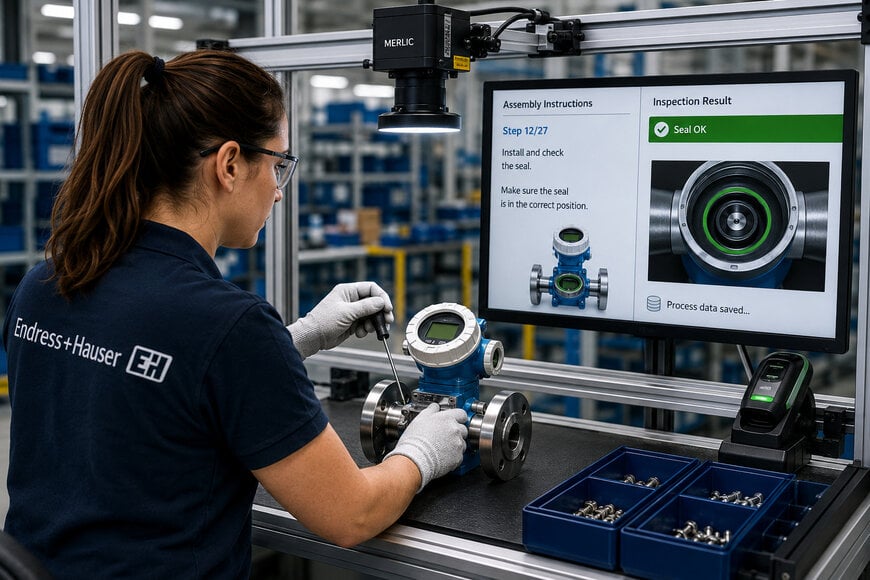
Application area: Machine vision, manual assembly, quality assurance
Industry sector: Flow measurement, industrial instrumentation
Endress+Hauser Flow, headquartered in Reinach, Switzerland, develops flow measurement technology and fluid management solutions. Its assembly operations include products with high component variance and relatively low production volumes, conditions in which fully automated assembly is not practical.
Before the machine vision-assisted process was introduced, quality assurance typically relied on checks performed by two employees, supplemented by additional testing. Endress+Hauser wanted to reduce this inspection workload while maintaining consistent assembly quality and identifying errors before products reached later process stages.
The company also needed an assistance system that could operate within its existing production control environment. Cloud-based solutions were unsuitable because of data protection and availability requirements, while integrating a separate third-party system into the existing Manufacturing Execution System (MES) would have required additional development and hardware.
Machine vision integrated with the MES
Endress+Hauser selected MVTec MERLIC as the machine vision software for its digital assembly assistance system. The software is integrated into the company's proprietary web-based MES, which controls the production workflow.
Before an assembly operation starts, the MES verifies that the flowmeter is at the correct process step, that the workstation is appropriate and that the logged-in employee is authorized to perform the operation. Once these conditions are met, the system displays assembly instructions using both text and images.
MERLIC runs in the background with the recipe data and parameters associated with the specific process step. It evaluates images captured during assembly and confirms whether critical operations have been performed correctly. The inspection results, process information and image data are then recorded by the MES.
This arrangement allows machine vision to complement manual work rather than replace the production employee. The high product variance remains manageable through human assembly, while image-based inspection provides automated verification of defined process steps.
Reading codes and verifying critical assembly steps
The machine vision workstation uses a camera mounted above a height-adjustable assembly table. The camera observes the workpiece while the employee performs the required operations.
The components are typically flowmeters approaching completion. A barcode associated with each component identifies the specific assembly sequence and requirements for a batch size of one. The MES uses this information to display the appropriate instructions and images to the employee.
MERLIC provides additional quality assurance during the process. One example is the verification of seals, where the software checks whether the required seal has been installed. Successful completion of defined critical steps is communicated to the MES, allowing the device to proceed to the next production stage.
The machine vision setup includes an industrial PC, a camera with a liquid lens for variable focusing and a laser distance sensor. Barcode scanners provide additional identification of the components.
AI-based image analysis
Two AI-based technologies within MERLIC are used for image-based recognition. Semantic segmentation provides pixel-level localization of defined error classes, while object detection identifies object classes and locates them using bounding boxes.
The machine vision application operates in the background while the employee works. When a required operation is recognized as correctly completed, the production interface advances to the next assembly instruction. This reduces the need for manual confirmation and integrates inspection directly into the assembly sequence.
Julius Krause of the Industrial Engineering department at Endress+Hauser explains that the objective was not simply to automate inspection, but to support production employees while improving quality assurance and enabling errors to be corrected earlier in the process.
Standard software simplifies integration
Endress+Hauser chose standard machine vision software instead of a dedicated assembly assistance platform partly because the existing production control system already provided interfaces for integrating image processing.
MERLIC is a no-code machine vision platform, allowing complete applications to be configured without conventional programming. Its open interfaces, including GenICam, also provide flexibility in selecting compatible cameras and other hardware.
For Endress+Hauser, using standard software also means that employees can work with the same machine vision environment for different inspection tasks rather than being trained on multiple software platforms.
The system was integrated with support from MVTec's customer support team. During implementation, Endress+Hauser requested several enhancements, including optimization of AI model export to the target hardware and a communicator plugin for sending images directly to the company's central servers.
Deployment and expansion
Development, testing and validation of the machine vision-assisted assembly process take place at Endress+Hauser's headquarters in Reinach before the process is introduced at other production sites.
Endress+Hauser has used MERLIC for the application since March 2025. Following the initial deployment and validation, the company began rolling out the process to other global production sites in autumn 2025.
The next development stage is intended to increase the level of automated identification. MERLIC will be used to read component codes through barcode reading and optical character recognition (OCR), retrieve the corresponding digitally stored information and use it during the assembly and inspection process.
The planned workflow will require the production employee to hold the workpiece under the camera at the beginning of the operation. The system can then identify the component and subsequently use machine vision to inspect it during assembly.
A hybrid approach to quality assurance
The Endress+Hauser application demonstrates how machine vision can be applied to manual production environments where product variation limits the practicality of full automation. By combining human assembly with automated image-based verification, the system provides process-specific instructions, checks critical operations and records inspection data within the existing MES.
The deployment does not replace manual assembly. Instead, machine vision is used where automated inspection can provide consistent verification while employees continue to handle the variable assembly tasks.
Edited by Sucithra Mani, Induportals editor – adapted by AI.
www.mvtec.com
