
www.ptreview.co.uk
30
'26
Written on Modified on
EcoStruxure Platform for Water Leak Analysis
Schneider Electric introduces a digital ecosystem to optimize diagnostics and reduce water loss through real-time data analysis.
www.se.com
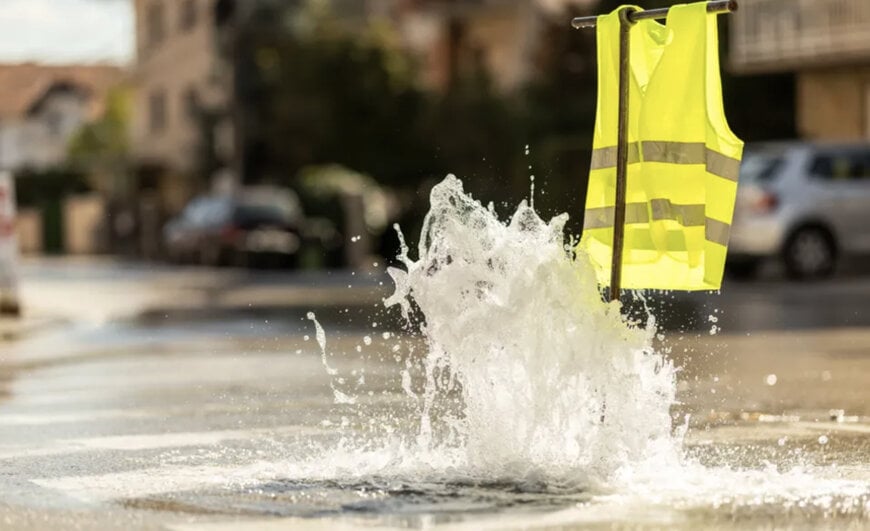
Reducing non-revenue water losses requires software systems capable of aggregating heterogeneous data for the early detection of anomalies. To address this operational need, Schneider Electric has launched EcoStruxure Water Advisor, a cloud-based ecosystem that leverages artificial intelligence and digital twin technology for the predictive monitoring of distribution networks.
Engineering Context
Global water utilities frequently operate with highly obsolescent infrastructures and isolated control systems. In a typical municipal distribution network, reliance on manual processes and the lack of interoperability between SCADA modules and billing platforms prolong the time required to identify hidden leaks. This operational delay results in the dissipation of significant volumes of treated water, along with the waste of electrical energy required for pumping and chemical treatment. The transition toward proactive maintenance requires software architectures capable of unifying telematics flows, eliminating operational silos, and automating water balance calculations.
Technical Explanation
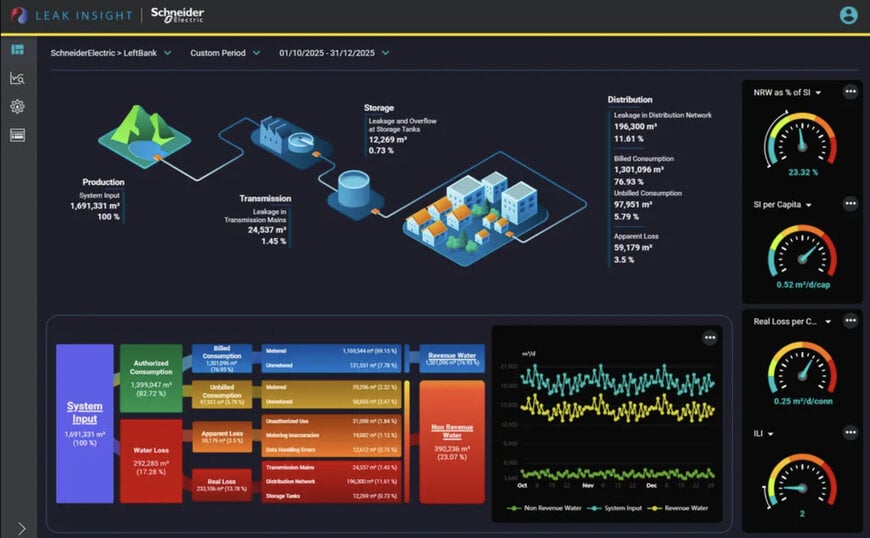
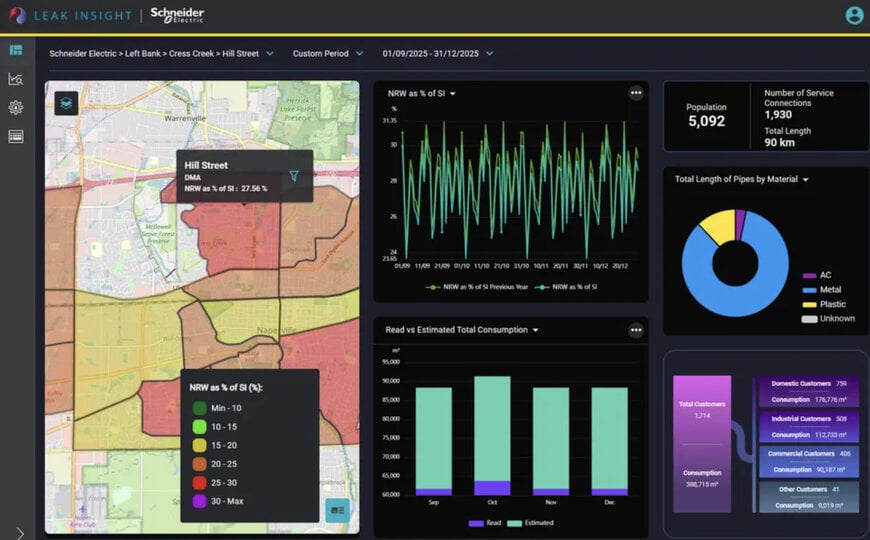
The software architecture is hosted on the secure AVEVA CONNECT cloud platform and operates by constantly integrating data from SCADA systems, field-based Internet of Things (IoT) sensors, hydraulic models, and energy infrastructures. The first available application module, named EcoStruxure Water Advisor – Leak Insight, operates as a Software-as-a-Service (SaaS), applying predictive analytics algorithms to evaluate network performance. The system generates daily water balances and uses interactive maps to correlate pressure variations and flow anomalies, comparing the real behavior of the infrastructure with its simulated digital model (Digital Twin). When hydrodynamic parameters deviate from tolerance thresholds, the algorithm detects the inconsistency and estimates its location.
Product Relevance
The centralization of telematics parameters enables operators and hydraulic engineers to gain immediate visibility into infrastructure performance. The accelerated identification of leaks and pressure drops allows for prioritizing interventions in geographic areas presenting the most critical volumetric loss rates. In addition to containing the loss of water resources, continuous monitoring of hydraulic parameters optimizes the efficiency of pumping cycles, reducing energy costs. The mitigation of pressure fluctuations also extends the mechanical life cycle of pipes and valves, ensuring reliable supply and supporting regulatory compliance.
Real-World Applications
The Leak Insight module is engineered for rapid deployment, ensuring compatibility with pre-existing operational technology (OT) and information technology (IT) systems while minimizing the need to expand the utility's hardware infrastructure. In real-world operational contexts, the platform translates raw data into actionable maintenance coordinates, improving the logistical coordination of field repair crews. Currently, various pilot projects and initial platform deployments are active at public utilities globally to test and validate the system's diagnostic accuracy on municipal-scale networks.
Additional Context
This section details technical specifications and competitive benchmarking not included in the original product announcement.
In the water network telemetry sector, Digital Twin modeling is considered a fundamental enabling technology for reducing non-revenue water rates. Competing software platforms, such as the OpenFlows WaterSight suite developed by Bentley Systems, utilize similar integration architectures that combine SCADA data, field sensors, and GIS (Geographic Information Systems) for real-time hydraulic calibration. At the engineering level, the effectiveness of these digital twins directly depends on the accuracy of the physical sensors and the synchronization latency between the real infrastructure and its virtual counterpart. While standard solutions are limited to leak control, more advanced integrated systems extend their computational capabilities to water quality forecasting, simulating chlorine decay and water age within pipelines to mitigate health risks. The adoption of unified architectures reduces database fragmentation and consolidates asset management strategies for public administrations.
Edited by Maria Brueva, Induportals editor – adapted by AI.
www.se.com
