
www.ptreview.co.uk
14
'26
Written on Modified on
Miniature Fork and Label Sensors for Industrial Automation Systems
The wenglor sensoric group has developed new optical and ultrasonic sensing components to improve object detection within space-constrained manufacturing environments.
www.wenglor.com
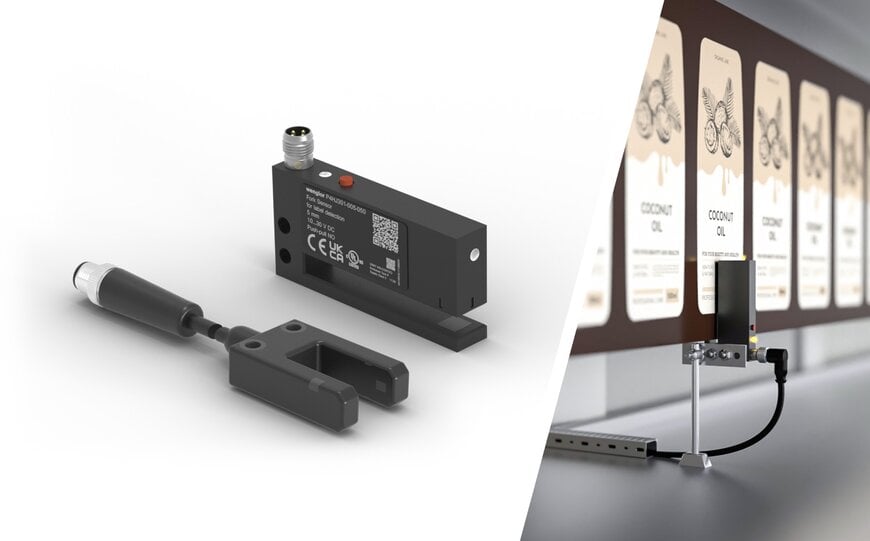
The wenglor sensoric group is releasing miniature fork light barriers and label sensors designed to optimize detection tasks in packaging, conveyor, and industrial automation technology. The new components provide precise object and label identification for automated guided vehicles, robotic systems, and high-speed assembly lines.
Spatial Integration and Small Part Detection
Operating within confined installation spaces requires components that maintain high switching accuracy without compromising their structural footprint. The newly introduced miniature fork light barriers address this mechanical constraint in automated guided vehicles (AGVs) and assembly shuttles. Capable of detecting small parts down to 0.7 millimeters, the sensors are available in fixed fork widths of 10, 20, and 30 millimeters.
To ensure durability in harsh industrial environments, the physical housings feature an IP67 and IP68 protection rating, shielding the internal optics against dust and liquid ingress. Furthermore, the integration of the IO-Link 1.1 protocol allows for standardized two-way digital communication, enabling system integrators to configure signal and switching thresholds remotely to maintain continuous process stability.
Material-Independent Label Detection Architecture
The sensor portfolio extension also includes specialized label sensors engineered to manage high-speed labeling processes. Depending on the specific material characteristics of the target object, the systems utilize either optical or ultrasonic detection architectures. The optical label variants rely on infrared light transmission, providing an accuracy of ±0.05 millimeters for the reliable identification of both thin and thick labels on fast-moving conveyor belts.
Conversely, for applications involving transparent, glossy, or low-contrast materials, the ultrasonic sensors analyze varying sound attenuation levels as the acoustic waves pass through the material web. This acoustic method enables detection entirely independent of surface texture or color. With a response time of 0.25 milliseconds, the ultrasonic units support continuous operation at elevated conveyor speeds without signal degradation or missed detection events.
Additional Context
This section details technical specifications and competitive benchmarking not included in the original news release.
Within the industrial sensor market, miniature fork sensors and label detection units compete directly with established product lines from manufacturers such as SICK and Pepperl+Fuchs. SICK’s WFS fork sensor series similarly targets confined spaces and utilizes IO-Link connectivity, achieving a typical minimum detectable object size of approximately 0.8 millimeters, which closely aligns with the 0.7-millimeter threshold of the components detailed above.
For ultrasonic label detection, Pepperl+Fuchs offers the UGB series, which utilizes similar sound attenuation principles to detect clear and metallic labels with response times generally ranging around 0.3 to 0.5 milliseconds depending on the specific switching frequency. The 0.25-millisecond response time of the ultrasonic sensors detailed in this release represents a highly competitive specification for ultra-high-speed web and packaging applications, prioritizing rapid signal processing and high reproducibility over standard operational parameters.
Edited by Aishwarya Mambet, Induportals Editor, with AI assistance.
www.wenglor.com
