
www.ptreview.co.uk
25
'26
Written on Modified on
Beckhoff Vision Unit Illuminated Series Expands
By combining a camera, illumination, and liquid lens, the VUI vision series significantly reduces installation and commissioning effort. With 16 new models, the range now offers higher resolutions and additional functionality.
www.beckhoff.com
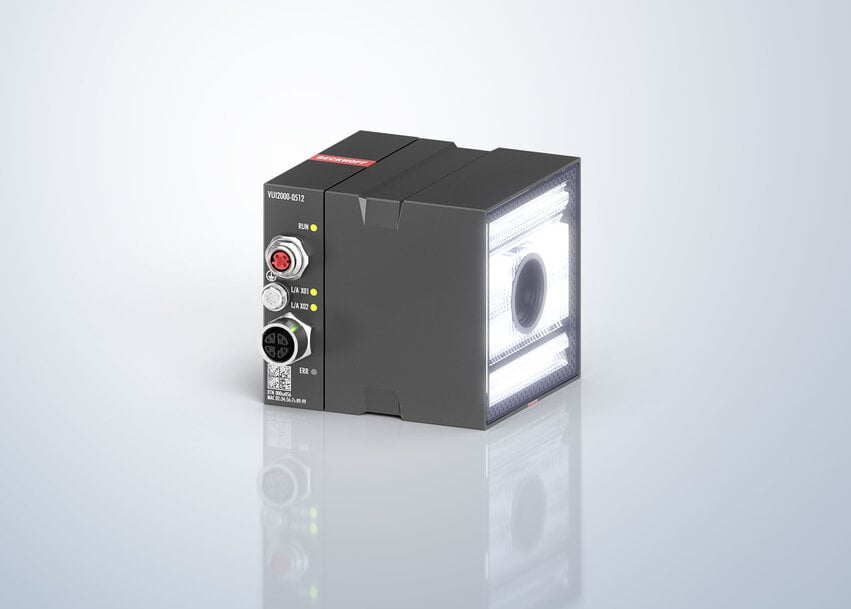
Beckhoff has expanded its Vision Unit Illuminated (VUI) machine vision portfolio by introducing 16 new devices. The upgraded series integrates advanced image sensors and optional crossed polarizing filters into a single compact housing that unifies a camera, LED illumination, and liquid lens focusable optics.
Sensor Integration and Application Profiles
The VUI series is engineered for the environmental conditions of machine building and manufacturing environments, featuring a robust, compact enclosure developed for direct integration into machine control networks. The 16 additional models incorporate Sony Pregius S™ global shutter image sensors to address varying levels of measurement and detection accuracy.
The expanded hardware selection provides three distinct sensor configurations:
- 5.1 MP Resolution: Optimized for high-throughput assembly lines with fast manufacturing cycle rates.
- 8.1 MP Resolution: Positioned for standard industrial inspection and part tracking.
- 12.4 MP Resolution: Developed for high-precision quality control demanding detailed feature identification.
Optical Filtering and Reflection Suppression
To expand the operational versatility of the hardware, the new VUI models are available with integrated crossed polarizing filters. This optical configuration resolves complex vision tasks by selectively suppressing specular surface reflections generated by the onboard illumination elements. By filtering out unpolarized glare, the camera captures target features with higher contrast. This capability enables consistent image acquisition when inspecting components through highly reflective or transparent barriers, including polished sheet metal, glass sheets, plastic packaging films, and fluid surfaces like water.
The VUI family is an integral component of the modular Beckhoff Vision portfolio, which unifies industrial machine vision hardware and software layers with EtherCAT industrial communication networks. This integration allows the vision subsystem to synchronize directly with active machine motion control axes. By running all vision algorithms, machine logic, and motion tasks on a unified PC-based control platform utilizing industrial PCs and TwinCAT automation software, the architecture minimizes cross-system communication latencies to increase total production throughput.
Additional Context
This section details technical specifications not included in the original news release.
Industrial machine vision inspection frequently suffers from image degradation caused by glare and specular reflections when light rays bounce off shiny, non-metallic surfaces. When unpolarized light from an integrated LED ring hits a glossy target like a plastic blister pack or glass container, the reflected light becomes partially or fully polarized parallel to the surface plane. If this reflected light reaches the image sensor directly, it saturates the individual pixels, creating bright white blind spots that obscure structural defects or barcodes.
Crossed polarization resolves this by placing a linear polarizing filter over the internal LED illumination source to orient the outgoing light waves in a single plane. A secondary linear polarizing filter, oriented at a 90-degree angle (the analyzer), is positioned directly in front of the camera lens. Light that undergoes specular reflection maintains its polarization angle and is completely blocked by the perpendicular analyzer. Conversely, light that diffuses or scatters off the actual details of the underlying part experiences depolarization, passing through the analyzer to the sensor matrix to deliver a high-contrast, glare-free image.
The integration of liquid lens focusable optics further enhances the flexibility of unified vision sensors during dynamic production changes. Traditional motorized lenses rely on miniature mechanical gears and stepper motors to physically adjust the distance between glass lens elements to shift the focal plane, a process that introduces mechanical wear and requires several hundred milliseconds to settle.
A liquid lens contains a sealed cell filled with two immiscible liquids of differing refractive indices—typically an aqueous conductive solution and an insulating oil layer—resting on a hydrophobic coating. When the TwinCAT control software sends an electrical voltage command via EtherCAT to the lens interface, it induces an electro-wetting effect that alters the curvature of the spherical meniscus interface between the fluids. This change in shape shifts the focal length of the optical system within milliseconds, enabling the VUI camera to adjust its focus on the fly between sequential product batches of varying heights without moving the physical camera assembly.
Edited by Romila DSilva, Induportals Editor, with AI assistance.
To expand the operational versatility of the hardware, the new VUI models are available with integrated crossed polarizing filters. This optical configuration resolves complex vision tasks by selectively suppressing specular surface reflections generated by the onboard illumination elements. By filtering out unpolarized glare, the camera captures target features with higher contrast. This capability enables consistent image acquisition when inspecting components through highly reflective or transparent barriers, including polished sheet metal, glass sheets, plastic packaging films, and fluid surfaces like water.
The VUI family is an integral component of the modular Beckhoff Vision portfolio, which unifies industrial machine vision hardware and software layers with EtherCAT industrial communication networks. This integration allows the vision subsystem to synchronize directly with active machine motion control axes. By running all vision algorithms, machine logic, and motion tasks on a unified PC-based control platform utilizing industrial PCs and TwinCAT automation software, the architecture minimizes cross-system communication latencies to increase total production throughput.
Additional Context
This section details technical specifications not included in the original news release.
Industrial machine vision inspection frequently suffers from image degradation caused by glare and specular reflections when light rays bounce off shiny, non-metallic surfaces. When unpolarized light from an integrated LED ring hits a glossy target like a plastic blister pack or glass container, the reflected light becomes partially or fully polarized parallel to the surface plane. If this reflected light reaches the image sensor directly, it saturates the individual pixels, creating bright white blind spots that obscure structural defects or barcodes.
Crossed polarization resolves this by placing a linear polarizing filter over the internal LED illumination source to orient the outgoing light waves in a single plane. A secondary linear polarizing filter, oriented at a 90-degree angle (the analyzer), is positioned directly in front of the camera lens. Light that undergoes specular reflection maintains its polarization angle and is completely blocked by the perpendicular analyzer. Conversely, light that diffuses or scatters off the actual details of the underlying part experiences depolarization, passing through the analyzer to the sensor matrix to deliver a high-contrast, glare-free image.
The integration of liquid lens focusable optics further enhances the flexibility of unified vision sensors during dynamic production changes. Traditional motorized lenses rely on miniature mechanical gears and stepper motors to physically adjust the distance between glass lens elements to shift the focal plane, a process that introduces mechanical wear and requires several hundred milliseconds to settle.
A liquid lens contains a sealed cell filled with two immiscible liquids of differing refractive indices—typically an aqueous conductive solution and an insulating oil layer—resting on a hydrophobic coating. When the TwinCAT control software sends an electrical voltage command via EtherCAT to the lens interface, it induces an electro-wetting effect that alters the curvature of the spherical meniscus interface between the fluids. This change in shape shifts the focal length of the optical system within milliseconds, enabling the VUI camera to adjust its focus on the fly between sequential product batches of varying heights without moving the physical camera assembly.
Edited by Romila DSilva, Induportals Editor, with AI assistance.
