
www.ptreview.co.uk
22
'26
Written on Modified on
AI Single-Board Computer for Edge Inference Workloads
AAEON has introduced a Panther Lake-based embedded computing platform combining CPU, GPU, and NPU resources for industrial AI inference and edge computing deployments.
www.aaeon.com
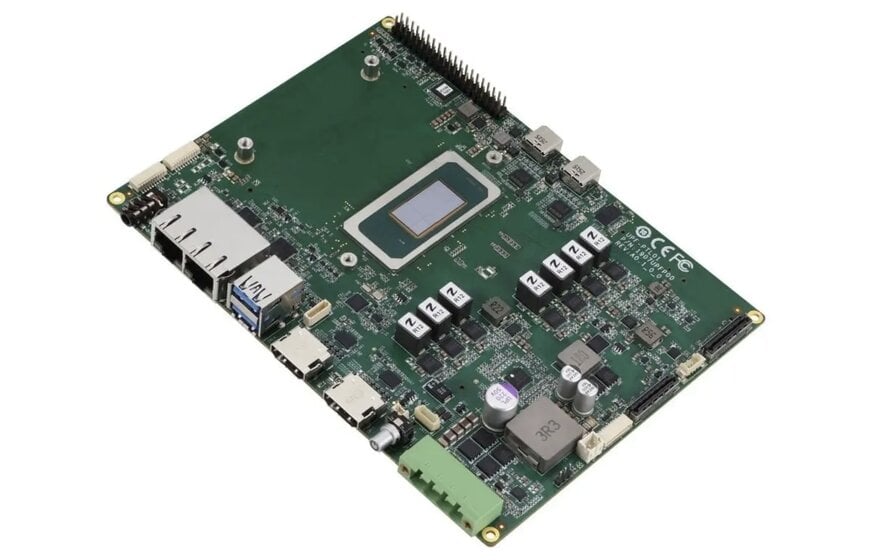
AAEON has released a new single-board computer built around Intel’s Panther Lake generation Core Ultra processors, targeting edge AI applications that require local inference acceleration, industrial connectivity, and flexible embedded deployment. The platform integrates neural processing hardware capable of up to 180 TOPS, positioning it for workloads such as machine vision, industrial automation, and intelligent edge analytics.
Embedded AI Computing Architecture for Edge Deployment
The new board, marketed as the UP Xtreme PTL, is a 170mm × 125mm embedded computing platform designed for industrial and edge AI environments where compact form factors and high I/O density are required. It is offered with Intel Core Ultra X7 358H, Core Ultra 7 356H, or Core Ultra 5 325 processors from Intel’s Panther Lake generation.
A key architectural element is the inclusion of an integrated NPU alongside conventional CPU and GPU compute resources. This heterogeneous compute model is increasingly relevant for AI inference because neural workloads such as object detection, image classification, and local language model acceleration can be offloaded from the CPU, reducing power consumption and improving deterministic response times in edge computing systems.
The quoted performance figure of up to 180 TOPS refers to aggregate AI acceleration across processor subsystems rather than standalone NPU throughput, making the platform relevant for mixed AI inference workloads rather than narrowly defined accelerator-only tasks.
Industrial Connectivity and System Expansion
The board is designed for industrial integration, with dual 2.5GbE Ethernet ports supporting high-throughput network connectivity for machine communication, industrial vision pipelines, or distributed edge computing nodes. Display output includes two HDMI interfaces, with support for up to four simultaneous displays, making the board suitable for operator consoles, digital signage, or multi-camera monitoring systems.
USB connectivity includes two USB 3.2 ports and two USB 4.0 Type-C interfaces, expanding compatibility with high-bandwidth peripherals, storage, and display devices. The inclusion of a 40-pin GPIO header indicates compatibility with embedded control applications requiring direct sensor or actuator interfacing.
Storage expansion is provided through two M.2 2280 M-Key slots, while wireless expansion is supported through an M.2 2230 E-Key slot for Wi-Fi and Bluetooth modules.
Memory and Power Configuration for Embedded Systems
The system supports dual DDR5 SO-DIMM slots with memory speeds up to DDR5-7200 and a maximum capacity of 128GB, although memory must be installed separately. This configuration supports memory-intensive inference workloads, video analytics pipelines, and industrial edge applications requiring local buffering or model execution.
Power input ranges from 19V to 36V DC via terminal block, aligning with industrial power environments where wider DC input tolerance is often required for deployment in factory automation, robotics, or transportation infrastructure.
This electrical design makes the platform suitable for digital supply chain deployments where embedded AI systems may operate under variable power conditions outside conventional office IT environments.
Edge AI Use Cases and Market Relevance
Single-board AI computing platforms increasingly serve as local inference engines in environments where cloud dependence introduces latency, bandwidth cost, or data governance constraints. In manufacturing, this can include visual inspection systems performing defect detection directly on the factory floor. In robotics, onboard inference enables navigation and perception without requiring persistent network connectivity. In smart infrastructure, such boards can process sensor feeds for anomaly detection or occupancy analysis.
The combination of CPU, GPU, and NPU resources reflects a broader shift in embedded computing toward heterogeneous acceleration, particularly as industrial AI workloads move from experimental deployments to operational infrastructure.
Additional Context
This section details technical specifications and competitive benchmarking not included in the original news release.
The UP Xtreme PTL enters a competitive segment that includes embedded AI computing systems from vendors such as ASUS IoT and Advantech, as well as compact AI PCs using similar Intel Core Ultra architectures. Accepted benchmarking criteria in this segment include total AI compute throughput (TOPS), memory capacity, I/O density, network bandwidth, display support, and industrial power compatibility.
AAEON’s quoted ceiling of 180 TOPS places the platform in line with newer Panther Lake-based embedded AI systems using Intel’s latest heterogeneous compute architecture. By comparison, earlier Intel Core Ultra Series 2 compact AI systems such as ASUS NUC AI platforms typically offered lower aggregate AI throughput in the 100–120 TOPS class, reflecting generational compute scaling.
The dual 2.5GbE configuration is significant because many embedded boards in adjacent categories continue to rely on single Ethernet or 1GbE connectivity, limiting suitability for machine vision or edge inference clusters handling multiple data streams.
Its support for up to 128GB DDR5 memory also exceeds the constraints of many compact AI appliances that rely on soldered LPDDR memory, making the board potentially more flexible for developers deploying larger inference models or memory-intensive edge analytics workloads.
Edited by Aishwarya Mambet, Induportals Editor, with AI assistance.
www.aaeon.com
