
www.ptreview.co.uk
22
'26
Written on Modified on
Physical AI brings intelligent automation into industrial production
Using its modular GROW automation cell, SCHUNK showcased how simulation-driven robotics and AI can transform Physical AI from concept to scalable, production-ready manufacturing applications.
schunk.com
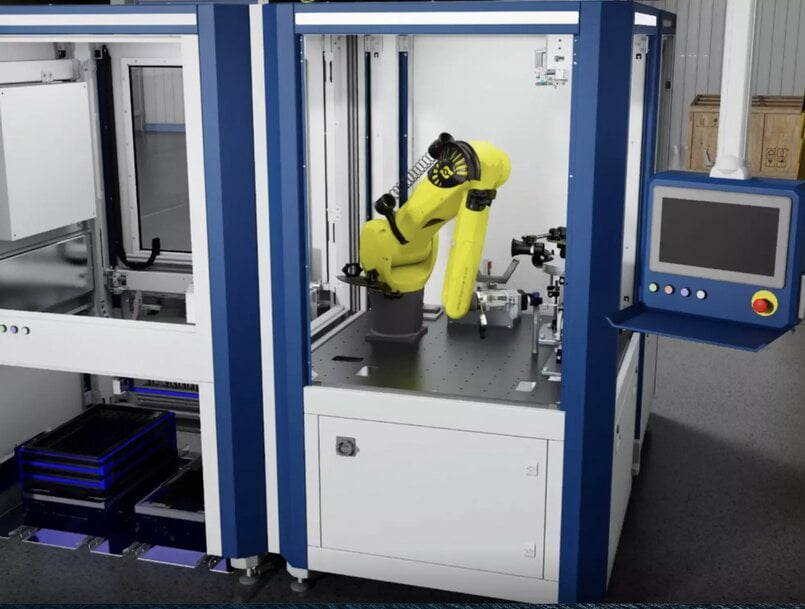
SCHUNK has introduced a standardized, modular platform designed to deploy autonomous physical artificial intelligence applications directly into factory floor operations. The cooperation involves integrating high-fidelity simulation frameworks with adaptive robotic hardware to establish repeatable fabrication workflows. This technical approach addresses the requirement for flexible, self-optimizing machinery within discrete manufacturing and industrial logistics sectors.
Optimization of Autonomous Trajectories in the Digital Supply Chain
Traditional assembly lines face severe capacity constraints when managing multi-variant, low-volume product runs due to rigid programming methods and lengthy physical reconfiguration times. Shifting toward a modular automation architecture reconfigures raw material handling and mechanical toolpath generation into self-adjusting processes. By establishing these adaptive edge units, production networks eliminate static workflow restrictions and channel real-time equipment telemetry directly into a unified digital supply chain. This automated connectivity functions as an intelligent layer within a broader automotive data ecosystem, facilitating dynamic production scheduling and synchronizing floor workflows with wider supplier logistics.
Micro-Kinematic Validation and Virtual Commissioning Staging
The core mechanism relies on a simulation-first methodology that prepares and optimizes robotic sequences digitally before deploying them to physical systems. By embedding high-fidelity simulation libraries and structural robotics frameworks into the engineering pipeline, three-dimensional movements, complex clamping forces, and high-frequency gripping cycles are modeled and trained virtually. This end-to-end digital twin validation allows robotic motion paths and real-time torque compensations to converge mathematically before hardware integration. This structural modeling prevents mechanical collision risks during initial operations and curtails physical commissioning windows by approximately 40%, lowering initial capital expenditure risks.
Software-Driven Translation and Cross-Platform Integration Workflows
Transitioning from virtual training models to active factory floor execution is managed via open-architecture, software-enabled workflows. These communication protocols allow deep-learning control strategies validated in simulated environments to be compiled and written directly into on-site industrial controllers. This synchronization translates complex virtual logic into physical actions sustainably under real production conditions. Concurrently, the automation interface logs spatial deviations and component slippage metrics, feeding data back into the optimization loops. This automated tracking lifts overall picking throughput and transitions factory personnel from repetitive manual labor to technical system monitoring and diagnostic roles.
Additional Context
This section details technical specifications and competitive benchmarking not included in the original news announcement.
In comparison to traditional, customized non-standard automation integration packages from suppliers like Fanuc or ABB, which rely on rigid hand-coded pendant points, the modular platform focuses on software-hardware decoupling and scalable building blocks. Conventional two-dimensional or three-dimensional vision guidance methods frequently suffer from pose-estimation latencies exceeding 500 milliseconds when encountering reflective, stacked, or oily metallic components, which degrades positional repeatability. Technical benchmarks indicate that this system leverages specialized acceleration hardware to lower local inference loop latency to under 10 milliseconds, matching the strict dynamic response metrics required for continuous high-speed trajectory tracking.
Furthermore, by utilizing adaptive gripping mechanisms that actively adjust mechanical clamping pressure, internal structural wear on the end-effector is minimized, reducing potential mechanical points of failure by approximately 15% compared to conventional rigid impact tools. This structural durability improves the system's mean time between failures (MTBF), providing a reliable, low-maintenance standard for high-throughput flexible fabrication cells.
Edited by Romila DSilva, Induportals Editor, with AI assistance.
www.schunk.com
