
www.ptreview.co.uk
21
'26
Written on Modified on
Digital Isolators Support I²C Signal Protection
Würth Elektronik introduces bidirectional I²C isolators with 3750 VRMS isolation and ±150 kV/µs noise immunity for embedded systems.
www.we-online.com
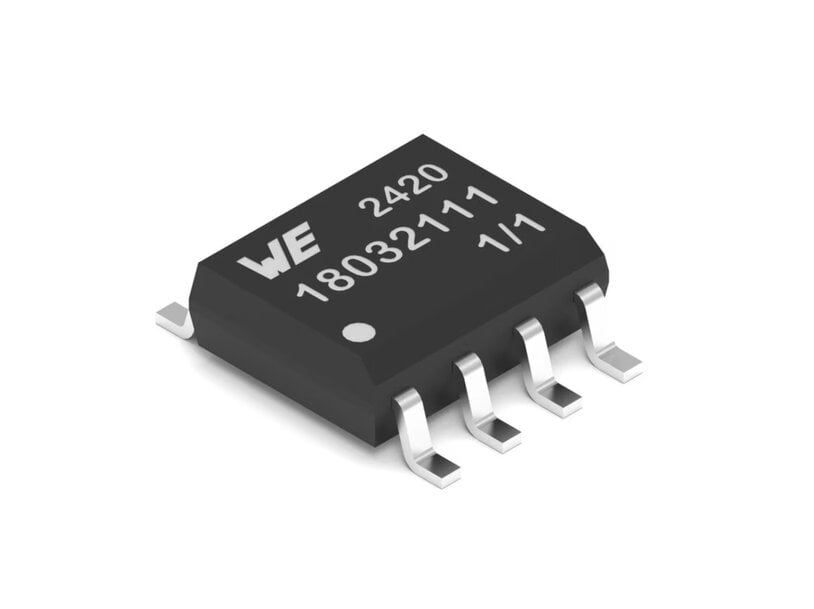
Würth Elektronik has expanded its digital isolator portfolio with new two-channel components designed for galvanic isolation in I²C communication interfaces. The WPME-CDI2C series supports bidirectional data transmission up to 2 MHz and targets applications in industrial automation, automotive electronics, IoT devices, and sensor-based systems where signal integrity and electrical isolation are critical.
The devices are introduced in an SOIC-8NB package compatible with commonly used I²C isolator footprints, enabling integration into existing hardware designs without major modifications.
Galvanic isolation for industrial and embedded communication interfaces
I²C is widely used for communication between integrated circuits in sensors, displays, battery management systems, monitoring equipment, and motor control applications. In these environments, galvanic isolation helps separate electrical domains to reduce interference, prevent data corruption, and protect sensitive components from voltage transients.
The WPME-CDI2C series supports bidirectional transmission required by I²C architectures while providing isolation between connected systems. Such isolation is increasingly important in industrial electronics and automotive systems where differing ground potentials or electromagnetic disturbances can affect signal reliability.
Electrical performance specifications for noise immunity and insulation
According to Würth Elektronik, the isolators support data transmission rates up to 2 MHz and provide an isolation voltage of up to 3750 VRMS, certified under UL 1577. The devices also meet requirements for basic insulation according to IEC 60747-17 (VDE 0884-17), a standard commonly used to evaluate semiconductor isolation performance.
The components feature common-mode transient immunity (CMTI) of ±150 kV/µs, indicating resistance to rapid voltage changes that can occur in high-power switching environments. Higher CMTI values are generally associated with improved signal stability in applications such as motor drives, industrial power electronics, and automotive control systems.
Interface configurations for embedded design flexibility
The isolators are available in two configurations: one with bidirectional serial data (SDA) and bidirectional serial clock (SCL) lines, and another combining a bidirectional SDA with a unidirectional SCL line. These options are intended to support different I²C implementation requirements across embedded system designs.
Compatibility with standard I²C isolator pin layouts may simplify replacement in existing circuits while reducing redesign requirements during component upgrades.
Additional Context
Technical specifications and competitive benchmarking not included in the original product announcement
Digital isolators for I²C communication compete with products from manufacturers including Analog Devices and Texas Instruments, where benchmark criteria typically include isolation voltage, data rate, CMTI performance and certification compliance. Comparable devices such as the Analog Devices ADuM1250 provide 2500 VRMS isolation with bidirectional I²C capability, while Texas Instruments ISO1640 supports up to 3000 VRMS isolation and I²C clock rates up to 1.7 MHz.
At 3750 VRMS isolation voltage and ±150 kV/µs CMTI, the Würth Elektronik WPME-CDI2C is positioned toward higher isolation and transient immunity levels among standard I²C digital isolators, while maintaining compatibility with common SOIC-8 packages used in embedded electronics.
Edited by Natania Lyngdoh, Induportals editor, assisted by AI.
www.we-online.com
