
www.ptreview.co.uk
17
'26
Written on Modified on
ABB Updates Distributed Control System for Modernization
New release introduces interoperable connectivity, virtualization support, and separated control architectures to improve lifecycle management across process and energy operations.
global.abb
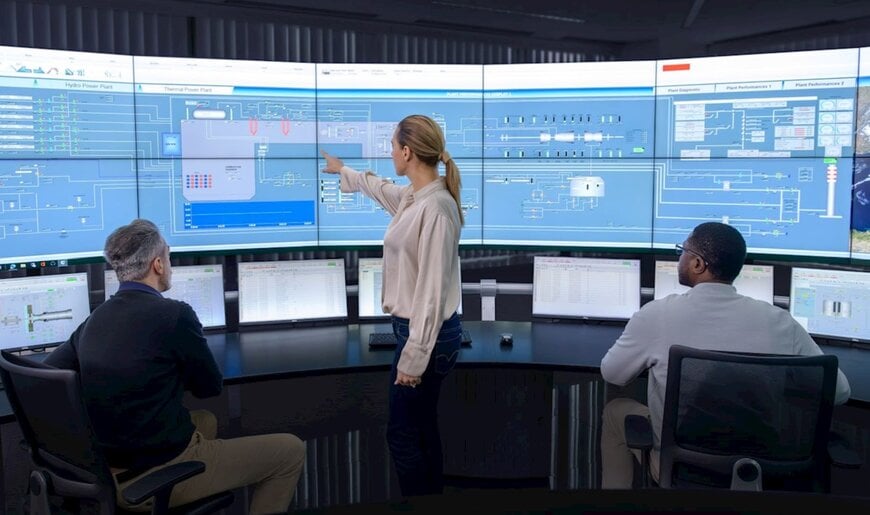
Industrial control systems in sectors such as energy, water, oil and gas, pharmaceuticals, and paper production are under pressure to modernize without disrupting ongoing operations. In this context, ABB has released SPR2025, an updated version of its Symphony® Plus distributed control system (DCS), designed to support incremental upgrades and integration of newer digital capabilities.
Bridging legacy systems with newer architectures
SPR2025 is structured to support both existing installations and new deployments. It enables migration from legacy platforms such as Harmony (INFI90) while maintaining operational continuity. Features such as online updates, automated conversion tools, and expanded operating system compatibility allow upgrades to be implemented without full system replacement.
The inclusion of virtualization support allows multiple operating systems to run within a unified environment, simplifying lifecycle management across IT and OT layers. This is particularly relevant for facilities transitioning toward hybrid architectures within a digital supply chain.
System-wide connectivity and data integration
The updated system introduces OPC UA connectivity across the entire control architecture, enabling standardized and secure communication between distributed components. Combined with an Ethernet-based backbone, this supports higher data throughput and more consistent integration of field devices.
Support for intelligent electronic devices (IEDs) enhances interoperability with modern instrumentation, allowing operators to connect and manage diverse assets within a unified system environment.
Separating control and digital layers
A central addition in SPR2025 is the Automation Extended functionality, which introduces a separation between core control functions and digital applications. This architecture allows advanced analytics, performance monitoring, and AI-based decision support tools to operate independently from the control layer.
By isolating these environments, the system maintains the reliability and determinism required for process control while enabling the integration of data-driven applications. This approach aligns with evolving industrial architectures where control stability and digital innovation must coexist.
Updates targeting lifecycle efficiency
Several system enhancements focus on reducing operational disruption and improving maintainability. Version synchronization and online updates provide a more predictable system-wide update process, minimizing engineering effort and downtime.
Compatibility with current Microsoft operating systems and virtualization platforms supports long-term maintainability. Enhanced device management through the Field Information Manager (FIM) improves commissioning, diagnostics, and maintenance of field instruments.
Expanded network connectivity, including additional virtual plant network interfaces, enables more flexible system configurations while reducing physical infrastructure requirements.
Supporting phased modernization strategies
The system supports a gradual transition from Harmony Rack systems to the SDe series, using automated tools to preserve existing engineering data and configurations. This reduces the need for full system redesign and protects prior investments.
By combining standardized communication, modular upgrades, and separation of control and digital functions, the updated platform provides a structured path for industrial operators to modernize control systems while maintaining operational continuity and system reliability.
Edited by Aishwarya Mambet, Induportals Editor, with AI assistance.
www.abb.com
