
www.ptreview.co.uk
24
'26
Written on Modified on
Centralized Control Systems for Integrated Industrial Environments
ABB’s Unification X provides a technical framework for consolidating disparate operational systems into a single interface to improve operator efficiency in industrial control rooms.
global.abb
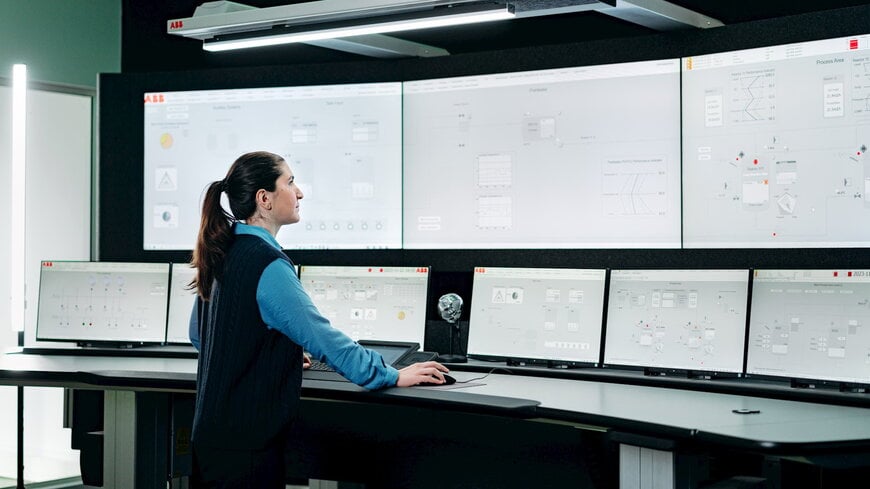
Industrial control rooms often require the management of fragmented hardware and software interfaces, which can lead to cognitive overload and delayed response times. Unification X serves as a technical integration layer for the digital supply chain of process information, allowing operators in sectors such as power generation, oil and gas, and manufacturing to manage multiple systems through a streamlined hardware and software configuration.
System Architecture and Space Optimization
The primary technical objective of Unification X is the reduction of hardware redundancy. In traditional configurations, operators often navigate multiple independent workstations, keyboards, and monitor arrays. This solution consolidates these inputs into a centralized setup, typically deployed on the Extended Operator Workplace (EOW) platform.
During comparative testing between traditional control room layouts and the Unification X architecture, ABB verified a reduction in the physical footprint of an operator configuration by 35%. This optimization is achieved through a design study process that aligns digital workflows with physical ergonomic requirements, ensuring that critical data remains within the operator's primary field of view without necessitating excessive movement.
Operational Flexibility and Integration
The technology allows for instantaneous switching between control setups, a feature critical for high-pressure scenarios such as emergency response or shift handovers. By streamlining disparate systems into a unified set of monitors and human-machine interfaces (HMIs), the system enables "workstation swapping." This capability allows operators to relocate to different physical desks while maintaining their specific digital environment, facilitating better coordination during night shifts or abnormal process conditions.
Beyond the process industries, the application of this automotive data ecosystem logic—where data flows seamlessly between different functional nodes—extends to utilities, infrastructure management, and emergency services.
Security and Network Infrastructure
To mitigate risks associated with increased connectivity, Unification X is built on a dedicated, isolated network architecture. This structure is designed to separate operational technology (OT) traffic from general corporate IT traffic, providing a layer of protection against external cyber threats. The networked architecture ensures that system performance, specifically latency in command execution, is not compromised by the security protocols required for modern industrial digitalization.
Sebastian Karlsson, General Manager of Control Room Solutions at ABB’s Energy Industries division, stated that the solution is designed to align control room integration with secure digitalization and operator-centric design principles. By utilizing a scalable framework, the system supports dual workstations and multi-desk configurations, allowing the infrastructure to adapt as plant requirements evolve.
Edited by Evgeny Churilov, Induportals Media - Adapted by AI.
www.abb.com
