
www.ptreview.co.uk
19
'26
Written on Modified on
OMRON camera detects cleanroom workers for safer automation
Edge-processed vision module distinguishes suited operators to support machine safety interlocks in semiconductor, pharmaceutical, and food production equipment.
industrial.omron.eu
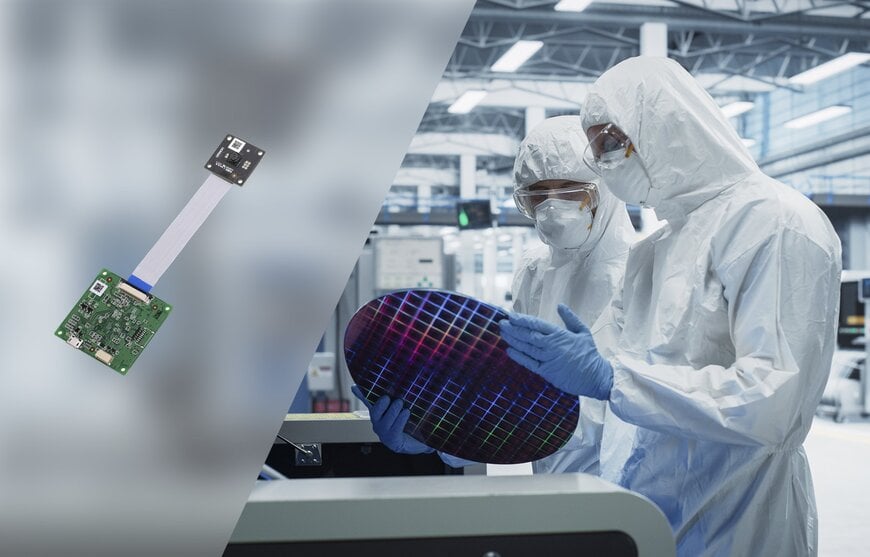
Industrial equipment operating near personnel in contamination-controlled environments must recognise humans despite bulky protective clothing that alters body shape. Addressing this detection gap, OMRON Electronic Components Europe introduced a safety camera module trained specifically for cleanroom operators.
Detecting people when geometry no longer looks human
Conventional pose-estimation vision systems rely on visible limb proportions. Cleanroom suits, however, obscure body contours and remove typical skeletal reference points, while alternatives such as thermal or ultrasonic sensing struggle with shielding materials and confined spaces.
The HVC-P2* B5T-007003 module integrates pre-trained AI models with embedded processing hardware to identify workers wearing protective garments. Training data included multiple postures — standing, sitting, crouching, and crawling — allowing detection during typical maintenance activities such as setup, refilling, servicing, and repair.
The module outputs a detection signal to the machine controller, enabling safety interlocks to switch equipment into a protective operating mode when a person is nearby. A raw image stream can optionally be accessed for supervisory verification.
Because processing occurs locally, the system operates as an edge-vision safety layer without requiring external computation or image transfer, supporting low-latency response and inherent data privacy in industrial automation environments.
Practical integration into machinery
The camera combines compact imaging hardware with dedicated firmware optimized for cleanroom PPE recognition. Machine builders and system integrators can deploy it as a pluggable component rather than training their own machine-vision models.
Two lens options adapt the detection zone:
- 50° field-of-view long-distance lens
- 90° wide-angle lens
Typical layouts include vertical mounting, upward viewing beneath equipment, or multi-camera oblique placement to avoid occlusion. A flexible printed circuit connects the camera head to the processing board, simplifying installation inside confined housings or retrofitted machinery.
Configuration occurs over USB using a supplied GUI, where detection modes and trigger thresholds can be set. The development kit includes drivers, command specifications, evaluation software, and sample code to accelerate integration into a factory control system.
Intended industrial use
The module targets safety monitoring in semiconductor fabrication tools, pharmaceutical processing lines, and food-handling equipment — environments where cleanroom clothing is mandatory and reliable human detection is required for automated operation. By generating deterministic presence signals rather than general image analytics, it functions as a dedicated sensing component within a broader digital supply chain of automated production systems.
*Human Vision Components
www.omron.com
Configuration occurs over USB using a supplied GUI, where detection modes and trigger thresholds can be set. The development kit includes drivers, command specifications, evaluation software, and sample code to accelerate integration into a factory control system.
Intended industrial use
The module targets safety monitoring in semiconductor fabrication tools, pharmaceutical processing lines, and food-handling equipment — environments where cleanroom clothing is mandatory and reliable human detection is required for automated operation. By generating deterministic presence signals rather than general image analytics, it functions as a dedicated sensing component within a broader digital supply chain of automated production systems.
*Human Vision Components
www.omron.com
