
www.ptreview.co.uk
30
'26
Written on Modified on
120 MHz Microcontrollers for Industrial Automation and System Control
Toshiba has initiated series production of new microcontrollers utilizing Arm Cortex-M4 processors to manage complex control logic in factory and consumer equipment.
www.global.toshiba
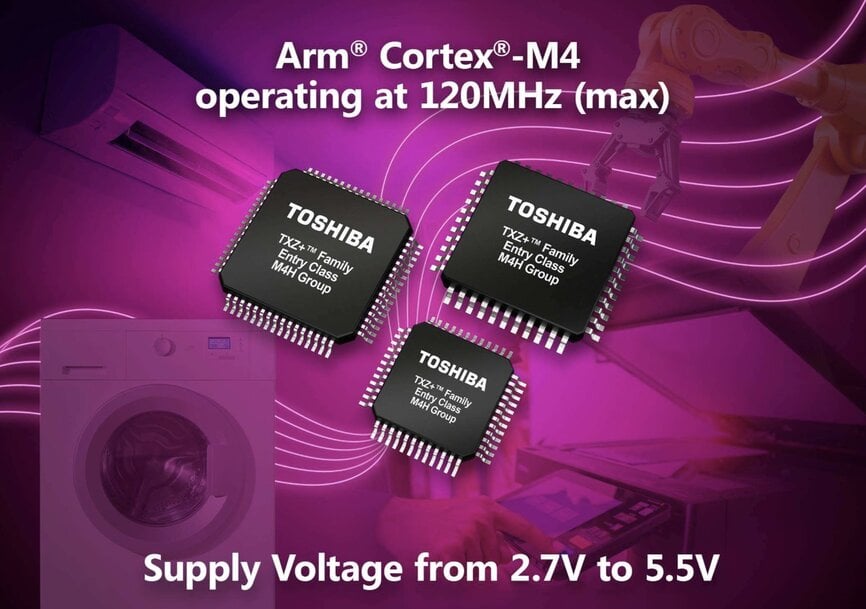
Toshiba Electronics Europe has released the M4H group of microcontrollers, including the TMPM4H4FYUG, TMPM4H2FYDUG, and TMPM4H1FYUG, to support system control functions such as interface processing and timing management. These components are designed to manage electromechanical processes within industrial automation infrastructure and consumer appliance manufacturing.
Processor Architecture and Power Specifications
The microcontrollers integrate an Arm Cortex-M4 core equipped with a floating-point processing unit (FPU) and a memory protection unit (MPU). Operating at clock frequencies up to 120 MHz, the hardware supports 256 kilobytes of program flash memory alongside 18 kilobytes of parity-checked RAM. Designed to accommodate 5-volt powered equipment, the units operate within a supply voltage range of 2.7 V to 5.5 V. An integrated 10 MHz high-speed oscillator provides ±1% accuracy, allowing hardware engineers to reduce the number of external components required on the printed circuit board while maintaining design flexibility.
Peripheral Integration and Motor Control
To facilitate communication and sensor integration within industrial networks, the architecture includes a 12-bit analog-to-digital converter (ADC), standard timers, and direct memory access (DMA). The communication interfaces consist of a universal asynchronous receiver-transmitter (UART), a serial peripheral interface (SPI), and an integrated circuit interface (I2C). For electromechanical applications such as multifunction printers, factory robotics, air conditioners, and washing machines, the chips feature an advanced programmable motor driver (A-PMD) specifically configured to control brushless DC motors. Additionally, built-in self-diagnostic functions ensure compliance with functional safety requirements in continuous-operation environments.
Hardware Packaging and Ecosystem Support
The microcontroller series offers three Low-profile Quad Flat Package (LQFP) options to accommodate varying input/output constraints, physical space limitations, and assembly requirements. The configurations include a 64-pin package (10 mm × 10 mm, 0.5 mm pitch), a 48-pin package (7 mm × 7 mm, 0.5 mm pitch), and a 44-pin package (10 mm × 10 mm, 0.8 mm pitch). To support system evaluation and software integration, the hardware is supplied with product documentation, sample software, and Common Microcontroller Software Interface Standard (CMSIS) compliant drivers. Evaluation boards and development environments are progressively distributed in coordination with Arm ecosystem partners to support the transition from prototype evaluation to mass production.
Additional Context
This section details technical specifications and competitive benchmarking not included in the original news release.
In the embedded systems market, the integration of 5-volt supply capabilities within 32-bit Arm Cortex-M4 architectures is specifically targeted at environments with high electromagnetic interference, such as industrial motor drives and major home appliances. The Toshiba M4H series competes directly with other 5-volt tolerant, motor-control-focused microcontrollers, such as the NXP Kinetis KE1xF series and the Renesas RA4T1 group.
Benchmarking in this hardware category focuses on maximum clock frequency, the resolution of integrated analog-to-digital converters (ADCs), and hardware-accelerated motor control algorithms. While some competitors, such as the STMicroelectronics STM32G4 series, operate at higher frequencies (up to 170 MHz) and offer 16-bit ADCs, the Toshiba M4H balances its 120 MHz processing speed with the Advanced Programmable Motor Driver (A-PMD). This specialized peripheral hardware offloads brushless DC (BLDC) motor commutation tasks from the central processor. Furthermore, standard benchmarking for these devices requires compliance with IEC 60730 Class B safety standards, evaluating the efficacy of integrated memory parity checks and self-diagnostic routines necessary to prevent critical failures in automated machinery.
Edited by Aishwarya Mambet, Induportals Editor, with AI assistance.
www.toshiba.semicon-storage.com
