
www.ptreview.co.uk
23
'26
Written on Modified on
Industrial Software Platform for Megawatt AI Data Center Simulation
AVEVA introduces an integrated digital twin infrastructure utilizing virtual environments to optimize power, cooling, and workload efficiency in hyperscale computing facilities.
www.aveva.com
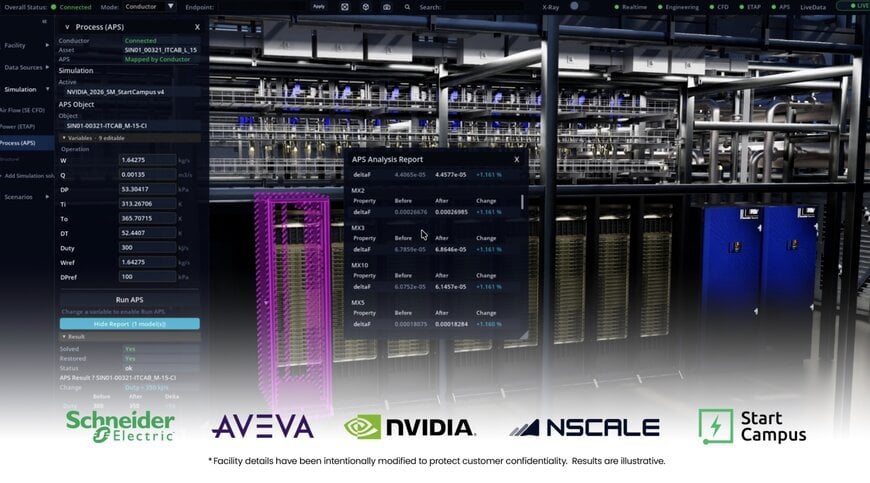
AVEVA is deploying an end-to-end digital twin simulation project, developed alongside Schneider Electric, Nscale, and Start Campus, to model and optimize physical AI infrastructure operations. Built on the NVIDIA Omniverse DSX Blueprint, the Immersive Twin platform integrates power, cooling, and electrical models with AI workload requirements to accelerate deployment within high-density data center ecosystems.
Hyperscale Facility Implementation and Scale
The simulation technology is implemented at Nscale's operations within the SIN01 data center, located at the 1.2-gigawatt SINES Data Campus in Portugal. Developed by Start Campus, the facility is designed to support high-capacity AI processing and will host over 66,000 NVIDIA Rubin graphics processing units (GPUs). By creating a unified digital model of a deployment this size, operators can assess the thermal and electrical impact of high-density computing clusters before executing physical hardware installations.
Operational Data Integration and Simulation Mechanics
The digital twin infrastructure leverages the OpenUSD framework to connect asset data across platforms from AVEVA, ETAP, Schneider Electric, and third-party vendors. The system ingests engineering and operational data to generate simulations covering process behavior, electrical distribution, and liquid cooling loops. This capability allows facilities to run exact scenarios for hardware configurations—such as modeling how an increase in rack power density affects the broader power chain—reducing procurement risks and minimizing physical infrastructure modifications.
Workload Efficiency and Lifecycle Management
For AI cloud platforms like Nscale, aligning physical infrastructure performance with compute requirements directly impacts token generation efficiency. AVEVA’s software suite, including CONNECT, the PI System, Unified Engineering, and Asset Information Management, provides continuous visibility into asset performance. By visualizing these metrics through NVIDIA Omniverse applications, operators manage the entire lifecycle of an AI factory, transitioning from initial facility design to continuous operational optimization based on active thermal and electrical loads.
Additional Context
This section details technical specifications and competitive benchmarking not included in the original news release.
Within the data center infrastructure management (DCIM) and physics-based industrial simulation sector, AVEVA's software portfolio competes with solutions such as Siemens Xcelerator and Bentley Systems' iTwin framework. Siemens utilizes its Tecnomatix and Simcenter platforms to provide computational fluid dynamics (CFD) and thermal modeling for high-density facilities. Bentley's iTwin focuses heavily on structural and lifecycle asset management but often relies on third-party integrations for deep electrical transient analysis.
A primary competitive differentiator for the AVEVA software ecosystem, working in conjunction with Schneider Electric hardware, is the native integration with the NVIDIA Omniverse DSX Blueprint. This architecture provides GPU-accelerated 3D visualization and simulation based on the OpenUSD standard, enabling the synchronous modeling of both physical cooling loops and specific IT workload outputs, such as AI token processing efficiency, which traditional DCIM platforms typically track as separate data silos.
Edited by Aishwarya Mambet, Induportals Editor, with AI assistance.
www.aveva.com
