
www.ptreview.co.uk
23
'26
Written on Modified on
SKF launches CeraDrive hybrid ceramic bearings for electric motors
New hybrid ceramic bearing design helps improve reliability, extend grease life, and support energy-efficient VFD-driven motor operation.
www.skf.com
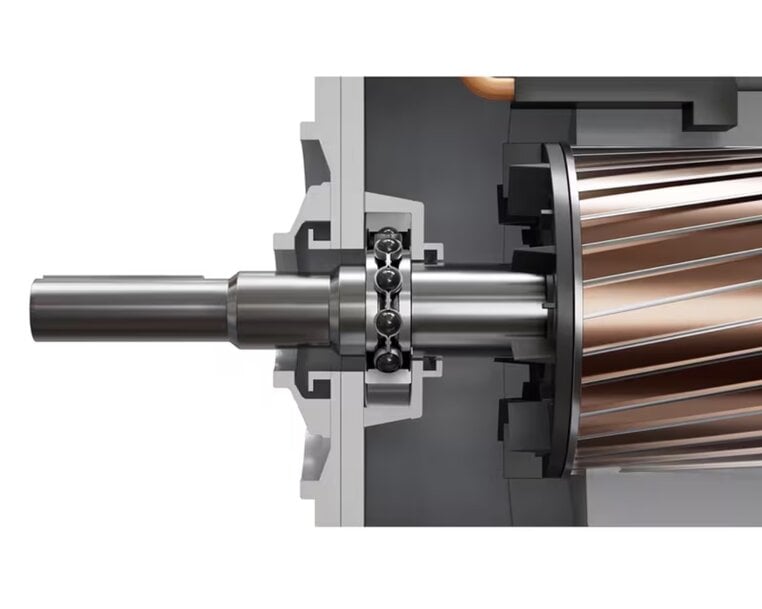
Industrial electric motors operate under increasingly severe electrical and thermal environments, driven by the broad adoption of variable frequency drives (VFDs). High-frequency switching inside pulse-width modulation inverters induces parasitic common-mode voltages along motor shafts, triggering capacitive discharge currents through traditional bearing assemblies. These electrical discharges produce localized micro-cratering, fluting patterns, and severe lubricant degradation, representing a leading mechanism of premature motor failure. Simultaneously, high rotational speeds, elevated operating temperatures, and contaminated operational conditions accelerate grease degradation and mechanical surface wear. Mitigating these combined electrical and tribological failure modes requires bearing geometries that combine galvanic isolation with advanced wear resistance, while maintaining standard form factors for drop-in retrofit.
Hybrid Ceramic Design and Electrical Erosion Protection
To address premature bearing degradation, SKF announced the launch of SKF CeraDrive, an engineered hybrid ceramic bearing solution targeted specifically at industrial electric motors and alternators. The product line integrates electrically insulating ceramic rolling elements housed within high-performance steel rings.
Because ceramic rolling elements are non-conductive, the architecture eliminates the risk of electrical erosion, preventing bearing fluting and premature raceway damage in inverter-fed motor applications. Furthermore, the internal geometry incorporates smaller, lighter ceramic balls designed to minimize rotational mass and inertia while maintaining external envelope dimensions compliant with standard industrial electric motor end-bell housings. This drop-in standardization allows motor original equipment manufacturers (OEMs) and maintenance teams to deploy hybrid ceramic technology into existing motor platforms without requiring mechanical redesigns or custom machining.
Tribological Gains and Predictive Life Modeling
Beyond electrical isolation, the non-metallic ceramic elements interact with the steel raceways to deliver significant tribological advantages over conventional all-steel bearings. SKF CeraDrive provides up to eight times longer grease service life, higher rotational speed capabilities, and reduced frictional torque, resulting in lower internal operating temperatures and reduced parasitic energy losses.
Alexis Greffet, Business Engineer for Hybrid and Machinery Specials at SKF, noted that while hybrid ceramic bearings have historically been viewed as specialized solutions reserved for niche applications, CeraDrive is engineered to broaden accessibility across general industrial motor platforms. To support application engineering, bearing behavior is mapped using the SKF Generalized Bearing Life Model (GBLM), enabling engineers to calculate surface and subsurface stress distributions and predict bearing service life under real-world operating environments.
Additional Context
This section details technical specifications and competitive benchmarking not included in the original product announcement.
In alternating current variable frequency drive operations, rapid insulated-gate bipolar transistor switching produces high rates of voltage change over time that discharge through the motor bearings as electrical discharge machining currents. In conventional all-steel bearings, such as standard ISO 6200 and 6300 series deep groove ball bearings, these currents pit raceway surfaces and break down the dielectric properties of grease, requiring secondary mitigation such as conductive shaft grounding rings or externally insulated end-shields. Hybrid bearings employ silicon nitride ceramic rolling elements, which possess an electrical resistivity exceeding one hundred trillion ohm-meters, completely halting current flow through the bearing contacts up to thousands of volts without adding external mechanical grounding brushes. Silicon nitride is also 40 percent less dense than bearing steel and exhibits a lower coefficient of thermal expansion, mitigating centrifugal ball loading and skidding under low-load, high-speed transitions.
Within the industrial electric motor component market, SKF CeraDrive benchmarks against insulated and hybrid solutions from Schaeffler, NSK, and Timken. While ceramic-coated steel rings, such as alumina oxide coated outer rings, provide electrical protection up to one to three kilovolts direct current, coatings remain vulnerable to mechanical chipping during press-fit installation and do not alter the internal tribological pair. By utilizing solid silicon nitride rolling elements running against hardened steel raceways, hybrid ceramic bearings prevent micro-welding adhesion under marginal lubrication conditions, maintaining hydrodynamic film integrity and allowing relubrication intervals to be extended across food processing, paper mills, mining, and heavy manufacturing installations.
Edited by Romila DSilva, Induportals Editor, with AI assistance.
www.skf.com
