
www.ptreview.co.uk
14
'26
Written on Modified on
Linear Direct Drive Axis Automation Systems
SCHUNK expands its SLD linear direct drive portfolio with the SLD Mini and SLD Midi to resolve cycle time bottlenecks in high-throughput assembly.
schunk.com
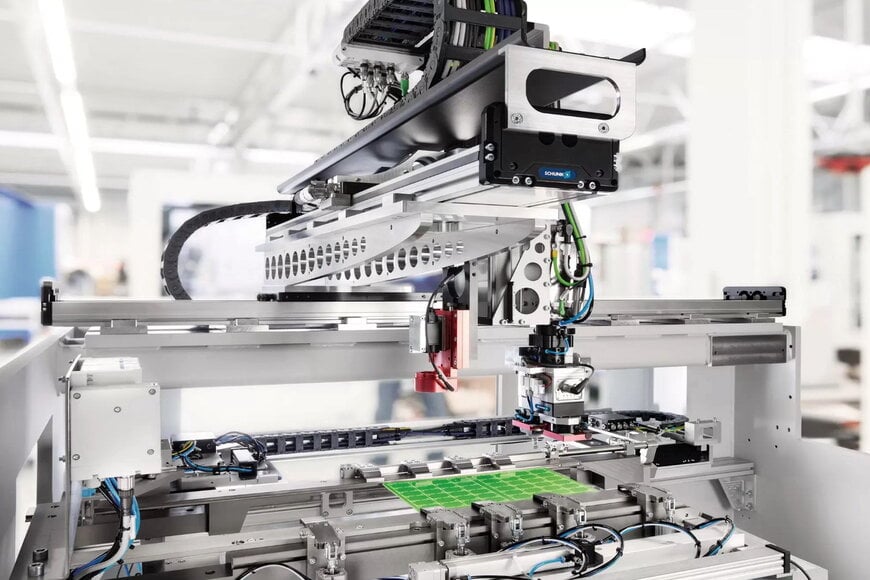
Modern high-speed assembly and handling operations frequently face throughput limitations caused by mechanical backlash, belt elasticity, and oversized drive envelopes in traditional belt-driven or ball-screw linear units. In sectors such as electronics manufacturing, battery assembly for electric mobility, and medical device fabrication, production engineers require dynamic motion systems that combine high acceleration with minimal installation volume to optimize footprint efficiency. SCHUNK addresses these operational constraints by extending its linear direct drive range with the SLD Mini and SLD Midi series.
Engineering Architecture and Dynamic Performance
The SLD Mini and SLD Midi axes integrate both the direct drive motor and the optical/magnetic path-measuring system directly into the mechanical axis profile. By eliminating intermediate transmission elements such as gearboxes, couplings, and timing belts, the direct drive architecture eliminates mechanical backlash and reduces positioning hysteresis. This integrated layout eliminates external interfering contours, allowing engineers to nest axes closely within constrained machine frames.
Dynamic capabilities include accelerations reaching up to 100 m/s² and linear transit velocities up to 5 m/s. These dynamics substantially reduce point-to-point transit times in pick-and-place routines. SCHUNK manufactures the axes across multiple frame sizes and winding configurations, allowing machine builders to select motor characteristics based on moving mass, thermal duty cycle, and mechanical envelope requirements.
Integration into Multi-Axis Handling Workflows
Linear direct axes serve as structural and kinematic baselines for both single-axis transfers and coordinated multi-axis Cartesian gantries. Within an automated cell, the axes interface directly with end-of-arm tooling, rotary actuators, and process instrumentation. In precision electronics assembly, for example, the axes manage primary component transport while electric parallel grippers execute part placement and force-torque sensor modules monitor insertion loads to prevent component fracturing.
To streamline the commissioning of complex pick-and-place tasks involving unsorted parts, the hardware connects with upstream vision modules such as the AI-assisted 2D Grasping Kit. Dimensional planning and kinematic verification occur prior to mechanical assembly via digital configuration tools and application-specific axis finders, ensuring thermal and mechanical loads remain within rated operating envelopes.
Additional Context
This section details technical specifications and competitive benchmarking not included in the original product announcement.
Direct drive linear axes operate on the principle of permanent-magnet synchronous linear motors (PMSLM), where the stationary magnetic track serves as the secondary part and the moving coil carriage serves as the primary part. In precision industrial automation, linear direct drives compete directly with high-lead ground ball screws and high-end pneumatic rodless cylinders. While precision ball screws deliver high thrust force density at lower procurement costs, their linear velocities are mechanically bounded by critical screw speed (whipping) and lead limitations, typically capping speeds below 1.5 to 2 m/s over extended strokes.
Comparable dynamic direct drive modules in the European industrial market include the Festo ELGD-DIS series, the LinMot linear motor guides, and the HIWIN LMC ironcore linear motor stages. Festo and LinMot solutions similarly target rapid light-to-medium parts handling, commonly offering maximum accelerations between 50 and 100 m/s² and velocities ranging from 3 to 5 m/s. Direct drive systems rely on linear encoders featuring sub-micrometer resolution (frequently via digital interfaces like BiSS-C or DRIVE-CLiQ) to achieve high bidirectional repeatability, typically within ±0.005 mm to ±0.001 mm. The trade-off for direct drive integration remains thermal management: continuous operation at high duty cycles requires adequate heat dissipation through the machine base to prevent thermal expansion from degrading positional accuracy.
Edited by Evgeny Churilov, Induportals Media - Adapted by AI.
www.schunk.com
