
www.ptreview.co.uk
14
'26
Written on Modified on
Real-Time Localization and 3D Vision Software for Autonomous Navigation
SIGMATEK introduces enhanced sensor fusion algorithms and volumetric obstacle detection to improve the navigation accuracy of autonomous mobile robots.
www.sigmatek-automation.com
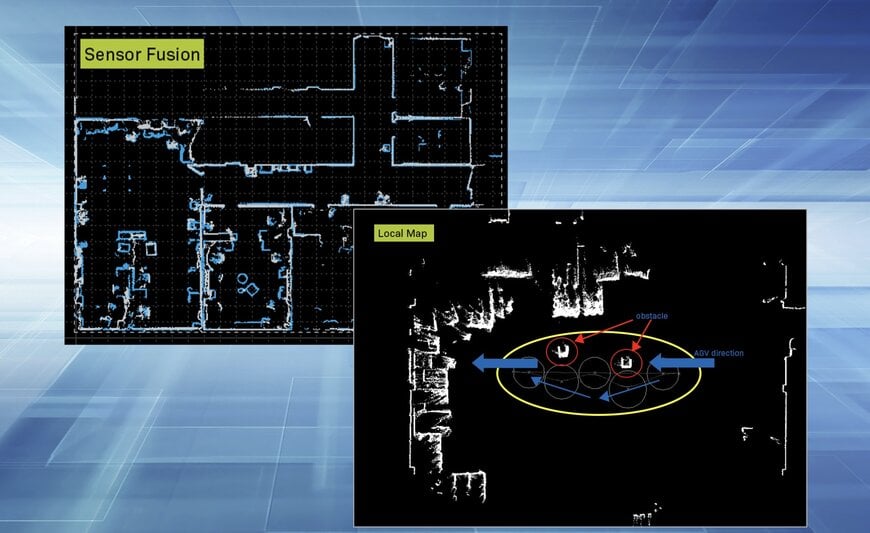
SIGMATEK has released updates to its SLAMLoc software and introduced the AGV Automation Visionary 3D platform to enhance routing and obstacle detection for automated guided vehicles (AGVs) and autonomous mobile robots (AMRs). These technologies address the navigation requirements of dynamic intralogistics and industrial automation environments, where temporary obstacles and strict safety protocols challenge automated transport processes.
Sensor Fusion and Dynamic Detour Calculation
The SLAMLoc software utilizes Simultaneous Localization and Mapping (SLAM) to process data from multiple laser scanners installed on a vehicle. By fusing these inputs into a shared coordinate system, the software generates a comprehensive map of the surrounding environment. To handle temporary obstacles, the system generates a local map, referred to as a MiniMap, which captures the immediate physical space around the vehicle in real time. This data allows the routing algorithm to calculate immediate detours, reducing operational downtime when unexpected objects block the planned trajectory.
Offline Diagnostics and System Troubleshooting
To accelerate commissioning and maintenance, the localization software includes a detailed troubleshooting module that operates without requiring physical access to the vehicle. Engineers can analyze specific operational scenarios offline to determine why an automated transport unit stopped, deviated from its path, or experienced a navigation interruption. This diagnostic capability reduces service times and supports the continuous optimization of automated routing in manufacturing facilities.
Three-Dimensional Obstacle Detection
Relying solely on two-dimensional laser scanners limits a vehicle's ability to detect complex geometric hazards. To address this, the AGV Automation Visionary 3D software integrates with one or two Visionary-T Mini cameras from SICK. This hardware-software combination enables volumetric monitoring of the vehicle’s route. The 3D detection system identifies physical anomalies that exist above or below the 2D scanning plane, such as overhanging forklift tines, staircases, drop-offs into empty elevator shafts, and low-profile objects on the factory floor. The company showcased these combined safety and navigation capabilities at the SPS smart production solutions trade show in Nuremberg, Germany (24 to 26 November, 2026, Hall 7, Stand 270).
Additional Context
This section details technical specifications and competitive benchmarking not included in the original news release.
In the industrial automation market, SLAM-based navigation architectures compete with established natural feature navigation platforms like BlueBotics ANT and open-source implementations utilizing the ROS 2 (Robot Operating System) navigation stack. While open-source ROS 2 setups require extensive custom programming for sensor fusion and local costmap generation, proprietary solutions like SLAMLoc provide pre-validated algorithms for multi-scanner fusion and dynamic rerouting.
Furthermore, standard 2D planar LiDAR systems are fundamentally blind to negative obstacles (drop-offs) and overhanging structures. By integrating SICK’s time-of-flight (ToF) 3D cameras directly into the navigation logic, the system provides higher point cloud density at close ranges compared to standard 2D scanners. This hardware integration directly addresses a known vulnerability in conventional AGV obstacle detection, providing measurable improvements to process stability in dense operational environments.
Edited by Aishwarya Mambet, Induportals Editor, with AI assistance.
www.sigmatek-automation.com
