
www.ptreview.co.uk
12
'26
Written on Modified on
Automated Optical Inspection AI Eliminates False Rejection Bottlenecks
TDK SensEI introduced edgeRX VISION, an edge AI visual inspection system designed to eliminate false rejects without replacing existing manufacturing cameras.
www.tdk.com
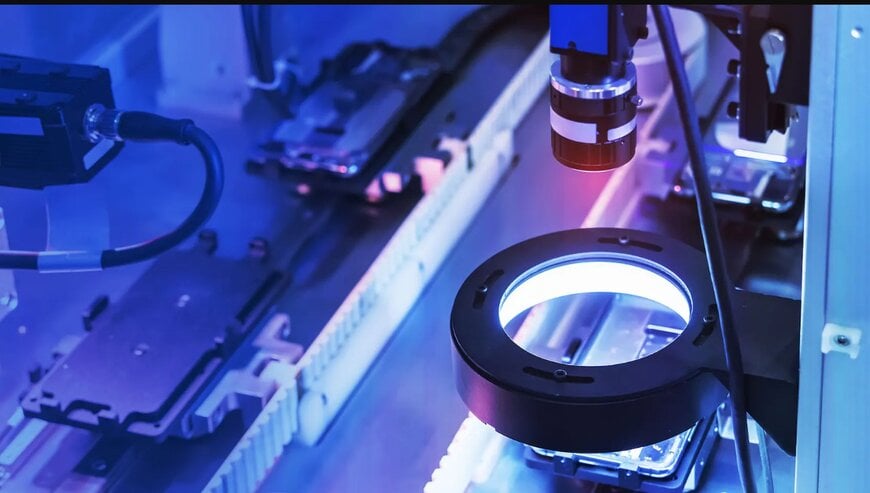
High-throughput industrial manufacturing requires continuous visual quality control to detect surface defects, component deformation, and particulate contamination before products advance downstream. The integration of automated optical inspection powered by edge computing addresses the operational bottleneck where traditional rule-based machine vision halts assembly lines due to benign anomalies such as minor mechanical misalignments or transient surface dust.
Resolving the Rule-Based Inspection Tradeoff in High-Speed Production
Production environments in electronics, machinery, food processing, and pharmaceuticals face severe operational challenges when balancing defect detection rates against machine downtime. In standard automated optical inspection setups, cameras compare captured image frames against strict, predefined pixel thresholds. If inspection criteria are set too strict to prevent defective items from reaching downstream assembly, the rate of false positives rises sharply, causing line stoppages for acceptable parts. Conversely, relaxing criteria to maintain throughput increases the risk of product escapes.
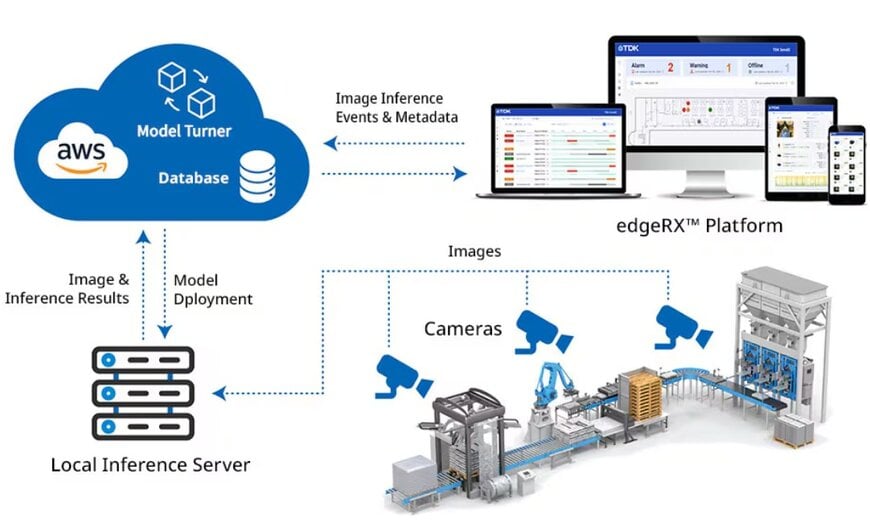
TDK SensEI addresses this operational tradeoff by deploying edgeRX VISION directly into operational lines as an analytical retrofit. Instead of requiring rip-and-replace infrastructure investments, the software interfaces with installed factory cameras, illumination modules, and line-side software stacks.
Operating Mechanism and Edge Computing Architecture
The architecture relies on machine learning models trained on production image datasets containing verified variations of both standard and defective parts. Rather than evaluating absolute pixel deviations, edgeRX VISION extracts semantic visual features to differentiate genuine mechanical flaws—such as scratches, chips, and structural deformation—from harmless conditions like dust specks or minor part positioning shifts.
To satisfy low-latency production requirements, all image processing occurs directly on line-side edge computing hardware without cloud dependencies. The system processes up to 2,000 parts per minute, allowing continuous in-line analysis on fast automated tracks without inducing cycle-time lag. The underlying model resolution evaluates miniature discrete items down to 1 mm by 0.5 mm in dimension.
To accelerate model deployment and maintenance, TDK SensEI uses large language models within internal engineering pipelines to structure raw data collection and automate image-labeling tasks, shortening training periods for factory-specific defect catalogs.
Integration Across Industrial Quality Workflows
The edgeRX VISION deployment workflow operates as an image analysis layer within the broader edgeRX operational technology platform, complementing the edgeRX PRO sensor hardware module released in August 2026.
By functioning at line side, the system captures structured inspection telemetry for root-cause quality analytics. Tracking defect rates against operational timestamps, machine serials, and raw material lot numbers enables plant engineers to correlate flaw spikes with tooling wear or batch variances, shifting plant quality management from passive defect filtering to proactive process stabilization.
According to Sandeep Pandya, CEO of TDK SensEI, the engineering strategy focuses on expanding line integration: "Going forward, we plan to expand the platform's capabilities through enhanced analytics, greater automation, and deeper integration with manufacturing environments, helping our customers extract even more value from their visual inspection data."
Additional Context
This section details technical specifications and competitive benchmarking not included in the original product announcement.
Traditional machine vision architectures typically rely on localized rule algorithms running on PC-based frame grabbers, using tools like normalized cross-correlation or morphological edge filtering. These deterministic systems struggle with optical variance, leading manufacturing plants to adopt deep learning defect detection architectures based on convolutional neural networks (CNNs) and vision transformers (ViTs).
Benchmark industrial AI vision platforms, such as Cognex VisionPro Deep Learning and Keyence IV/VS-series AI sensors, address similar inspection challenges. Where standard industrial smart cameras often top out at 500 to 1,200 parts per minute depending on lighting exposure and inference network depth, edgeRX VISION's target throughput of 2,000 parts per minute positions the system for ultra-high-speed electronic assembly and packaging automation lines.
Edited by Evgeny Churilov, Induportals Media - Adapted by AI.
www.tdk.com
