
www.ptreview.co.uk
01
'26
Written on Modified on
Agentic AI Assistant for Embedded System & FPGA Design
AMD introduces AMD Ross to automate hardware partitioning, timing closure, and debugging across complex embedded system workflows.
www.amd.com

Modern embedded engineering teams face compounding integration friction as system designs require concurrent execution across heterogeneous silicon architectures, board layout, high-level synthesis, and edge inference deployment. To unify these disjointed engineering domains and shorten prototyping schedules, AMD has introduced AMD Ross, an agentic AI assistant engineered to operate directly across the embedded tool chain and automate repeatable hardware-software co-design tasks.
Engineering Challenges in Heterogeneous Embedded Development
Embedded system architectures increasingly combine field-programmable gate arrays, adaptive system-on-chips, x86 host compute, and dedicated neural processing units. Managing these multi-domain platforms forces engineering organizations to navigate separate software toolchains, specialized command-line interfaces, and disparate diagnostic workflows.
Engineers frequently lose development cycles to manual tool configuration, constraint syntax verification, and repetitive iterative debugging. For instance, resolving static timing violations or restructuring C++ code with pragma directives in high-level synthesis requires deep, institutional hardware knowledge. When expertise is siloed, junior engineers face steep learning curves, while senior architects remain bottlenecked by routine bring-up issues and physical layer verification.
Agentic Architecture and Tool Integration Mechanics
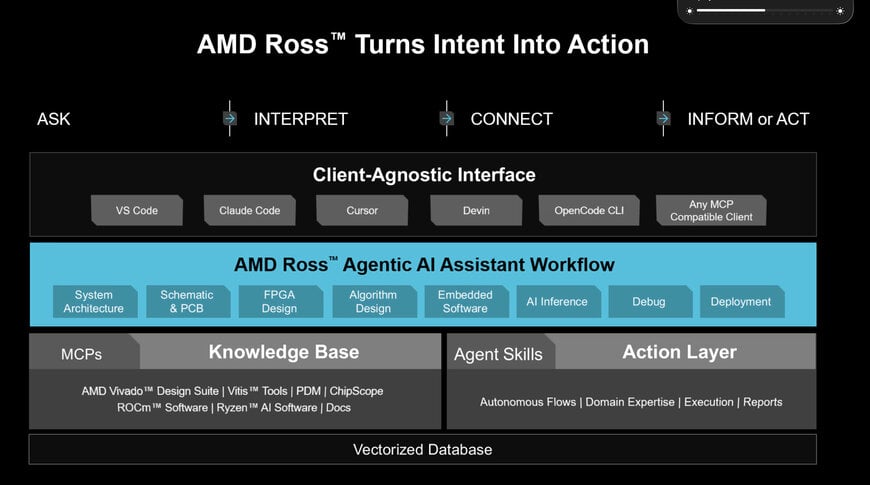
AMD Ross functions as an operational layer connecting natural-language intent with execution-level embedded design automation tools. Rather than operating as an isolated text generator, the assistant executes structured workflows through four foundational engineering components:
- Model Context Protocol Servers: Using open-standard Model Context Protocol architecture, the assistant establishes bidirectional communication channels with local AMD design environments. These servers allow agents to inspect live tool states, execute command sequences, query utilization metrics, and retrieve synthesis reports directly from active sessions without requiring manual syntax entry.
- Vectorized Technical Knowledge Base: The assistant integrates AMD-validated vector databases comprising product documentation, schematic design guides, application notes, user manuals, and historical answer records. Using retrieval-augmented generation, the system grounds its recommendations in verified hardware documentation, operating either through cloud infrastructure or within air-gapped, offline engineering networks.
- Structured Agent Skills: Reusable engineering practices are formalized as open, Markdown-based skill specifications. These modular files encode systematic procedures for specific design tasks, providing large language models with the deterministic steps needed to parse error logs, apply pipeline optimizations, and perform root-cause timing analyses.
- Reference Design Examples: Tested, ready-to-run implementation examples demonstrate the application of automated workflows against functional embedded use cases, providing baseline configurations for production validation.
The platform is client-agnostic, enabling engineering teams to pair it with preferred large language models, development containers, command-line interfaces, and modern integrated development environments.
Cross-Domain Tool Automation and Use Cases
AMD Ross interfaces across primary embedded development suites, including Vivado Design Suite, ChipScope logic analysis, Power Design Manager, Vitis unified software platform, Vitis High-Level Synthesis, Vitis AI, ROCm, and Ryzen AI software.
During the architectural phase, the assistant supports hardware and software partitioning decisions by evaluating compute intensity against resource footprints. In digital logic implementation, the system analyzes Vitis High-Level Synthesis algorithms, recommending specific loop unrolling factors, array partitioning parameters, and latency pipelining pragmas to maximize throughput while minimizing look-up table utilization.
For physical implementation, the assistant automates timing closure routines. It classifies timing path violations, identifies routing congestion or setup-and-hold discrepancies, and suggests specific floorplanning or constraint adjustments. At the board level, it assists with schematic validation and power estimation to ensure compliance with thermal envelopes before fabrication.
In post-synthesis verification and lab bring-up, the agent assists engineers with internal logic analyzer configurations by setting up debug cores, defining trigger conditions, and interpreting captured bus traffic.
Industrial Implementation and Diagnostic Feedback
Early field evaluations highlight the platform's role in accelerating board-level bring-up and verification cycles. Geetha Govindaraj, associate director of the FPGA System on Module Business Unit at iWave Global, reported that the integration of the assistant into their development workflow reduced the duration and engineering effort required during the hardware bring-up and troubleshooting phases.
Additional Context:
This section details technical specifications and competitive benchmarking not included in the original product announcement.
The deployment of generative and agentic artificial intelligence within electronic design automation represents a major shift in semiconductor and embedded systems workflows. Historically, design tools relied on static rule checkers, proprietary scripting languages like Tcl, and deterministic optimization algorithms.
In the broader electronic design automation landscape, primary competitors have taken varying architectural approaches to artificial intelligence:
Synopsys provides Synopsys.ai, which incorporates generative AI across the digital design flow via Synopsys Copilot, targeting RTL generation, formal verification, and automated test pattern generation. Synopsys primarily relies on proprietary, tool-native interfaces integrated deeply into ASIC-centric physical implementation suites like IC Compiler II.
Cadence Design Systems deploys the Cadence JedAI platform alongside Cerebrus Intelligent Chip Explorer and ChipStack. These solutions apply reinforcement learning and specialized LLMs to optimize multi-run floorplanning, clock-tree synthesis, and analog placement across silicon-proven process design kits.
Unlike monolithic, proprietary AI stacks common in ASIC workflows, AMD Ross is distinct in its utilization of the open-standard Model Context Protocol to bridge local design environments with arbitrary external AI foundation models. This decoupled structure allows embedded systems developers to run local, privacy-compliant language models on secure workstations or on-premises servers without exporting sensitive register-transfer level source code or proprietary intellectual property to third-party public clouds.
Furthermore, while general-purpose programming copilots specialize in standard software languages such as Python or C, they lack hardware spatial awareness, propagation delay models, and understanding of FPGA routing fabrics. AMD Ross addresses this specific gap by grounding LLM execution within deterministic electronic design automation APIs and targeted hardware constraint environments.
Edited by Natania Lyngdoh, Induportals editor, with AI assistance.
www.amd.com
Cross-Domain Tool Automation and Use Cases
AMD Ross interfaces across primary embedded development suites, including Vivado Design Suite, ChipScope logic analysis, Power Design Manager, Vitis unified software platform, Vitis High-Level Synthesis, Vitis AI, ROCm, and Ryzen AI software.
During the architectural phase, the assistant supports hardware and software partitioning decisions by evaluating compute intensity against resource footprints. In digital logic implementation, the system analyzes Vitis High-Level Synthesis algorithms, recommending specific loop unrolling factors, array partitioning parameters, and latency pipelining pragmas to maximize throughput while minimizing look-up table utilization.
For physical implementation, the assistant automates timing closure routines. It classifies timing path violations, identifies routing congestion or setup-and-hold discrepancies, and suggests specific floorplanning or constraint adjustments. At the board level, it assists with schematic validation and power estimation to ensure compliance with thermal envelopes before fabrication.
In post-synthesis verification and lab bring-up, the agent assists engineers with internal logic analyzer configurations by setting up debug cores, defining trigger conditions, and interpreting captured bus traffic.
Industrial Implementation and Diagnostic Feedback
Early field evaluations highlight the platform's role in accelerating board-level bring-up and verification cycles. Geetha Govindaraj, associate director of the FPGA System on Module Business Unit at iWave Global, reported that the integration of the assistant into their development workflow reduced the duration and engineering effort required during the hardware bring-up and troubleshooting phases.
Additional Context:
This section details technical specifications and competitive benchmarking not included in the original product announcement.
The deployment of generative and agentic artificial intelligence within electronic design automation represents a major shift in semiconductor and embedded systems workflows. Historically, design tools relied on static rule checkers, proprietary scripting languages like Tcl, and deterministic optimization algorithms.
In the broader electronic design automation landscape, primary competitors have taken varying architectural approaches to artificial intelligence:
Synopsys provides Synopsys.ai, which incorporates generative AI across the digital design flow via Synopsys Copilot, targeting RTL generation, formal verification, and automated test pattern generation. Synopsys primarily relies on proprietary, tool-native interfaces integrated deeply into ASIC-centric physical implementation suites like IC Compiler II.
Cadence Design Systems deploys the Cadence JedAI platform alongside Cerebrus Intelligent Chip Explorer and ChipStack. These solutions apply reinforcement learning and specialized LLMs to optimize multi-run floorplanning, clock-tree synthesis, and analog placement across silicon-proven process design kits.
Unlike monolithic, proprietary AI stacks common in ASIC workflows, AMD Ross is distinct in its utilization of the open-standard Model Context Protocol to bridge local design environments with arbitrary external AI foundation models. This decoupled structure allows embedded systems developers to run local, privacy-compliant language models on secure workstations or on-premises servers without exporting sensitive register-transfer level source code or proprietary intellectual property to third-party public clouds.
Furthermore, while general-purpose programming copilots specialize in standard software languages such as Python or C, they lack hardware spatial awareness, propagation delay models, and understanding of FPGA routing fabrics. AMD Ross addresses this specific gap by grounding LLM execution within deterministic electronic design automation APIs and targeted hardware constraint environments.
Edited by Natania Lyngdoh, Induportals editor, with AI assistance.
www.amd.com
