
www.ptreview.co.uk
01
'26
Written on Modified on
Advantech Launches Unified Robot Controllers Powered by Qualcomm Dragonwing
The ASR-A503 and AFE-A503 platforms consolidate AI, vision, and robot control into a single heterogeneous edge architecture.
www.advantech.com
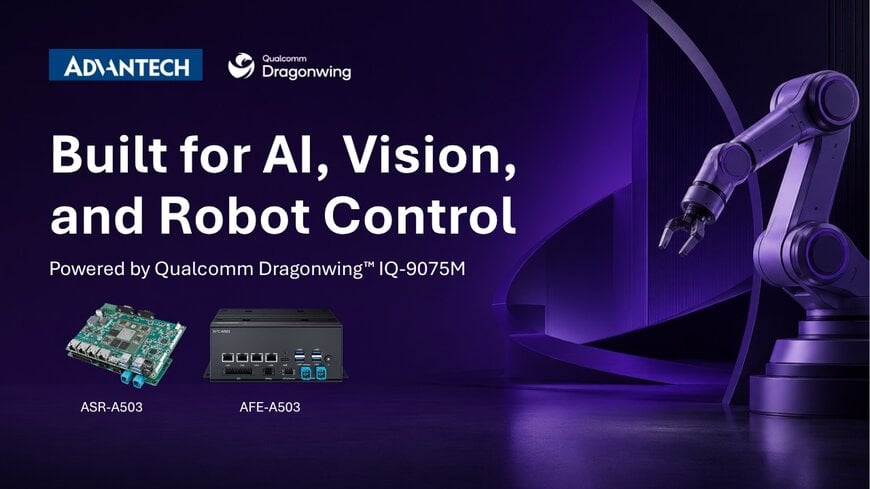
Advantech has expanded its edge computing portfolio with the introduction of the ASR-A503 robot controller single-board computer (SBC) and the AFE-A503 industrial robot controller. Both platforms are powered by the Qualcomm Dragonwing™ IQ-9075M processor, designed specifically to address the system-level requirements of next-generation Autonomous Mobile Robots (AMRs), humanoids, and service robots. By utilizing heterogeneous computing, these platforms allow robotics developers to consolidate perception, planning, and control workloads onto a unified architecture.
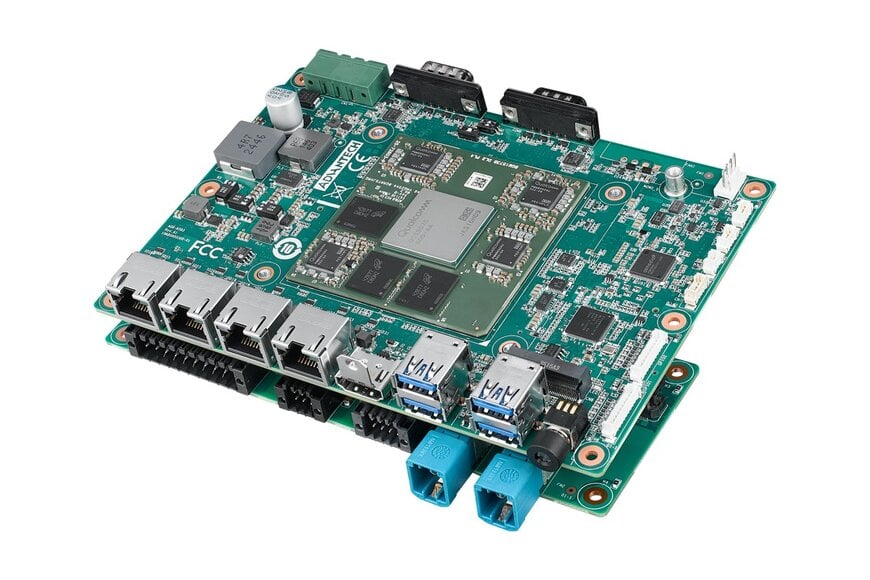
ASR-A503 robot controller based on the Qualcomm Dragonwing IQ-9075M
While raw peak AI performance (TOPS) is often emphasized in edge computing, production-ready robotics require a delicate balance of performance-per-watt, thermal design, and robust I/O. Delivering up to 100 dense TOPS (and 200 sparse TOPS), the ASR-A503 SBC provides developers with flexible board-level integration for customized designs. It supports up to eight camera inputs (GMSL and MIPI-CSI) alongside GbE, CAN FD, digital I/O, and serial interfaces.
For faster field deployment, the AFE-A503 extends this exact architecture into a ruggedized, fully integrated industrial enclosure featuring isolated interfaces, wide-temperature operation (-40 to 85°C), and 20 to 36 VDC power input, eliminating extensive hardware integration efforts.
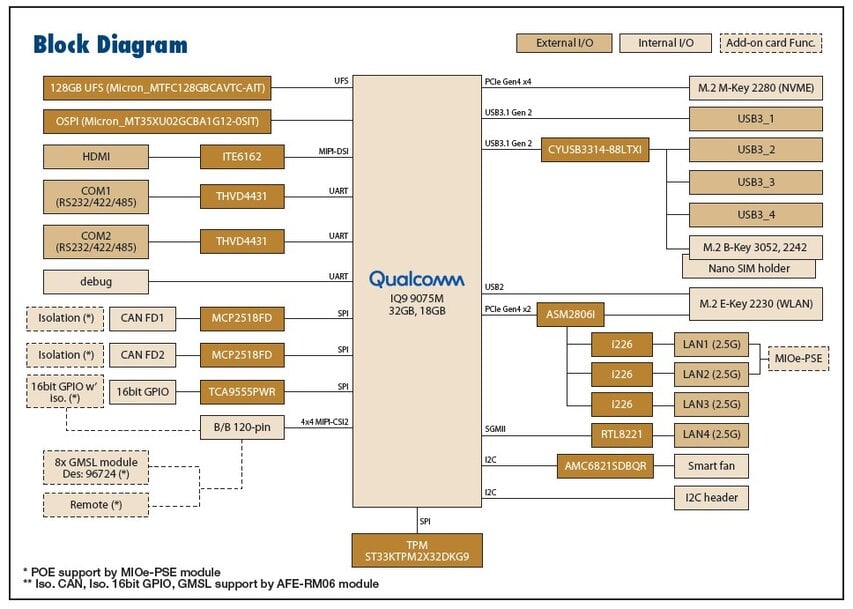
ASR-A503 robot controller block diagram
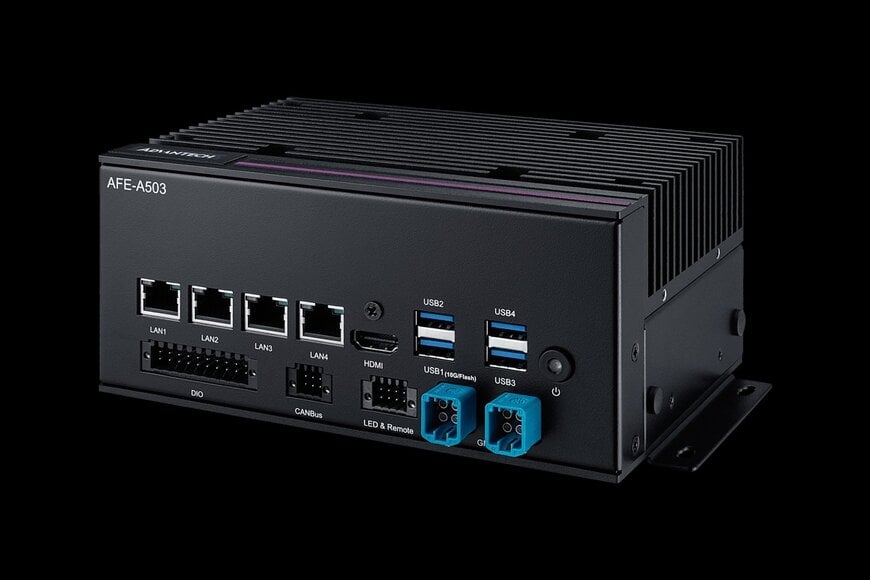
AFE-A503 industrial robot controller
Additional Context
This section provides technological and market background not explicitly detailed in the original release.
The engineering challenge in mobile robotics has historically been the fragmentation of hardware. To build an AMR, engineers typically integrate a discrete GPU for AI inference (processing camera feeds and LiDAR), an x86 processor for path planning and navigation, and a separate microcontroller (MCU) for real-time motor control and CAN bus communication. This multi-chip approach consumes significant physical space, requires complex cooling solutions, and rapidly drains battery life. Furthermore, passing high-bandwidth sensor data between these discrete chips via PCIe lanes introduces latency that can disrupt high-speed robotic maneuvers.
The Qualcomm Dragonwing IQ-9075M solves this by distributing these workloads across a single System-on-Chip (SoC). The integrated Neural Processing Unit (NPU) and Image Signal Processor (ISP) handle the heavy lifting of perception; the Kryo CPU cores manage the complex mathematics of SLAM (Simultaneous Localization and Mapping) and path planning; while dedicated real-time subsystems handle deterministic I/O for motor control. By keeping all this data on a single chip with shared memory, the Advantech platforms drastically cut power consumption and thermal output—two of the most critical limiting factors for battery-operated humanoids and warehouse logistics robots.
Edited by an industrial journalist, Lekshman Ramdas, with AI assistance.
www.advantech.com
