
www.ptreview.co.uk
23
'26
Written on Modified on
Automated Finishing Cells Resolve Bottlenecks in Toolholder Production
Modular robotic cells deployed by SCHUNK eliminate manual handling and stabilize high-mix tool finishing workflows.
schunk.com
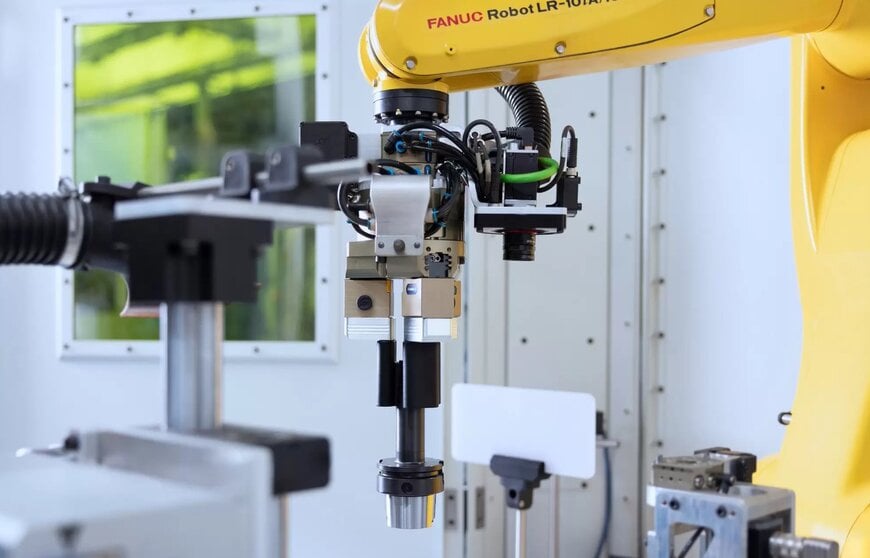
The SCHUNK toolholder manufacturing facility in Lauffen am Neckar operates with 149 machines, 34 robots, and approximately 400 workers. While earlier machining stages were already highly automated, the final finishing phase relied on repetitive manual intervention. Parts underwent balancing, laser marking, anti-corrosion oiling, and packaging by hand.
Laser marking presented a severe capacity constraint. Operators loaded individual parts manually, initiated the marking sequence, rotated parts for multi-point marking, and returned them to storage carts. Cycle times required a part changeover every ten seconds. Monotonous physical handling was compounded by workpieces weighing up to five kilograms and a catalog comprising approximately 650 variants processed in typical batch sizes of 100 units. Adding custom customer markings, serialization, and multi-surface data matrix codes created a throughput bottleneck at the end of the value chain.
Target Objectives for the Manufacturing Process
Plant engineering set distinct operational goals to eliminate production delays:
- Relieve operators from ergonomic strain and repetitive part handling.
- Maintain existing internal logistics without introducing specialized, cost-intensive automation trays.
- Achieve process reliability and automated optical inspection for variable part geometries.
- Enable fast changeovers between small batches without requiring dedicated automation programmers.
Implementation of Modular Robotic Cells
Production management deployed modular GROW automation cells directly into the toolholder finishing line. To prevent the labor waste associated with transferring workpieces to dedicated automation trays, the cells were engineered around existing factory transport carts.
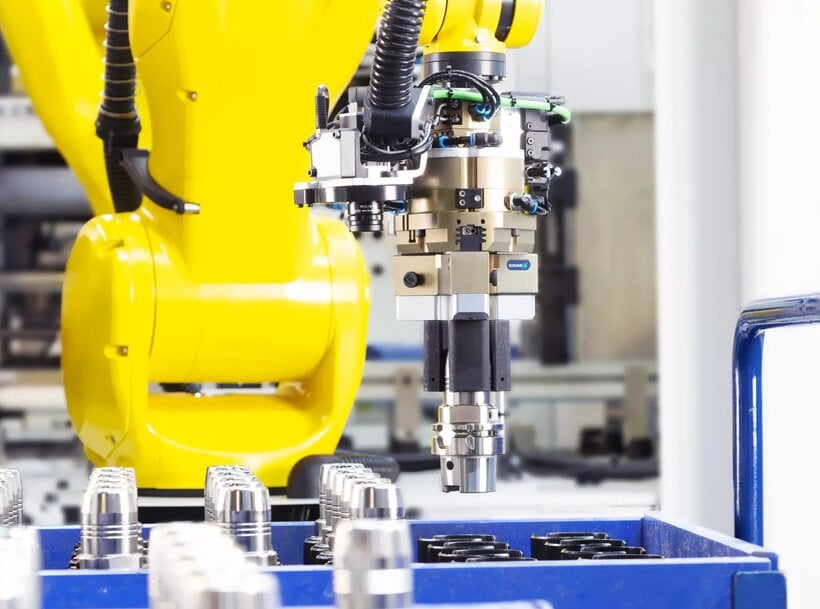
Operators slide standard shop floor carts directly into the logistics module of the cell. A barcode scan of the production order automatically transmits the workpiece identification, dimensions, marking programs, and laser parameters to the control system.
Vision Guidance and Robotic Handling Sequence
Because standard shop carts exhibit variable positioning, an integrated overhead machine vision system detects the exact spatial coordinates of the components in the cart before handling begins. A multi-axis industrial robot uses form-fit grippers to extract the toolholder and transports it past a secondary camera to inspect orientation features, such as holes and contours.
Once orientation is registered, the robot positions the toolholder beneath the laser head and manipulates the part across multiple axes to mark all designated surfaces. A secondary vision check verifies data matrix code legibility and confirms data integrity against the batch order. For physical grip adaptability, SCHUNK deployed a jaw quick-change mechanism. Approximately 50 interchangeable gripper sets accommodate the entire spectrum of 650 toolholder variations, reducing mechanical changeovers to several minutes per batch.
Integration of Automated Oiling and Packaging
To preserve throughput across the entire finishing line, the plant linked two modular cells to automate downstream preservation and packaging. The first robot moves marked toolholders into a sealed chamber to apply an anti-corrosion oil film. Concurrently, a second handling robot loads packaging materials, collects an automated print label with a vacuum end effector, places it on the packaging exterior, seals the container, and transfers the sealed units to an accumulation rotary buffer. Operators collect fully packed batches periodically, separating routine component handling from line supervision.
Operational Results and Productive Idle Time
Deploying two laser marking cells alongside two oiling and packaging cells balanced the facility's value stream:
Production management deployed modular GROW automation cells directly into the toolholder finishing line. To prevent the labor waste associated with transferring workpieces to dedicated automation trays, the cells were engineered around existing factory transport carts.
Operators slide standard shop floor carts directly into the logistics module of the cell. A barcode scan of the production order automatically transmits the workpiece identification, dimensions, marking programs, and laser parameters to the control system.
Vision Guidance and Robotic Handling Sequence
Because standard shop carts exhibit variable positioning, an integrated overhead machine vision system detects the exact spatial coordinates of the components in the cart before handling begins. A multi-axis industrial robot uses form-fit grippers to extract the toolholder and transports it past a secondary camera to inspect orientation features, such as holes and contours.
Once orientation is registered, the robot positions the toolholder beneath the laser head and manipulates the part across multiple axes to mark all designated surfaces. A secondary vision check verifies data matrix code legibility and confirms data integrity against the batch order. For physical grip adaptability, SCHUNK deployed a jaw quick-change mechanism. Approximately 50 interchangeable gripper sets accommodate the entire spectrum of 650 toolholder variations, reducing mechanical changeovers to several minutes per batch.
Integration of Automated Oiling and Packaging
To preserve throughput across the entire finishing line, the plant linked two modular cells to automate downstream preservation and packaging. The first robot moves marked toolholders into a sealed chamber to apply an anti-corrosion oil film. Concurrently, a second handling robot loads packaging materials, collects an automated print label with a vacuum end effector, places it on the packaging exterior, seals the container, and transfers the sealed units to an accumulation rotary buffer. Operators collect fully packed batches periodically, separating routine component handling from line supervision.
Operational Results and Productive Idle Time
Deploying two laser marking cells alongside two oiling and packaging cells balanced the facility's value stream:
- Processed Volume: 135,000 toolholders marked autonomously over a 24-month operational period.
- Setup Speed: Changeover times dropped to approximately five minutes per batch across several hundred variants.
- Workforce Deployment: Repetitive loading every ten seconds was replaced by periodic cell setup and process oversight; two-thirds of finishing personnel learned to set up and program new part variants without prior robotics backgrounds.
- Capital Efficiency: Toolholders undergo marking, corrosion protection, and packaging concurrently while operators execute other tasks, yielding rapid return on investment comparable to high-capital machining cells.
The deployment demonstrates that high-mix, low-volume finishing processes can be automated reliably when handling systems interface directly with established plant logistics and variable component positions.
Edited by Evgeny Churilov, Induportals Media - Adapted by AI.
www.schunk.com
Edited by Evgeny Churilov, Induportals Media - Adapted by AI.
www.schunk.com
