
www.ptreview.co.uk
22
'26
Written on Modified on
Precision Bearing Architecture for Orbital Mechanics and Satellite Systems
Rodriguez engineers specialized low-weight mechanical components designed to endure launch vibrations and sustain prolonged operational accuracy in demanding aerospace environments.
www.rodriguez.de
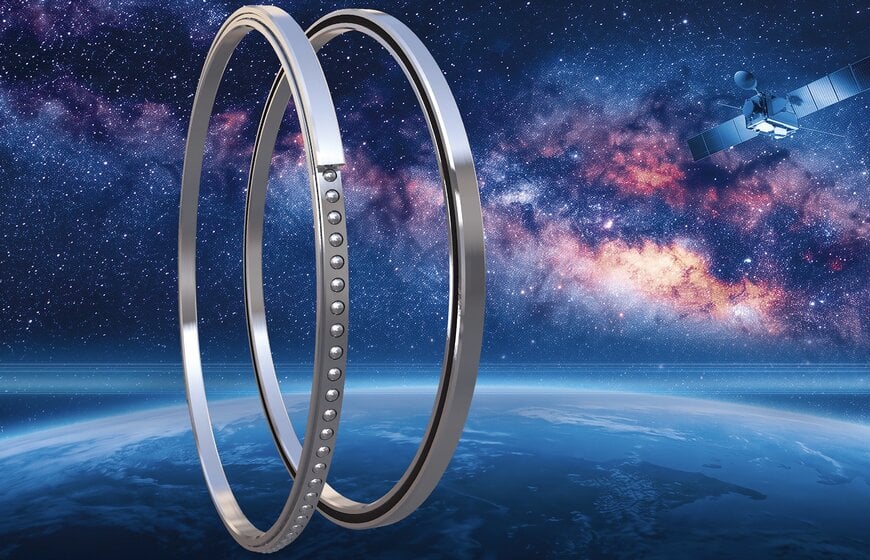
Rodriguez is supplying customized thin-section bearings engineered to support the extended operation, maintenance, and repositioning of satellite platforms and orbital infrastructure. These compact precision components address the aerospace industry's demand for low-weight, high-rigidity mechanical solutions within highly restricted installation spaces, spanning applications from movable solar arrays to mobile satellite systems.
Minimizing Mass in Aerospace Component Engineering
As satellite lifespans extend, the mechanical demands placed on orbital infrastructure increase proportionally. Thin-section bearings achieve structural efficiency by maintaining a particularly slim cross-section relative to a large bore diameter. This geometry significantly reduces the overall mass and spatial footprint of the bearing assembly compared to standard industrial bearings, providing critical weight-saving advantages for payload integration.
The operational lifecycle of these components dictates stringent mechanical tolerances. Ulrich Schroth, Head of the Value Added Products (VAP) Division at Rodriguez, notes that mechanical components must initially withstand severe vibrational loads and high G-forces during rocket launch sequences. Following deployment, the bearings are required to execute continuous, precise, and reliable kinematic movements over extended operational periods in orbit.
Mechanical Requirements for the Satellite Servicing Ecosystem
Typical technical applications for these components include positioning systems, movable solar arrays, and robotic arms utilized for in-orbit servicing, which facilitate the physical maintenance or repositioning of active satellites. Modified bearing assemblies utilizing these architectural principles have been successfully integrated into exterior robotic arm mechanisms on the International Space Station (ISS) for several years.
Standard commercial-off-the-shelf bearings are generally insufficient for the environmental extremes of space flight. Consequently, the Rodriguez VAP division modifies thin-section bearings to match specific system requirements and spatial constraints. This customization process adjusts dimensional parameters such as diameter and width, alongside material selection and mass optimization. Engineering these solutions requires strict mitigation of space-environment variables, including hard vacuum conditions, radiation exposure, and material outgassing limits, which directly dictate the selection of specialized solid or low-vapor-pressure fluid lubricants.
Additional Context
This section details technical specifications and competitive benchmarking not included in the original news release.
Within the aerospace bearing sector, thin-section components (such as those manufactured by benchmark competitors like Kaydon/SKF and SilverThin) are differentiated from standard deep-groove ball bearings by their constant cross-section. While standard bearings increase in cross-sectional thickness as the bore diameter grows, thin-section bearings maintain a uniform profile (often as small as 0.1875 inches squared) even at bore diameters exceeding 40 inches. This constant cross-section allows aerospace engineers to increase shaft diameters for enhanced structural rigidity without incurring a proportional weight penalty.
Furthermore, bearings rated for space flight must utilize tribological solutions that comply with strict outgassing standards, such as NASA’s requirement of a Total Mass Loss (TML) of less than 1.0% and Collected Volatile Condensable Material (CVCM) of less than 0.1%. Standard industrial greases vaporize in a vacuum, leading to premature bearing failure and optical sensor contamination. Consequently, space-grade thin-section bearings are typically benchmarked by their integration of dry film lubricants, such as Molybdenum Disulfide (MoS2), or specialized perfluoropolyether (PFPE) vacuum greases that maintain viscosity across extreme orbital temperature gradients.
Edited by Aishwarya Mambet, Induportals Editor, with AI assistance.
www.rodriguez.com
