
www.ptreview.co.uk
21
'26
Written on Modified on
SCHUNK Introduces Vise Automation System for Accessible Machine Tending
Robot-handled vises simplify loading and unloading, reducing programming complexity while extending machine running times with low investment and flexible integration.
schunk.com
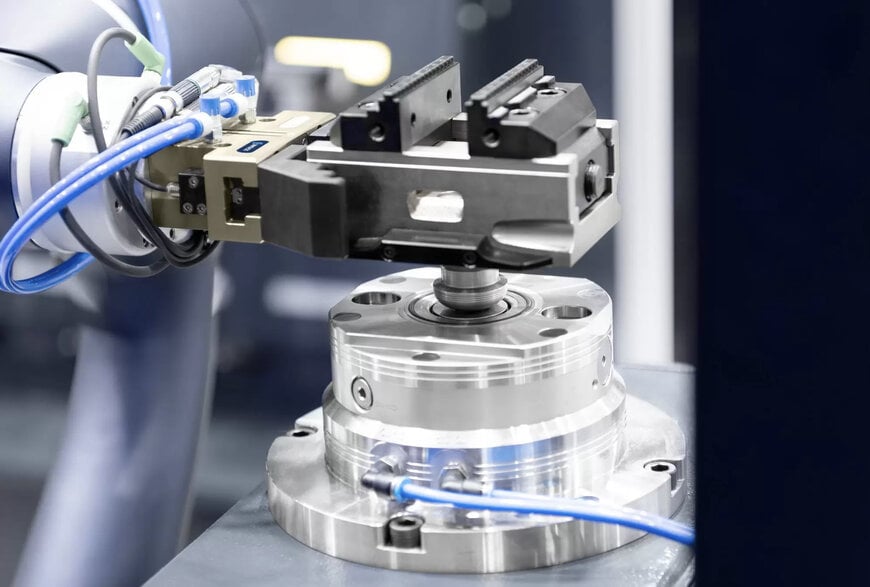
The VERO-S 1-way clamping station as a console version enables high-precision positioning and clamping of the vises in a single operation.
The clamping and gripping specialist SCHUNK has introduced a standardized vise automation system aimed at reducing deployment complexity and capital expenditure for machine tool loading and unloading. Targeted at machining operations, job shops, and high-mix, low-volume manufacturing environments, the modular setup enables automated component replenishment without requiring complex media transfer interfaces or extensive robot programming.
Mechanical Integration and Five-Axis Workpiece Accessibility
The system decouples workpiece securing from the automated transfer cycle. Operators secure raw stock into standardized machine vises externally before placing the assemblies into an adjacent storage rack. A handling robot fitted with dedicated gripping fingers transfers each loaded vise directly onto an elevated zero-point clamping station mounted to the machine tool table. After machining cycles conclude, the robot transfers the complete vise assembly back into the rack, where manual or automated re-clamping for secondary operations takes place.
A single-actuation zero-point console serves as the physical and mechanical interface between the handling robot and the machine tool. The elevated configuration provides clearance necessary for five-axis cutting operations while the base of the vise completely covers the clamping module, preventing chips and swarf from settling on locating surfaces. Actuation of the interface can be controlled through machine tool control signals or directly via the robot controller.
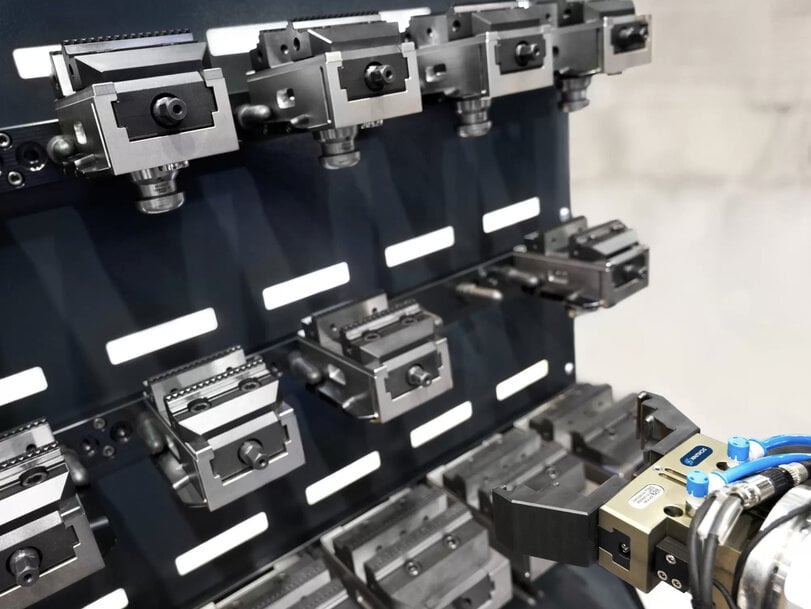
Using special gripper fingers, the robot removes the loaded vises from the storage rack and places them back there after machining.
Interface Standardization and Simplified Kinematics
Automating the movement of entire clamping fixtures rather than bare components minimizes kinematic programming demands. Because the robot handles a uniform outer clamping geometry regardless of internal workpiece variance, trajectory routines rely solely on fixed point-to-point motion profiles. This fixed-interface strategy eliminates the need to recalibrate gripping patterns or reprogram kinematics for variable component geometries.
Operating without fluid or pneumatic media lines delivered through the machine table allows deployment across standard milling centers and older machine platforms. Facilities can stage multiple vises prior to unstaffed shifts, extending autonomous spindle runtimes through evening and weekend production windows without additional operating personnel.
Additional Context:
This section details technical specifications and competitive benchmarking not included in the original product announcement
Comparable zero-point modular handling systems within precision CNC machining include the EROWA UPC and System 3R Dynafix architectures, as well as Lang Technik RoboTrex systems. Standard zero-point clamping systems typically achieve repeat accuracies under 0.005 mm, with standard pull-in retention forces ranging from 15 kN to over 40 kN depending on clamping pin diameter and turbo-assist actuation.
Direct vise-handling approaches contrast with direct workpiece handling solutions that rely on pneumatic robot grippers and automated machine table vises. While direct workpiece handling requires high-pressure hydraulic or pneumatic connections through rotary unions into the machine envelope, complete vise transfer utilizes mechanical or pneumatic zero-point lock mechanisms at the table base. This lowers integration overhead on three-axis and five-axis platforms, though it increases required payload capacities on the articulated handling arm to account for combined fixture and part mass.
Edited by Natania Lyngdoh, Induportals editor, assisted by AI.
www.schunk.com
The clamping and gripping specialist SCHUNK has introduced a standardized vise automation system aimed at reducing deployment complexity and capital expenditure for machine tool loading and unloading. Targeted at machining operations, job shops, and high-mix, low-volume manufacturing environments, the modular setup enables automated component replenishment without requiring complex media transfer interfaces or extensive robot programming.
Mechanical Integration and Five-Axis Workpiece Accessibility
The system decouples workpiece securing from the automated transfer cycle. Operators secure raw stock into standardized machine vises externally before placing the assemblies into an adjacent storage rack. A handling robot fitted with dedicated gripping fingers transfers each loaded vise directly onto an elevated zero-point clamping station mounted to the machine tool table. After machining cycles conclude, the robot transfers the complete vise assembly back into the rack, where manual or automated re-clamping for secondary operations takes place.
A single-actuation zero-point console serves as the physical and mechanical interface between the handling robot and the machine tool. The elevated configuration provides clearance necessary for five-axis cutting operations while the base of the vise completely covers the clamping module, preventing chips and swarf from settling on locating surfaces. Actuation of the interface can be controlled through machine tool control signals or directly via the robot controller.
Using special gripper fingers, the robot removes the loaded vises from the storage rack and places them back there after machining.
Interface Standardization and Simplified Kinematics
Automating the movement of entire clamping fixtures rather than bare components minimizes kinematic programming demands. Because the robot handles a uniform outer clamping geometry regardless of internal workpiece variance, trajectory routines rely solely on fixed point-to-point motion profiles. This fixed-interface strategy eliminates the need to recalibrate gripping patterns or reprogram kinematics for variable component geometries.
Operating without fluid or pneumatic media lines delivered through the machine table allows deployment across standard milling centers and older machine platforms. Facilities can stage multiple vises prior to unstaffed shifts, extending autonomous spindle runtimes through evening and weekend production windows without additional operating personnel.
Additional Context:
This section details technical specifications and competitive benchmarking not included in the original product announcement
Comparable zero-point modular handling systems within precision CNC machining include the EROWA UPC and System 3R Dynafix architectures, as well as Lang Technik RoboTrex systems. Standard zero-point clamping systems typically achieve repeat accuracies under 0.005 mm, with standard pull-in retention forces ranging from 15 kN to over 40 kN depending on clamping pin diameter and turbo-assist actuation.
Direct vise-handling approaches contrast with direct workpiece handling solutions that rely on pneumatic robot grippers and automated machine table vises. While direct workpiece handling requires high-pressure hydraulic or pneumatic connections through rotary unions into the machine envelope, complete vise transfer utilizes mechanical or pneumatic zero-point lock mechanisms at the table base. This lowers integration overhead on three-axis and five-axis platforms, though it increases required payload capacities on the articulated handling arm to account for combined fixture and part mass.
Edited by Natania Lyngdoh, Induportals editor, assisted by AI.
www.schunk.com
