
www.ptreview.co.uk
04
'26
Written on Modified on
Automated Stencil and Squeegee Changeover for DEK TQ Printers
ASMPT has introduced an automated setup changeover option for the DEK TQ printer platform to streamline stencil and squeegee replacement in SMT lines.
smt.asmpt.com
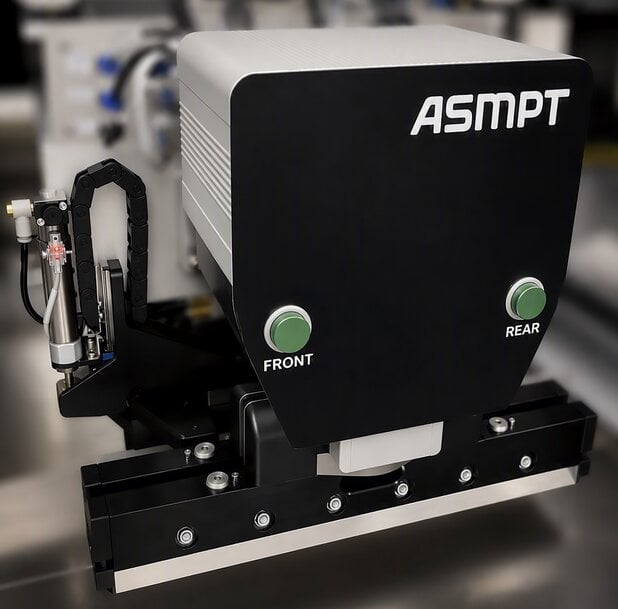
The new print head on the DEK TQ printer, featuring sensor technology, automatically picks up the squeegees and consumable cartridge. Image source: ASMPT
System Mechanics and Paste Transfer
A pre-prepared configuration underpins the operational sequence, combining the stencil directly with a consumable cartridge holding the squeegees. Operators load this paired assembly directly into the machine, allowing the print head to identify the squeegees and cartridge, engage them mechanically, and initiate printing.
During active production runs, the consumables unit remains positioned within the printing enclosure. During subsequent changeover sequences, this unit transfers the remaining solder paste roll directly onto the incoming stencil, while an integrated Camera Barcode Reader verifies setup identification, or barcode scanning is performed beforehand in the setup area.
Process Reliability and Hardware Configuration
Standard manual product changeovers require operators to remove squeegees and stencils, check support pin arrangements, install replacement stencils, and verify alignment manually, taking roughly four minutes. With the automated process, manual involvement is confined to opening the access hood, removing the spent stencil and squeegees deposited by the print head, inserting the pre-configured setup, and closing the hood in approximately 30 seconds.
Support pin verification workflows are expedited for manual configurations, and automatic positioning is managed using DEK Smart Pin Placement. Mechanical reliability is enhanced by an adapter built to poka-yoke standards to prevent incorrect assembly, alongside automated squeegee pickup to ensure reproducible changeover cycles.
"Solder paste printing is one of the processes that require lots of operator involvement on an SMT line. With a new, innovative solution for automated setup changeover, we reduce the need for manual assists considerably while also lowering the risk of operator errors," stated Martin Moggeridge, Senior Product Manager at ASMPT SMT Solutions.
Hardware components for the automated changeover option include a dedicated print head, squeegees, the consumable cartridge, an adapter module, and operating software, available as a build option on new DEK TQ units or as an upgrade kit for existing installations.
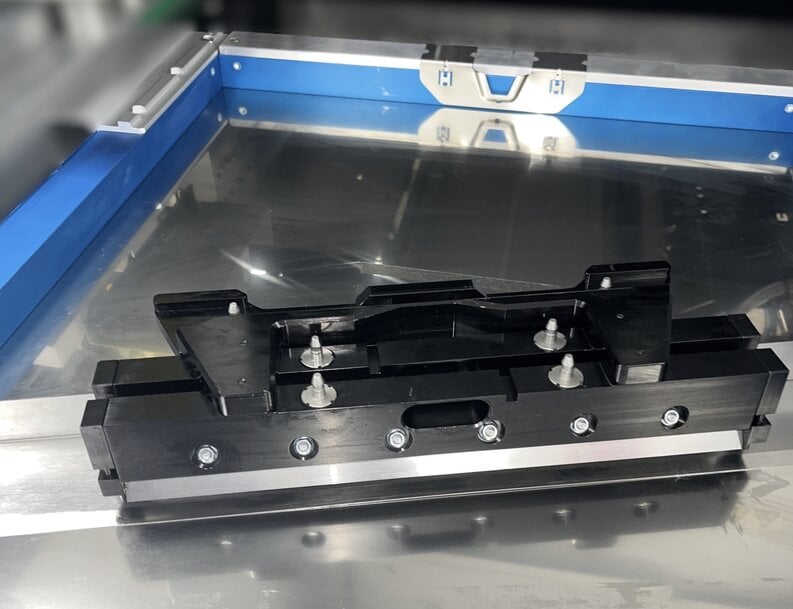
A pre-configured setup consisting of squeegees, consumable cartridge, adapter, and stencil enables automated setup changover on the DEK TQ printer – quickly and easily. Image source: ASMPT
Additional Context
This section details technical specifications not included in the original news release.
Solder paste printing in high-mix or high-volume surface mount assembly depends heavily on print head alignment accuracy, squeegee pressure consistency, and aperture release mechanics to avoid solder bridging or insufficient deposition. SMT stencil printers in this operational class typically operate with alignment capabilities engineered for high-density interconnect substrates, frequently maintaining alignment ratings around ±12.5 microns at 2 Cpk with core cycle times optimized for high-throughput lines. Industrial stencil frames for full-format platforms accommodate standard dimensions up to 29 inches, supporting foil thicknesses that typically range from 80 to 150 micrometers. Automating the squeegee-to-aperture engagement isolates the solder paste roll from ambient environmental exposure—such as cleanroom temperature and humidity variations—which otherwise alters paste rheology and accelerates solvent evaporation during prolonged manual interventions.
Edited by Romila DSilva, Induportals Editor, with AI assistance.
www.asmpt.com
