
www.ptreview.co.uk
02
'26
Written on Modified on
3D Position Sensing for Compact Motor Actuation Systems
Melexis enables flexible rotor-position feedback for compact automotive, mobility and robotic mechanisms with limited mounting space.
www.melexis.com
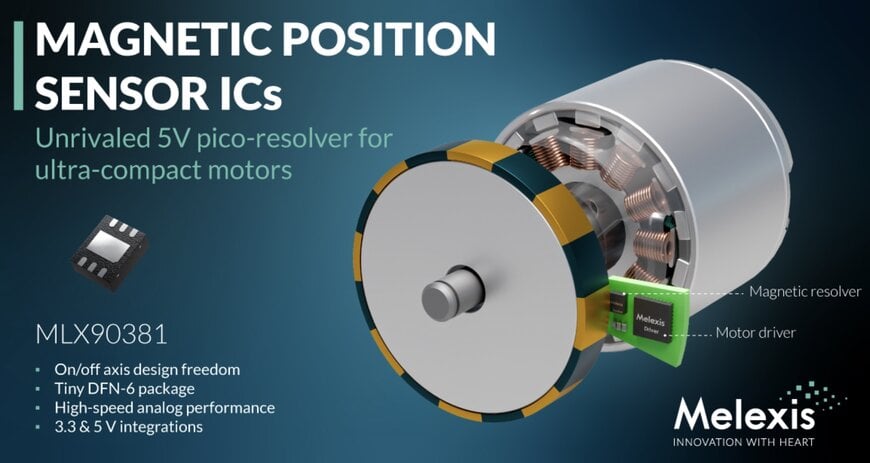
Melexis is releasing the MLX90381 5V, a compact magnetic pico-resolver designed to track rotor position in tight electromechanical assemblies. The component targets automotive architectures, alternative mobility platforms, and robotics by providing high-speed analog output for constrained motor control ecosystems.
Integration Within Constrained Motor Architectures
Position sensing in applications such as electronic valves, seat mechanisms, braking and steering motors, e-bike drives, and robotic actuators often precludes traditional end-of-shaft sensor mounting. In through-shaft or side-of-shaft motor designs, physical space is highly restricted. The MLX90381 5V addresses this by utilizing Triaxis Hall technology to measure magnetic flux density in three dimensions. By allowing system engineers to select between X/Y, X/Z, or Z/Y magnetic axis pairs, the device can be mounted adjacent to or below the magnetic track. This mechanism eliminates the need for additional lateral clearance, simplifying printed circuit board (PCB) geometry and tolerance management in dense mechanical assemblies.
Signal Processing and Dynamic Performance Parameters
The sensor outputs high-speed sine and cosine analog signals to relay continuous, real-time position data to the system controller. Operating on a standard 5V supply, the resolver provides a signal refresh rate of 2 microseconds. This low latency supports accurate measurement of rotational speeds exceeding 50,000 revolutions per minute (rpm), accommodating the dynamic bandwidth requirements of direct current (DC), brushless DC (BLDC), and permanent magnet synchronous motor (PMSM) configurations. For production line calibration, the device incorporates an I²C communication interface, allowing precise adjustments to sensitivity and filter bandwidth to optimize system-level signal processing.
Thermal Reliability and Automotive Qualification
The component is housed in a standard DFN-6 package with physical dimensions of 2.0 mm by 2.5 mm by 1.0 mm. It maintains operational stability across a severe temperature gradient of -40°C to 160°C. To satisfy safety-critical automotive requirements, the hardware features embedded diagnostic capabilities and achieves AEC-Q100 qualification alongside ASIL B Safety Element out of Context (SEooC) readiness. By combining multi-axis magnetic sensing with this compact footprint, the architecture systematically reduces integration bottlenecks associated with standard rigid detection components.
Additional Context
This section details technical specifications and competitive benchmarking not included in the original news release.
Standard tunnel magnetoresistance (TMR) position sensors, such as the Infineon TLE5012B or TDK TAS series, offer high angular accuracy and low signal jitter but are generally limited to planar (X/Y) field measurement. This architectural rigidity forces mechanical engineers to align the sensor precisely at the end of the shaft or perfectly parallel to the dipole magnet. In contrast, 3D Hall-effect technology, like the Triaxis mechanism in the MLX90381 or the Monolithic Power Systems (MPS) MA302, provides the capability to compute position from out-of-plane magnetic fields (X/Z or Y/Z). This objective tradeoff prioritizes mechanical packaging flexibility over absolute theoretical resolution, which is structurally necessary for through-shaft e-bike drives and compact robotic joints where axial alignment is physically blocked.
Edited by Aishwarya Mambet, Induportals Editor, with AI assistance.
www.melexis.com
