
Everything You Need to Know About Radar Level Sensors
Early radar level sensors were expensive, bulky and sometimes complex to implement. Advances in radio technology have made them increasingly compact, high-performing and versatile over the years, while also bringing their cost down.
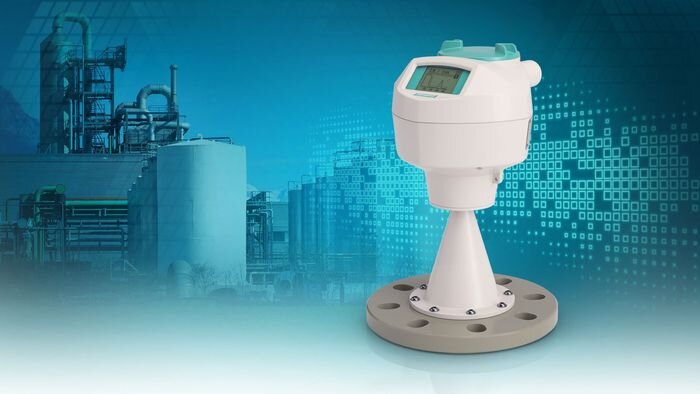
Operating principles of radar level sensors
Radar level measurement is based on the transmission of electromagnetic waves from an antenna and the subsequent reception of the waves reflected from the surface of a liquid or solid, in order to measure either the round-trip transit time or a phase shift. There are two main types of radar sensor: pulsed radar sensors and devices using frequency-modulated continuous-wave (FMCW) technology. The former determine the level from the propagation time of the radio wave. Historically less expensive due to their lower complexity, they are particularly suitable for measuring liquids with a dielectric constant as low as 1.6. The latter use a signal whose frequency is modulated linearly over time. The phase shift between the transmitted and received signals is used to determine the distance travelled. FMCW technology performs well with low-dielectric materials, including certain powders.
How electromagnetic wave frequency affects measurement
FMCW radar level measurement has traditionally operated in four distinct frequency bands: 6, 10, 24 and 80 GHz. For a given antenna size, the higher the frequency, the narrower the beam angle and the greater the potential measuring range. Over the years, electronic components operating at these frequencies have become increasingly compact and their cost has fallen sharply, with device prices dropping by a factor of three in around ten years.
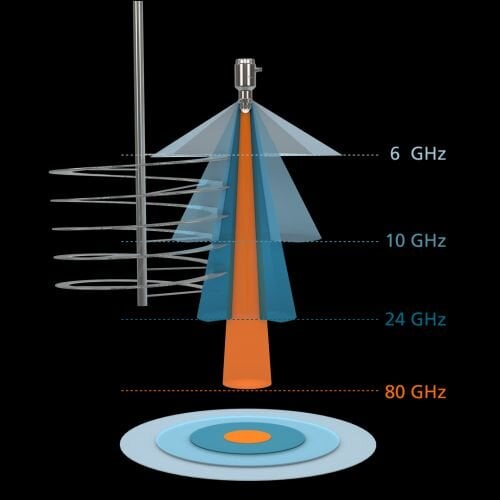
The higher the frequency used by the radar level sensor, the narrower the beam angle. Ifm's LW2120 radar level sensor operates at 80 GHz and measures the level of liquid and viscous media at distances of up to 10 metres.
Most sensors now operate at 80 GHz. A radar sensor operating at this frequency has a beam angle of just three degrees, with a beam diameter of 70 mm at a distance of three metres, compared with 160 mm at 24 GHz. This helps avoid unwanted reflections from tank reinforcement structures or agitators. The narrow beam ensures reliable results even in the presence of vapour, condensation, turbulence or dust. In addition, the reduced beam angle allows smaller process connections to be used. Combined with a 40 dB signal gain, this characteristic enables level measurements over distances of up to 120 metres and allows guided-wave radar sensors to be replaced without the need to install a waveguide inside the tank. However, frequencies of 6 GHz and 26 GHz remain more effective for certain products, such as refrigerants or acetone, which absorb 80 GHz waves.
Main advantages of radar level measurement technology
FMCW radar sensors provide non-contact measurements with millimetre-level accuracy across a wide variety of products. Measurements are unaffected by variations in temperature and pressure or by outdoor weather conditions. The sensors are easy to install and remove without having to shut down the process, unlike pressure sensors installed at the bottom of a tank, thereby eliminating the associated risk of leakage.
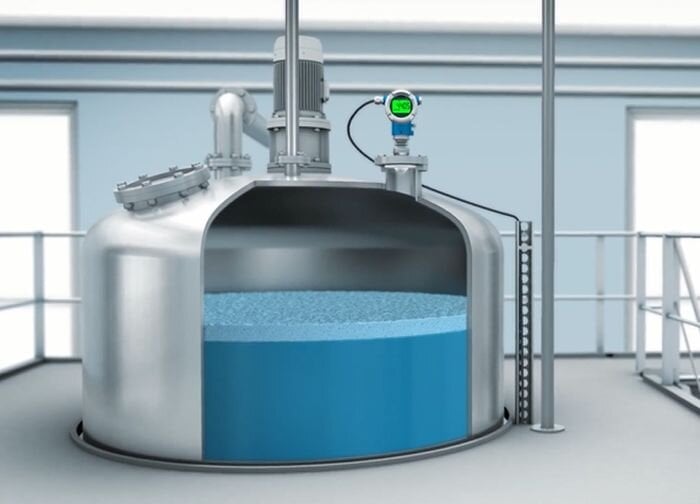
Endress + Hauser's Micropilot FMR62B is an 80 GHz radar level sensor. It is designed for continuous, non-contact level measurement in demanding liquid applications.
The transmitting and receiving lenses used at 80 GHz are flat, compact and flush-mounted. Their small dead zone enables reliable measurements to be made very close to the antenna. Furthermore, because electromagnetic waves can pass through non-conductive materials such as plastics, glass, ceramics and refractory bricks, non-intrusive measurements can be made through the walls of tanks containing aggressive products. Radar sensors also offer the advantage of being unaffected by the colour or reflectivity of the measured product.
Applications for radar level sensors
FMCW radar sensors operating at 80 GHz are suitable for an extremely broad range of applications, from 70 cm-deep cooking-oil tanks to 30 metre-high clinker powder silos. They are also used in wastewater pumping stations, where they provide an effective alternative to float-based systems.
Radar sensors are not, however, suitable for products with a very low dielectric constant (below 1.2, such as transformer oils), tanks with intense agitation or numerous internal obstructions, or surfaces that generate substantial amounts of foam or absorb certain frequencies. Testing is therefore required in these cases. Apart from these specific situations, the same sensor model can be used regardless of the product being measured or the height and material of the tank, simply by adapting the nozzle and connection arrangement.
Key developments in radar level sensors
Manufacturers have focused on ease of use by equipping their devices with user-friendly configuration tools. On some models, users have only two main parameters to adjust: the tank height and the data transmission mode. Bluetooth wireless connectivity simplifies commissioning, configuration and remote monitoring without requiring operators to climb to the top of the tank, while configurations can in some cases be stored in the cloud.
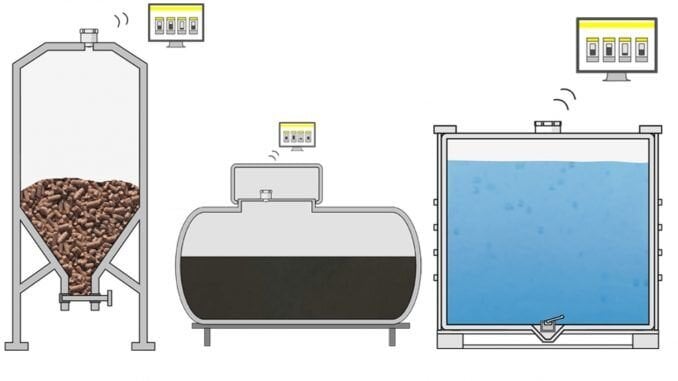
Vega's Vegapuls Air radar level sensors are battery-powered and communicate via NB-IoT/LTE-M or LoRa wireless technologies.
Some sensors feature the standard IO-Link digital interface, while other standalone models communicate wirelessly over NB-IoT/LTE-M or LoRa networks and use batteries offering up to 10 years of operating life. The devices also incorporate advanced functions such as foam and build-up detection, as well as online self-monitoring. Finally, the move towards higher frequencies has been accompanied by a dramatic reduction in instrument size and weight: a sensor that weighed 15–20 kg 25 years ago now weighs around 2 kg.
Published by Youssef Belgnaoui, editor at Induportals.
