
www.ptreview.co.uk
11
'26
Written on Modified on
High-Sensitivity Thermal Cameras for Critical Infrastructure Protection
Hanwha Vision integrates artificial intelligence with sub-16 millikelvin thermal sensors to enable precise object classification in challenging environmental and maritime conditions.
hanwhavision.eu
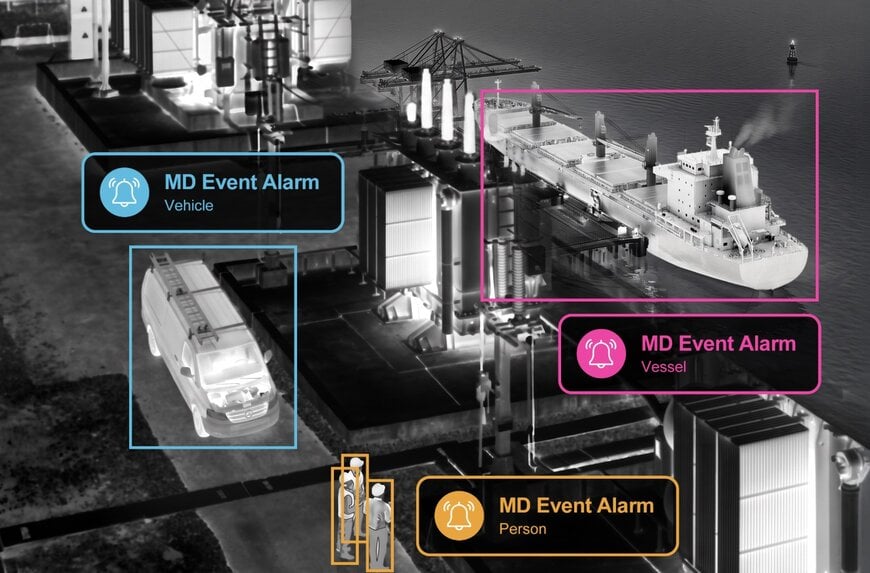
Hanwha Vision introduces the VGA AI Tele lens Thermal Camera series, combining high-sensitivity thermal imaging with artificial intelligence to support critical infrastructure protection and maritime security. The video surveillance systems provide automated object classification across land and waterways, maintaining detection capabilities during severe weather or low-light conditions.
Thermal Sensitivity and AI Object Classification
The cameras achieve a Noise Equivalent Temperature Difference (NETD) below 16mK. NETD measures the smallest temperature difference a thermal sensor can distinguish; a sub-16mK rating indicates a high degree of sensitivity, allowing the camera to generate refined thermal data even when targets possess temperatures very close to their surrounding environment.
This thermal precision directly supports the onboard artificial intelligence engine, enabling the system to classify objects rather than simply registering pixel movement. The algorithms can accurately identify people and vehicles, including targets that are partially obscured, crouching, or prone. By processing high-contrast thermal signatures, the cameras reduce false alarms and improve automated situational awareness in restricted perimeters.
Maritime Video Surveillance Systems
Beyond standard land-based perimeter security, the system includes AI-powered vessel detection functionalities optimized for marine environments. The AI engine applies classification analytics to watercraft, extending automated monitoring to coastal protection, port security, and maritime border control. Because the technology relies on thermal radiation rather than visible light, the cameras maintain detection performance through fog, rain, snow, and total darkness, ensuring continuous monitoring of waterways and open-sea environments.
Hardware Configurations and Environmental Resilience
To accommodate varying deployment requirements, the series offers four fixed lens configurations: 13mm, 19mm, 35mm, and 60mm. This allows system architects to specify the appropriate field of view and detection range for distinct zones. Each model is available in a 30-frames-per-second (fps) version for high-fluidity tracking, as well as an 8fps version to comply with regional export regulations and specific procurement mandates.
The hardware is enclosed in a ruggedized housing that meets IP66/67 and NEMA 4X ratings for dust and water ingress, alongside an IK10 rating for impact resistance. Furthermore, the cameras comply with the MIL-STD-810H military standard, verifying their resistance to rain, humidity, vibration, and salt spray exposure. Enhanced transient protection safeguards the internal electronics against electrical surges and unstable power supplies.
Cryptographic Security and Data Protection
The series integrates cryptographic hardware to protect network integrity. Each unit features a Secure Element certified to the FIPS 140-3 Level 3 standard, providing hardware-rooted encryption to defend against unauthorized network access and cyber threats. This cryptographic infrastructure is paired with SD card partition encryption, ensuring that edge-recorded surveillance footage is safeguarded against tampering and data extraction.
Additional Context
This section details technical specifications and competitive benchmarking not included in the original news release.
Within the industrial thermal imaging and critical infrastructure protection market, benchmark products from manufacturers such as Teledyne FLIR (e.g., the Elara series) and Axis Communications (e.g., the Q-series thermal networks) typically feature standard NETD ratings ranging between <30mK and <50mK. By achieving a sub-16mK NETD, the Hanwha Vision VGA series operates in an ultra-high sensitivity tier. In practical applications, a lower NETD allows the image signal processor to resolve finer details in low-contrast scenes—such as heavy fog or situations where ambient temperatures match the target's body heat. This measurable difference in thermal resolution significantly increases the operational range and accuracy of edge-based AI classification algorithms compared to standard <40mK models.
Edited by Aishwarya Mambet, Induportals Editor, with AI assistance.
www.hanwhavision.com
