
www.ptreview.co.uk
07
'26
Written on Modified on
Standardized Industrial Alarm Management Software
Adroit Technologies provides software to measure control room notifications against IEC 62682 standards, reducing nuisance alerts across the digital supply chain.
adroitscada.com
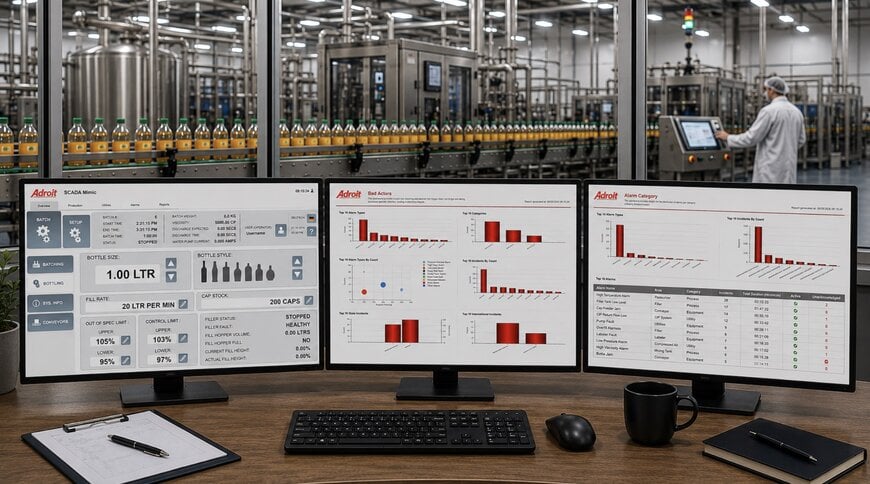
Adroit Technologies is deploying its updated Alarm Management software suite to mitigate alarm flooding and optimize process interventions within industrial manufacturing environments. The digital architecture provides objective measurement of control room alerts against established international frameworks to ensure field operators and maintenance personnel receive prioritized, actionable notifications.
Mitigating Alarm Flooding Through Standardized Frameworks
In industrial control environments, alarm systems alert operators to abnormal process conditions requiring intervention before equipment failures occur. However, poorly configured systems frequently generate nuisance alarms, leading to alarm flooding that degrades an operator’s capacity to identify critical events. To address this, organizations are shifting away from reactive maintenance by adopting formal alarm management strategies aligned with recognized engineering standards, specifically ISA-18.2 and IEC 62682.
The software measures system outputs against these recognized alarming standards, providing baseline metrics for continuous improvement programs. Johan Nieuwenhuizen, Sales Director and Co-CEO of Adroit Technologies, stated that objective measurement allows organizations to identify specific improvement opportunities that yield measurable operational benefits. By quantifying alarm performance, facilities eliminate background noise and reconfigure thresholds, resulting in improved process stability and equipment reliability.
Mobile Escalation and Operational Data Logging
Beyond centralized control rooms, the platform extends notification capabilities directly to field personnel via the Adroit AIR mobile application. The software delivers secure push notifications across major mobile operating systems, escalating critical alarms to designated engineers and supervisors.
To support root cause analysis and incident investigations, the system features an integrated Digital Logbook. This structured logging platform allows operators and maintenance teams to capture acknowledgment reasons, operational notes, and corrective actions tied to specific alarm events. Through Structured Query Language (SQL) database integration, these recorded events can automatically trigger work orders within integrated maintenance environments and broader enterprise architectures, such as an automotive data ecosystem.
Cloud Analytics for Predictive Maintenance
The software ecosystem scales into the Adroit Cloud to provide browser-based dashboards, performance reports, and key performance indicator (KPI) tracking for distributed sites. The analytics engine leverages artificial intelligence (AI) to evaluate historical data sets, identifying recurring 'bad actor' alarms and specific patterns indicative of process inefficiencies.
By tracking acknowledgment performance and exception reporting over time, engineering teams gain visibility into emerging mechanical issues before they escalate into unplanned downtime. This transition from isolated notifications to integrated workflow intelligence improves system traceability, regulatory compliance, and incident response times across the manufacturing infrastructure.
Additional Context
This section details technical specifications and competitive benchmarking not included in the original news release.
In the industrial automation sector, standardized alarm management solutions compete directly with software modules such as AVEVA Alarm State Manager and Yokogawa Exaquantum/ARA (Alarm Reporting and Analysis). The primary objective benchmarks for these platforms are governed by the ISA-18.2 standard, which specifies optimal performance metrics, including a target of fewer than 150 alarms per operator per day and an allowance of less than 1 percent of operating time spent in flood conditions (defined as more than 10 alarms per 10-minute period).
When evaluating mobile escalation and remote notification systems, applications like Adroit AIR are typically benchmarked against dedicated notification engines such as Win-911 or Seqent. Competitive differentiation in this category is measured by delivery latency, the capacity to establish redundant communication protocols (e.g., SMS, voice, and push pathways), and the system's ability to sync bidirectionally with active directory security architectures. Platform-agnostic tools that utilize standard SQL databases often present lower integration friction compared to software heavily dependent on proprietary historian databases.
Edited by Aishwarya Mambet, Induportals Editor, with AI assistance.
www.adroitscada.com
