
www.ptreview.co.uk
07
'26
Written on Modified on
High-Speed Four-Channel Digital Isolators for Industrial Automation
Toshiba introduces high-speed isolation devices designed to maintain signal integrity within high-temperature manufacturing environments and the industrial digital supply chain.
www.global.toshiba
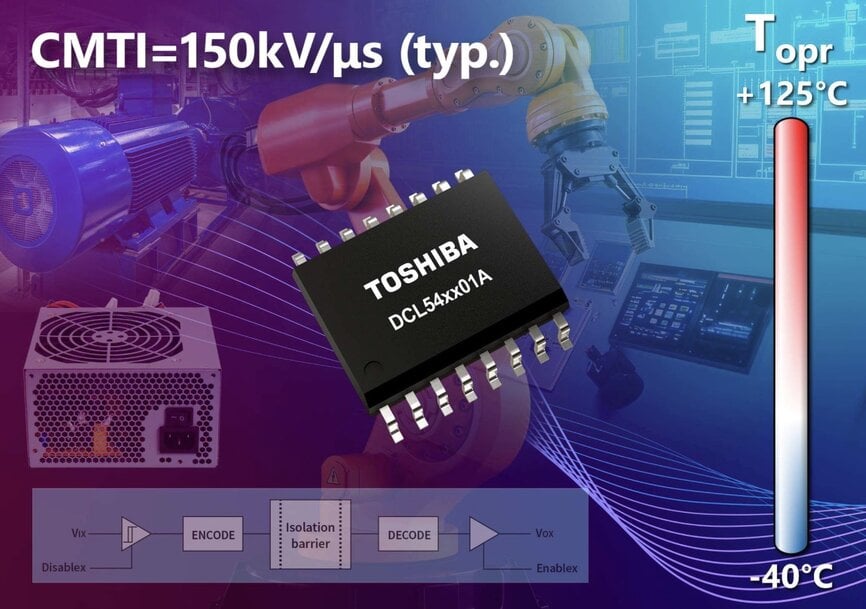
Toshiba Electronics Europe is releasing the DCL54xx01A series, a portfolio of four-channel digital isolators engineered for programmable logic controllers (PLCs) and motor control systems. This semiconductor hardware provides continuous data transmission and noise immunity for industrial automation equipment operating in extreme thermal conditions.
Maintaining Signal Integrity in High-Noise Environments
Industrial equipment utilizing fast-switching power devices frequently encounters elevated levels of common-mode noise, which can disrupt digital control signals. To mitigate this electrical interference, the DCL54xx01A series employs magnetic coupling isolation technology, achieving a typical common-mode transient immunity (CMTI) of 150 kV/µs. This high CMTI ensures reliable data transmission across isolation barriers in variable frequency drives, input/output (I/O) interfaces, and switched-mode power supplies. Furthermore, the isolators operate across a thermal range of -40 °C to +125 °C, supporting deployment in high-temperature industrial locations where standard commercial components might experience thermal degradation.
Device Specifications and Transmission Architectures
The DCL54xx01A series supports continuous data rates up to 150 megabits per second (Mbit/s) while operating on a supply voltage between 2.25 V and 5.5 V. During operation, the hardware provides an isolation voltage of 5,000 Vrms for one minute. The isolators minimize system timing errors with a typical propagation delay of 10.9 nanoseconds (ns) and a pulse width distortion of 0.8 ns.
To support a wide range of isolated communication interfaces within the industrial data ecosystem, the devices are housed in wide-body 16-pin SOIC (16 W SOIC) packages. Hardware engineers can specify transmission direction configurations of 4:0, 3:1, or 2:2 (two-way transmission), alongside various default output states and activation control options. These components complement earlier medium-speed digital isolators, which operate at a maximum of 25 Mbit/s in compact SSOP16 packages, providing scalable hardware options based on specific encapsulation and bandwidth requirements.
Additional Context
This section details technical specifications and competitive benchmarking not included in the original news release.
Standard four-channel digital isolators for industrial applications are widely produced by semiconductor manufacturers such as Texas Instruments (e.g., ISO774x series) and Analog Devices (e.g., ADuM14x series). A primary objective benchmark for these devices is the Common-Mode Transient Immunity (CMTI) rating, isolation voltage, and maximum supported data rate.
While legacy optical isolators typically offer lower data rates and degrade over extended operational lifespans, magnetic or capacitive digital isolators sustain higher bandwidths and greater reliability. For instance, competing standard capacitive digital isolators often provide data rates around 100 Mbit/s with a CMTI rating between 85 kV/µs and 100 kV/µs. By achieving 150 Mbit/s and a CMTI of 150 kV/µs through magnetic coupling, the DCL54xx01A architecture directly addresses the strict timing and noise rejection tolerances required by modern fast-switching silicon carbide (SiC) or gallium nitride (GaN) power systems.
Edited by Aishwarya Mambet, Induportals Editor, with AI assistance.
www.toshiba.com
