
www.ptreview.co.uk
06
'26
Written on Modified on
Compact Clamping and Braking for Pneumatic Cylinders
Zimmer Group expands its clamping and braking technology with a compact solution for safe motion control of pneumatic cylinders in industrial machinery.
www.zimmer-group.com
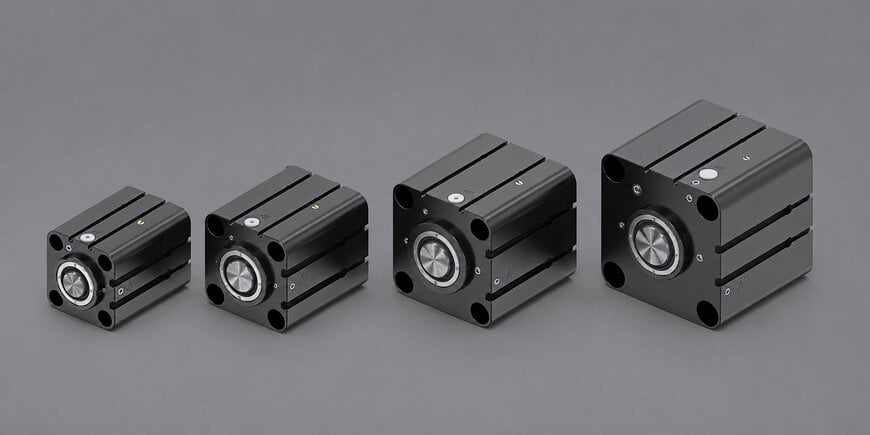
With the CBPS series, Zimmer Group introduces clamping and braking elements for pneumatic cylinders that can not only hold piston rods statically but also bring moving loads to a controlled stop. The series is aimed particularly at mechanical engineering, automation, and handling applications where vertical or otherwise moving loads must be secured in the event of pressure loss or machine shutdown.
Controlled Braking During Energy Loss
A key difference compared with purely static clamping elements is the combination of clamping and braking functions. The elements are closed when de-energized and use spring-stored energy. If the pneumatic energy supply fails, the element can therefore close, brake the movement of the piston rod, and subsequently hold the load.
This operating principle is particularly relevant for vertical axes, where a moving load should not be secured solely by a static holding function in the event of a pressure drop. According to Zimmer Group, the holding force of the CBPS elements is at least twice the force of the pneumatic cylinder used.
The available holding forces vary according to size. Published technical data specify, for example, 1,360 N for the CBPS2040 size, 2,120 N for the CBPS2050, 3,360 N for the CBPS2063, and 5,420 N for the CBPS2080.
Standardized Interfaces Simplify Machine Integration
The clamping elements can be combined directly with standard cylinders conforming to DIN EN ISO 15552 and compact cylinders conforming to DIN EN ISO 21287. This allows the safety technology to be incorporated into both new machine designs and retrofits of existing pneumatic axes without requiring a fully proprietary cylinder interface.
Tolerance classes f8, g8, and h7 are specified for piston rods and shafts. An integrated wiper protects the clamping mechanism against contamination and supports operation under typical industrial environmental conditions.
The permissible operating temperature range extends from -10 °C to +70 °C. According to the published technical data, the pneumatic operating pressure ranges from 4 to 6.5 bar.
Status Monitoring for Machine Control
For integration into automated machinery, the open or closed state of the clamping element can optionally be detected using magnetic field sensors. C-slots and T-slots are provided for this purpose.
The machine control system can therefore monitor whether the clamp is actually open or closed before subsequent machine movements are enabled. This feedback is particularly relevant for safety-related sequences and automated handling processes.
The published technical data also indicate short switching times. Depending on the size, opening times range, for example, from 0.035 to 0.065 seconds, while closing times for the variants considered range from 0.035 to 0.08 seconds.
Designed for Static Clamping and Dynamic Braking
Zimmer Group specifies a service life of five million static clamping cycles for the series. According to the product announcement, the design is also rated for up to 2,000 dynamic braking cycles.
The distinction between static clamping cycles and dynamic braking operations is technically significant. During static clamping, an already stationary piston rod is held in position, whereas dynamic braking requires the clamping mechanism to absorb kinetic energy. The permitted number of dynamic braking operations is therefore considerably lower than the number of static switching cycles.
According to the manufacturer, the series is designed for safety-related applications in accordance with DIN EN ISO 13849-1/-2. It therefore addresses machine concepts in which pneumatic movements must be brought to a controlled stop or protected against unintended lowering as part of a safety-related control function.
Applications in Vertical and Moving Pneumatic Axes
Typical applications include assembly and handling systems, automated production machinery, and machine axes in which pneumatic cylinders move loads vertically or in other safety-critical directions.
By combining braking, subsequent holding, and electrical status monitoring, a single mechanical element can perform several functions within the safety concept of a pneumatic axis. The standardized cylinder interfaces are particularly relevant for machine builders seeking to add safety functions without redesigning the entire pneumatic drive system.
Additional Context:
This section details technical specifications and competitive benchmarking not included in the original product announcement.
Clamping and locking systems for pneumatic cylinders are also available from other manufacturers. However, an objective comparison requires a distinction between static locking mechanisms and components that are permitted to brake moving piston rods.
As a comparable concept, SMC offers ISO 15552 cylinders from its CP96 series with a locking unit. For a published CP96 version with an 80 mm bore diameter, SMC specifies a maximum static holding force of 3,920 N, a minimum lock operating pressure of 0.3 MPa, and a stopping accuracy of ±1.0 mm. The locking mechanism operates in both directions of movement.
The CBPS series, by comparison, follows a modular approach as a separate clamping and braking element for standardized pneumatic cylinders. For the published CBPS sizes, holding forces range, for example, from 1,360 to 5,420 N. Zimmer Group also specifies a positioning accuracy of ±0.100 mm and a B10d value of five million cycles for the individual variants.
These values should not be interpreted directly as a performance ranking because cylinder size, piston rod diameter, permissible load, operating pressure, and the definition of the respective braking or locking operation differ. For engineering selection, the relevant criteria therefore include holding force, permissible dynamic braking energy, switching time, cylinder interface, and the safety-related characteristics of the specific size.
Edited by Sucithra Mani, Induportals editor – adapted by AI.
www.zimmer-group.com
