
www.ptreview.co.uk
30
'26
Written on Modified on
Programmable Logic Controller For Industrial Automation
Sfera Labs introduces a compact DIN-rail module integrating advanced computing architecture with precision analog inputs for rigorous process control deployments.
sferalabs.cc
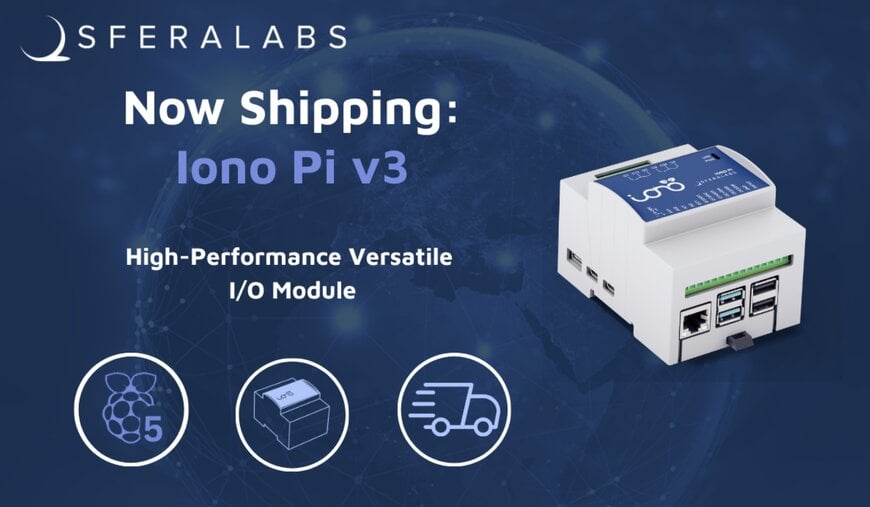
Sfera Labs has released the Iono Pi v3, an industrial programmable logic controller (PLC) that brings Raspberry Pi computing architecture directly to building automation and industrial IoT applications. The module integrates advanced processing power with multiple input/output configurations to support process control and secure hardware networking tasks.
Computing Architecture and System Integration
The Iono Pi v3 supports both Raspberry Pi 4B and Raspberry Pi 5 boards, offering memory configurations ranging from 1 GB to 16 GB. The device retains standard connectivity options, including Gigabit Ethernet, Wi-Fi, Bluetooth/BLE, four USB ports, and a microSD slot. It operates unmodified software stacks such as Linux, Node-RED, CODESYS, Python, or custom applications. To meet industrial I/O requirements, the unit features four power relay outputs rated at 5 A (250 V AC), six protected digital inputs (0 to 40 V), and three open-collector outputs with integrated fault detection.
Analog Signal Acquisition Upgrades
To facilitate precise process measurement and rapid signal acquisition, the third-generation module replaces its predecessor's 12-bit analog-to-digital converter (ADC) with a Microchip MCP3462 16-bit converter operating at up to 153.6 kilosamples per second (ksps). This high-resolution converter handles two analog voltage inputs (0 to 30 V) and two dedicated analog current inputs (0 to 20 mA). Consolidating these inputs into a single DIN-rail device allows engineers to manage high-precision sensor data directly alongside Linux-based control logic without requiring separate measurement hardware.
Hardware Stability and Cryptographic Security
For operational reliability, the system integrates an NXP PCF2131 real-time clock (RTC) featuring a temperature-compensated crystal oscillator with ±3 ppm accuracy. This RTC functions as an independent hardware watchdog; if the operating system stalls, the PCF2131 executes a full power cycle independent of the software. A timed power control mechanism also enables programmed sleep and wake cycles for remote installations requiring low power consumption. Additionally, a Microchip ATECC608 secure element provides hardware-level cryptographic key storage, ensuring device-level identity authentication for industrial IoT network deployments where software-only security is insufficient.
Auxiliary Interfaces and Compliance Parameters
The module includes seven bidirectional 5 V GPIO lines capable of supporting 1-Wire temperature sensor networks, Wiegand access control systems, and I2C devices. A 5 V auxiliary output, rated at 500 mA, allows the module to power multi-sensor networks directly without a separate supply. The device operates on a 9 to 28 V DC power supply equipped with surge and reverse polarity protection, all housed within a standard 4-module DIN-rail enclosure. All functions are accessible via a sysfs file system driver for Raspberry Pi OS. The hardware is CE, FCC, and IC compliant.
Additional Context
This section details technical specifications and competitive benchmarking not included in the original product announcement.
Within the industrial Raspberry Pi ecosystem, the Iono Pi v3 competes with devices like the Kunbus Revolution Pi (RevPi) and the Brainboxes BB-400. While the Revolution Pi relies on the Raspberry Pi Compute Module (CM4) to provide a modular, expandable I/O backplane, the Iono Pi v3 utilizes the standard Raspberry Pi single-board computer (SBC) format (4B and 5). This design choice allows for immediate adoption of the newer Raspberry Pi 5 processor before a Compute Module variant is widely available. Furthermore, the integration of a 16-bit ADC running at 153.6 ksps positions the Iono Pi v3 advantageously for high-speed analog telemetry compared to PLCs relying on standard 12-bit converters or requiring external expansion modules for equivalent precision.
Edited by Aishwarya Mambet, Induportals Editor, with AI assistance.
www.sferalabs.com
