
www.ptreview.co.uk
22
'26
Written on Modified on
High-Payload Collaborative Automation for Heavy Industrial Workpieces
YASKAWA Electric Corporation expands its collaborative robotics range with a high-capacity arm engineered for space-constrained manufacturing lines.
www.yaskawa.eu.com
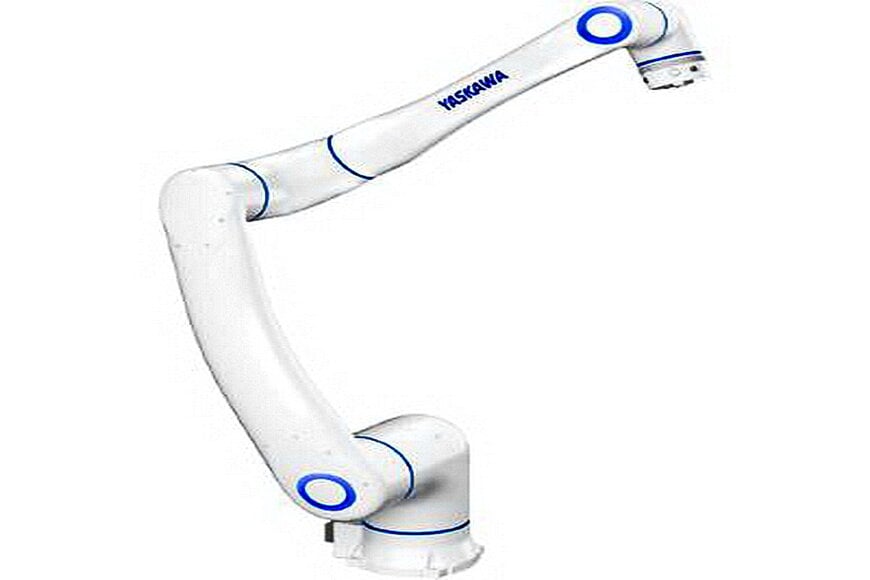
YASKAWA Electric Corporation has launched the MOTOMAN-HC35 collaborative robot, featuring a 35 kg payload capacity and a 2030 mm maximum reach. The system is designed for heavy-duty industrial tasks, including palletizing, high-torque screwdriving, and heavy component transport in automated manufacturing environments.
Increased Payload and Expanded Operating Envelope
The MOTOMAN-HC35 succeeds the MOTOMAN-HC20DTP, expanding the functional operational envelope and load-handling performance for industrial automation applications. By increasing payload capacity from 20 kg to 35 kg and reach from 1900 mm to 2030 mm, the system enables manufacturers to handle larger and heavier workpieces without requiring traditional industrial robot safety enclosures. The reinforced wrist moment capacity supports multi-product picking and higher palletizing stacking heights. In screwdriving applications, the mechanical structure maintains continuous fastening torques exceeding 200 Nm across its entire operating range.
Integrated Torque Sensors and Compact Structural Design
Collision response and operational safety rely on newly developed internal torque sensors integrated directly into the joints. These sensors monitor external forces to trigger immediate stopping behavior upon contact, minimizing impact forces and allowing higher operational speeds in collaborative workspaces. For programming and teaching, the system incorporates smooth hand-guiding functionality directly on the arm.
The manipulator incorporates a slim mechanical architecture with a reduced overall unit mass. The mounting footprint has been reduced to a diameter of 270 mm, compared to 380 mm on the previous generation model, allowing installation in tight manufacturing cells. Internal routing of application utilities includes an integrated Cat6A Ethernet cable running through the arm structure to the wrist flange, eliminating external cable snagging risks when interfacing with complex end-effectors.
Additional Context: Technical Specifications and Competitive Benchmarking
This section details technical specifications and competitive benchmarking not included in the original product announcement.
In the high-payload collaborative robot segment operating between 30 kg and 35 kg capacities, mechanical reach, base footprint, and safety sensing mechanisms define key performance distinctions across industry platforms. The MOTOMAN-HC35 provides a 35 kg payload capacity paired with a 2030 mm reach, anchored by a compact 270 mm base diameter and custom-developed joint torque sensors.
By comparison, the Universal Robots UR30 supports a 30 kg to 35 kg payload with a slightly smaller 245 mm base footprint, but offers a significantly shorter reach of 1300 mm and relies primarily on joint-based current monitoring for force feedback. On the heavier spectrum of traditional designs, the FANUC CR-35iA delivers a 35 kg payload and an 1813 mm reach, but requires a significantly larger installation footprint of approximately 1000 mm base area along with external soft padding and base-mounted force sensing.
Consequently, the MOTOMAN-HC35 achieves a balance between extended reach and mounting footprint, offering greater reach for wide-area palletizing than the UR30 while eliminating the bulky protective padding and large footprint requirement of legacy heavy cobots like the CR-35iA.
Edited by Evgeny Churilov, Induportals Media - Adapted by AI
www.yaskawa-global.com
