
www.ptreview.co.uk
21
'26
Written on Modified on
Matrix Robotics Demonstrates Humanoid Robotics at WAIC 2026
Matrix Robotics presented its MATRIX-3 humanoid robot and upgraded WAVE Physical World Foundation Model at WAIC 2026 in Shanghai.
matrixrobotics.ai
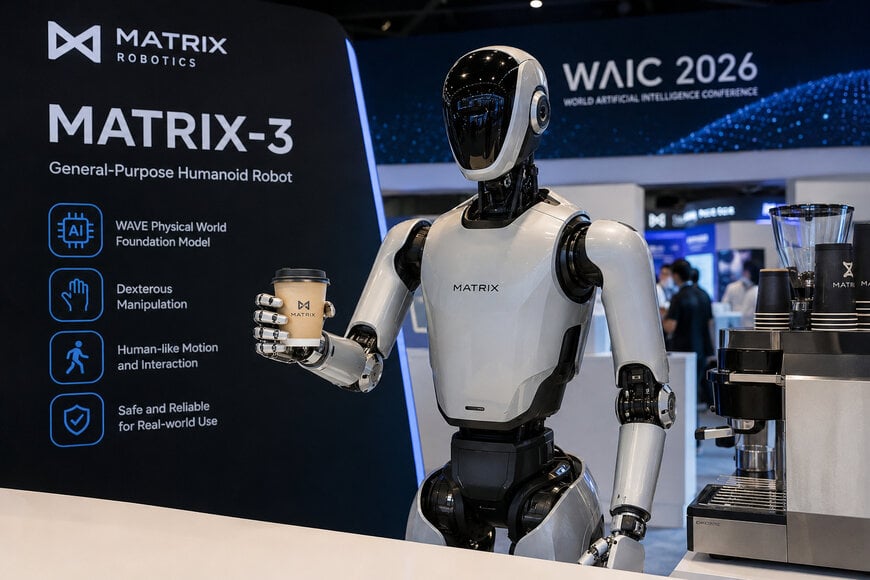
At the World Artificial Intelligence Conference (WAIC 2026), held from 17–20 July in Shanghai, China, Matrix Robotics presented its third-generation humanoid robot platform together with an upgraded Physical AI foundation model. The demonstrations focused on commercial service, human-robot interaction and autonomous manipulation for industrial and public-sector applications.
Applications across commercial and public environments
The demonstrations highlighted potential applications in commercial service, retail, hospitality, public services, science education, warehousing and cultural tourism. Rather than performing isolated demonstrations, four identical humanoid robots executed different operational tasks using the same underlying Physical AI model, illustrating how a common software platform can support multiple deployment scenarios.
The approach demonstrates how a single robotic platform can be adapted to different operational environments without requiring task-specific robot hardware, supporting scalable deployment in sectors where operational flexibility is required.
Physical AI architecture
Matrix Robotics presented an updated version of its WAVE Physical World Foundation Model, developed specifically for robots operating in physical environments. Unlike language models trained primarily on text, the model is designed to process physical interaction data collected from both simulated and real-world environments.
The system uses a two-layer architecture. The foundation model performs scene understanding, reasoning and task planning, while a separate motion control model generates coordinated whole-body movement. Together, these functions enable autonomous decision making combined with continuous motion control during task execution.
According to the company, model development is supported by an internally developed data collection, annotation and training infrastructure that enables continuous improvement using operational robot data.
Live technical demonstrations
Four application areas were demonstrated during the exhibition.
One robot operated as an autonomous coffee service assistant by manipulating coffee machine controls, handling cups and delivering beverages through multimodal perception and force-controlled manipulation.
A second demonstration focused on human-robot interaction using speech recognition, semantic understanding and visual perception to perform interactive communication, gesture recognition and audience engagement.
Another system demonstrated generalized object manipulation by identifying, grasping and transporting items with different sizes, weights and surface properties. Such capabilities are relevant for logistics, retail support and domestic assistance.
The fourth demonstration presented humanoid locomotion and navigation, including autonomous visitor detection, obstacle avoidance and coordinated full-body movement in a crowded exhibition environment.
Hardware platform
MATRIX-3 is designed for operation in environments built for human workers. The robot measures approximately 1.70 metres in height and weighs 65 kilograms.
Its hardware includes a 27-degree-of-freedom tendon-driven dexterous hand capable of operating conventional human tools and handling a variety of objects. Distributed tactile sensing and biomimetic surface materials support close-proximity human interaction, while integrated motion control algorithms enable coordinated walking and manipulation. The platform is designed for approximately four hours of continuous operation per charging cycle.
Industrial deployment
Matrix Robotics stated that its technology stack, including data processing, AI models, motion control, hardware design and manufacturing, has been developed in-house. Production is supported by the company's manufacturing facility in Shanghai, with planned annual production capacities of 5,000 units during 2026 and 10,000 units in 2027.
The company also reported that approximately 1,000 robot orders have been received across sectors including hospitality, research, cultural venues and commercial services. Pilot deployments have already begun to evaluate operation under real-world conditions.
Trade show highlights
During WAIC 2026, Matrix Robotics also announced an upgraded version of its WAVE Physical World Foundation Model together with the launch of the MATRIX Global Partner Program, intended to support regional deployment, system integration and after-sales service in domestic and international markets.
The event demonstrated the company's focus on combining Physical AI, humanoid robotics and industrial deployment into a unified platform capable of supporting multiple commercial applications through a common software and hardware architecture.
Edited by Sucithra Mani, Induportals editor – adapted by AI.
www.matrixrobotics.ai.com
