
www.ptreview.co.uk
08
'26
Written on Modified on
Motor Protection Meets Smart System Design
Rockwell Automation's 140ME brings essential motor safeguarding capabilities into scalable, data‑driven control panel designs.
www.rockwellautomation.com
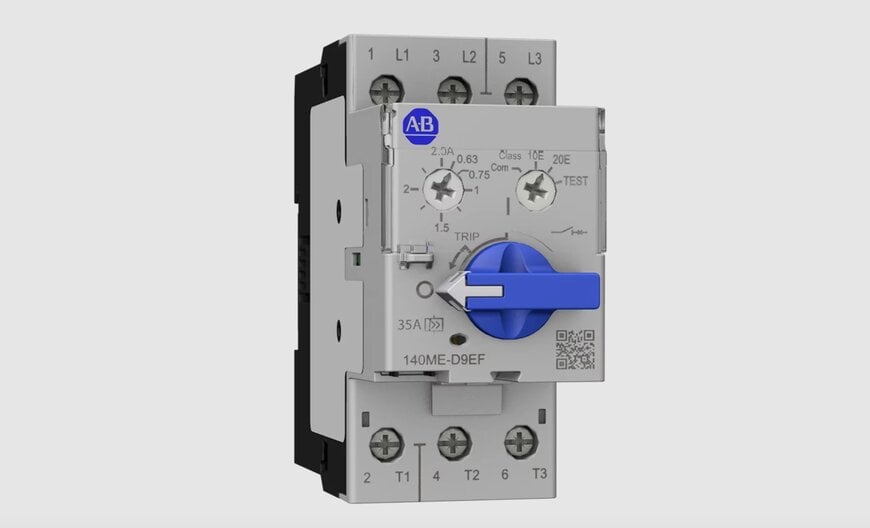
Rockwell Automation has launched the Bulletin 140ME Motor Protective Switching Device (MPSD) engineered to deliver branch-circuit protection for industrial motor control systems. The multi-functional hardware platform consolidates electrical disconnect capabilities, magnetic short-circuit protection, electronic overload protection, and manual switching operations within a single compact device footprint.
In-Panel Consolidation and Operational Resiliency
The 140ME is built to safeguard electric motors against operational hazards, including thermal overload, phase loss sensitivity, and high-current short-circuit conditions. By integrating multiple distinct protective and control mechanisms into a unified physical frame, the device minimizes internal control panel complexity, reduces point-to-point electrical wiring requirements, and shortens factory installation schedules.
The physical device incorporates clear structural status indicators and predictable trip characteristics to assist plant operators in identifying active electrical faults, accelerating system reset cycles, and stabilizing production uptime. The reduced physical envelope allows panel builders to maximize volumetric space utilization inside standardized electrical enclosures without restricting terminal accessibility or violating safety isolation boundaries.
Unified Motor Control Architecture
The 140ME functions as a core component of Rockwell Automation’s comprehensive Branch Motor Control & Protection portfolio. The switching device is engineered to achieve selective coordination and physical alignment when deployed alongside:
- 100-E Contactors: Managing high-frequency operational motor switching and line isolation.
- 140MT Motor Protection Circuit Breakers: Delivering cost-effective magnetic short-circuit and thermal protection configurations.
- E100 Electronic Overload Relays: Providing precise current monitoring and advanced thermal overload sensing.
This integrated component alignment establishes a unified, factory-tested motor control architecture that simplifies sub-panel engineering layout, enhances broad motor circuit protection, and improves component coordination across distributed in-panel configurations. The system synchronization facilitates a consistent engineering workflow spanning early drafting, mechanical assembly, and final field commissioning.
Network Integration via EtherNet/IP
The operational capabilities of the 140ME are expanded when integrated with the latest version of Rockwell Automation's EtherNet/IP In-cabinet Solution. Utilizing an specialized communication module mounted to a 100-E Contactor, the system extends network connectivity directly to the 140ME protective switches.
This digital communication interface routes real-time device diagnostics, internal component health metrics, and active operational parameters directly onto the central enterprise EtherNet/IP network. The network integration allows industrial manufacturers to continuously monitor field motor conditions from centralized control frameworks, rapidly diagnose localized anomalies, and deploy data-driven predictive maintenance strategies. The networked solution replaces traditional complex bundles of hard-wired control lines with a simplified flat-media cable infrastructure, establishing a scalable and connected motor control framework that adapts to evolving automated factory demands.
Additional Context
This section details technical specifications not included in the original news release.
The implementation of a Motor Protective Switching Device (MPSD) like the 140ME involves replacing traditional three-component motor starters—comprising a separate manual disconnect switch, short-circuit branch fuses, and an electromechanical thermal overload relay—with an integrated solid-state unit. In compliance with the IEC 60947-2 and IEC 60947-4-1 international standards, the 140ME utilizes a combination of mechanical contacts and microprocessor-controlled measurement transformers to provide precise, adjustable protection parameters. The electronic overload sensing circuitry monitors current waveforms continuously across all three phases; if an asymmetric drop occurs, signifying a phase loss condition, the electronic trip unit acts within milliseconds to prevent localized stator winding overheating, a common failure point in three-phase induction motors.
Integrating these devices into a digital network relies on a Single-Pair Ethernet (SPE) backbone built directly into the control panel's rail infrastructure. Traditional in-cabinet components require dedicated point-to-point digital and analog I/O wiring routed back to centralized input modules, creating extensive labor overhead and potential wiring errors.
The EtherNet/IP In-cabinet Solution replaces this layout with an ODVA-certified, 7-conductor flat media cable that distributes both 24V DC control power and high-speed industrial Ethernet communication across a single bus. The 100-E Contactor communication module functions as a local network gateway, reading internal data registers from the attached 140ME device—including historical trip logs, percentage thermal utilization, phase current imbalances, and contact wear indicators. This data is transferred natively via Common Industrial Protocol (CIP) objects into Studio 5000 Logix Designer software using specialized Add-On Profiles (AOPs), enabling synchronous automation control and asset management loops without adding extra field transceivers.
Edited by Romila DSilva, Induportals Editor, with AI assistance.
Network Integration via EtherNet/IP
The operational capabilities of the 140ME are expanded when integrated with the latest version of Rockwell Automation's EtherNet/IP In-cabinet Solution. Utilizing an specialized communication module mounted to a 100-E Contactor, the system extends network connectivity directly to the 140ME protective switches.
This digital communication interface routes real-time device diagnostics, internal component health metrics, and active operational parameters directly onto the central enterprise EtherNet/IP network. The network integration allows industrial manufacturers to continuously monitor field motor conditions from centralized control frameworks, rapidly diagnose localized anomalies, and deploy data-driven predictive maintenance strategies. The networked solution replaces traditional complex bundles of hard-wired control lines with a simplified flat-media cable infrastructure, establishing a scalable and connected motor control framework that adapts to evolving automated factory demands.
Additional Context
This section details technical specifications not included in the original news release.
The implementation of a Motor Protective Switching Device (MPSD) like the 140ME involves replacing traditional three-component motor starters—comprising a separate manual disconnect switch, short-circuit branch fuses, and an electromechanical thermal overload relay—with an integrated solid-state unit. In compliance with the IEC 60947-2 and IEC 60947-4-1 international standards, the 140ME utilizes a combination of mechanical contacts and microprocessor-controlled measurement transformers to provide precise, adjustable protection parameters. The electronic overload sensing circuitry monitors current waveforms continuously across all three phases; if an asymmetric drop occurs, signifying a phase loss condition, the electronic trip unit acts within milliseconds to prevent localized stator winding overheating, a common failure point in three-phase induction motors.
Integrating these devices into a digital network relies on a Single-Pair Ethernet (SPE) backbone built directly into the control panel's rail infrastructure. Traditional in-cabinet components require dedicated point-to-point digital and analog I/O wiring routed back to centralized input modules, creating extensive labor overhead and potential wiring errors.
The EtherNet/IP In-cabinet Solution replaces this layout with an ODVA-certified, 7-conductor flat media cable that distributes both 24V DC control power and high-speed industrial Ethernet communication across a single bus. The 100-E Contactor communication module functions as a local network gateway, reading internal data registers from the attached 140ME device—including historical trip logs, percentage thermal utilization, phase current imbalances, and contact wear indicators. This data is transferred natively via Common Industrial Protocol (CIP) objects into Studio 5000 Logix Designer software using specialized Add-On Profiles (AOPs), enabling synchronous automation control and asset management loops without adding extra field transceivers.
Edited by Romila DSilva, Induportals Editor, with AI assistance.
