
www.ptreview.co.uk
03
'26
Written on Modified on
Nidec Machine Tool Launches Digital Twin Platform
Nidec NC Twin recreates machine movements and processes in a virtual environment, allowing manufacturers to validate programs before production begins.
www.nidec.com
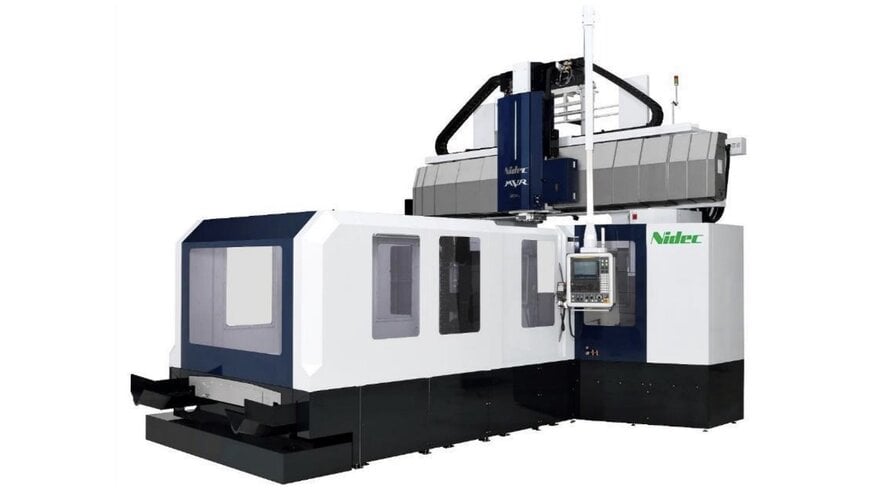
Nidec Machine Tool Corporation has announced the launch of Nidec NC Twin, a digital twin platform tailored for its MVR Series double-column machining centers. The software recreates machine kinematics, structural boundaries, and physical processing sequences within a virtual environment, allowing manufacturing facilities to validate numerical control (NC) programs before beginning physical production.
Operational Verification and Throughput Optimization
Industrial large-component machining typically demands significant time allocation for manual machine prove-outs, including dry runs, trial machining, and structural interference checks. These verification protocols require keeping primary production equipment offline, impacting factory throughout and reducing absolute equipment utilization. The digital twin platform addresses these operational constraints by enabling machine operators to execute setup and program verification remotely on a standalone computer while keeping the physical machinery active for revenue-generating manufacturing tasks.
The system helps mitigate skilled labor shortages and streamlines the transfer of technical machining know-how between successive generations of technicians. These operational variabilities are frequently amplified when production schedules are distributed across multiple decentralized manufacturing facilities, where localized processing quality and throughput efficiency fluctuate based on operator experience. Nidec Machine Tool finalized the engineering development of the software platform at the JIMTOF 2024 exhibition and subsequently validated the tracking models on active production machinery to refine simulation accuracy before commercial release.
Functional Simulation Tiers and Software Application
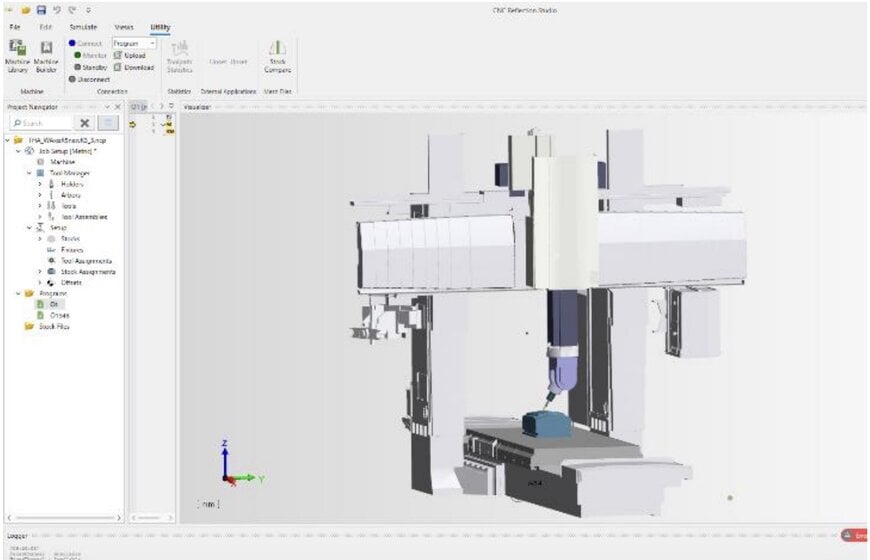
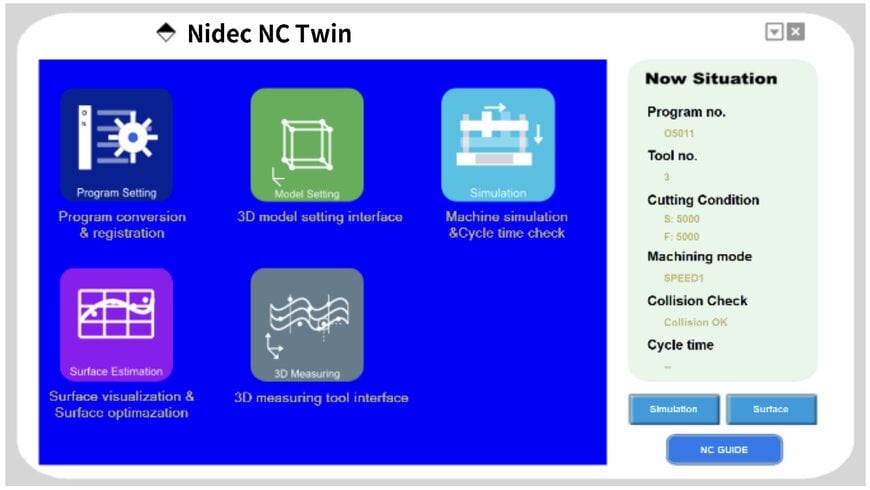
The digital twin architecture provides three specialized simulation modules to manage factory-floor workflows:
- Machine Operation Simulation: The software runs the identical, genuine FANUC NC code utilized by the factory-floor controller. This environment visualizes complex multi-axis tool motion, peripheral attachments, and physical workpieces, automatically identifying potential mechanical collisions between the active spindle, raw workpiece, and machine frames without requiring manual creation of localized simulation constraints.
- Machining Time Simulation: By leveraging the identical mechanical layout and machine configuration data as the target double-column machining center, the platform calculates cycle times, keeping estimation errors within 1%. This precision improves baseline process planning and downstream production cost evaluation compared to conventional commercial CAM simulators, which can deviate from real-world cycle times by more than 10%.
- Surface Quality Simulation: The predictive engine analyzes active machining parameters, tool-path deviations, axis acceleration curves, and surface roughness indicators (Sa/Sz) before tool-to-workpiece engagement. This analytical pre-check minimizes physical trial cuts and reduces raw material consumption.
The software platform establishes standardized, single-source program validation independent of the source CAM software utilized to generate the initial toolpaths. This cross-platform consistency ensures uniform safety validation for intricate procedures, such as 5-axis machining cycles and automated on-machine measurement macros, which standard commercial software simulators may fail to accurately replicate.
Commercial Availability and Exhibition Schedule
The company will showcase practical applications of the digital twin platform at the Japan International Machine Tool Fair 2026 (JIMTOF 2026), taking place at the Tokyo Big Sight exhibition center beginning on October 26, 2026. The technical demonstration will focus on methods to reduce field setup windows, increase machine utilization indices, and scale plant productivity through virtualized manufacturing infrastructure.
Additional Context
This section details technical specifications not included in the original news release.
Industrial digital twin platforms operating in high-precision computer numerical control (CNC) environments rely on mirroring the localized electronic control block and the physical machine kinematics. Traditional verification methods within Computer-Aided Manufacturing (CAM) software operate strictly on ideal toolpath vectors (G-code commands) and generic geometric configurations. They fail to account for the physical dynamic limits of the machine tool, such as servomotor acceleration/deceleration curves, jerk limits, tracking lag, and localized axis interpolation delays controlled by the CNC kernel.
To bridge this simulation gap, advanced digital twin systems embed a virtual copy of the specific machine control system, such as a genuine FANUC CNC engine, directly within the PC software environment. This setup allows the platform to interpret proprietary macro instructions, conditional branching logic, and measurement tool cycles identically to the physical machine panel.
The evaluation of machined surface quality before physical material removal relies on processing structural tool-path deviations and axis acceleration data through surface topology mapping algorithms. As the virtual tool path is executed, the software samples high-frequency velocity changes and servo-loop feedback parameters to simulate dynamic deflection and vibrational harmonics between the cutting tool edge and the workpiece material.
The system computes local arithmetic mean height (Sa) and maximum height (Sz) values across the virtual surface mesh, creating a three-dimensional topographical visualization of the anticipated surface finish. This allows manufacturing engineers to detect localized surface finish degradation or dimensional gouging caused by rapid axis reversals or structural machine resonance, enabling the pre-emptive optimization of feed rates and spindle speeds within the virtual environment.
Edited by Romila DSilva, Induportals Editor, with AI assistance.
Commercial Availability and Exhibition Schedule
The company will showcase practical applications of the digital twin platform at the Japan International Machine Tool Fair 2026 (JIMTOF 2026), taking place at the Tokyo Big Sight exhibition center beginning on October 26, 2026. The technical demonstration will focus on methods to reduce field setup windows, increase machine utilization indices, and scale plant productivity through virtualized manufacturing infrastructure.
Additional Context
This section details technical specifications not included in the original news release.
Industrial digital twin platforms operating in high-precision computer numerical control (CNC) environments rely on mirroring the localized electronic control block and the physical machine kinematics. Traditional verification methods within Computer-Aided Manufacturing (CAM) software operate strictly on ideal toolpath vectors (G-code commands) and generic geometric configurations. They fail to account for the physical dynamic limits of the machine tool, such as servomotor acceleration/deceleration curves, jerk limits, tracking lag, and localized axis interpolation delays controlled by the CNC kernel.
To bridge this simulation gap, advanced digital twin systems embed a virtual copy of the specific machine control system, such as a genuine FANUC CNC engine, directly within the PC software environment. This setup allows the platform to interpret proprietary macro instructions, conditional branching logic, and measurement tool cycles identically to the physical machine panel.
The evaluation of machined surface quality before physical material removal relies on processing structural tool-path deviations and axis acceleration data through surface topology mapping algorithms. As the virtual tool path is executed, the software samples high-frequency velocity changes and servo-loop feedback parameters to simulate dynamic deflection and vibrational harmonics between the cutting tool edge and the workpiece material.
The system computes local arithmetic mean height (Sa) and maximum height (Sz) values across the virtual surface mesh, creating a three-dimensional topographical visualization of the anticipated surface finish. This allows manufacturing engineers to detect localized surface finish degradation or dimensional gouging caused by rapid axis reversals or structural machine resonance, enabling the pre-emptive optimization of feed rates and spindle speeds within the virtual environment.
Edited by Romila DSilva, Induportals Editor, with AI assistance.
